



Use Wozber and land your dream job
Create CV
No registration required
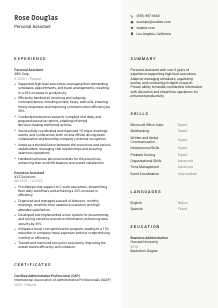
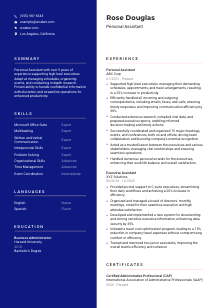
Juggling tasks and trips, but your CV feels misplaced? Organise your ambitions with this Personal Assistant CV example, created with Wozber free CV builder. Learn how to highlight your multitasking mojo to match job specifics, setting your career on a path as neat and efficient as your schedule.
A Personal Assistant CV has to show calm, precise support under pressure. Hiring teams look for someone who can keep an executive's day moving, protect confidential information, coordinate travel and meetings without friction, and handle shifting priorities without losing control of the details.
When that experience is tailored clearly, the CV reads less like general administrative support and more like executive-level assistance. Wozber's free CV builder helps shape that into an ATS-compliant CV by aligning your wording with the posting's language, so schedule management, correspondence handling, reporting support, and discretion stand out fast.
For a Personal Assistant, the contact section should feel orderly and dependable from the first line. It is a small section, but it sets the tone for how you handle professional presentation, accuracy, and practical requirements tied to the role.
Use your full name in a clean, readable format that stands out immediately. Personal Assistant roles depend on polish and precision, so even basic presentation choices should feel organised and professional.
Place "Personal Assistant" directly under your name when that matches the role you are pursuing. This mirrors the posting language and quickly positions you for executive support work rather than broader administrative jobs.
Include a reliable phone number and a professional email address that you check regularly. Since this role often involves fast communication, calendar coordination, and prompt follow-up, your contact details should make it easy to reach you without any distractions.
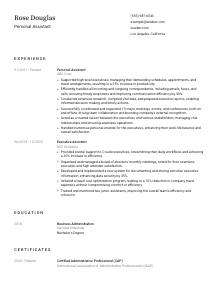
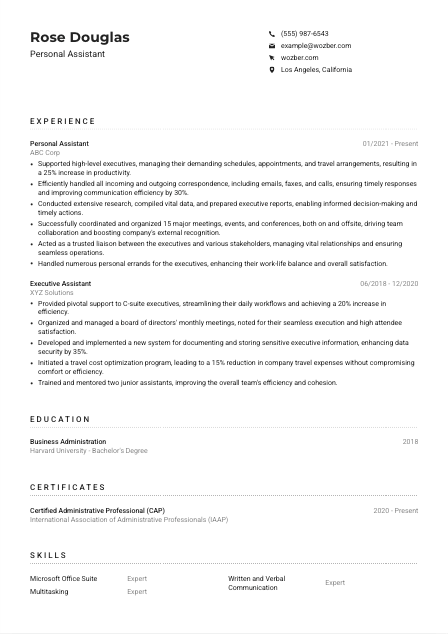
If an employer specifies a city or region, add it clearly in your header. In this example, listing "Los Angeles, California" addresses a stated requirement and removes an avoidable question about local availability.
A polished LinkedIn profile or personal professional website can reinforce your background in executive support, event coordination, or office operations. Make sure the roles, dates, and achievements match your CV so your presentation stays consistent.
Accurate personal details show the same reliability employers expect when you are managing calendars, travel plans, and confidential communication for senior leaders.




This section carries the most weight for most Personal Assistant openings. Employers want to see how closely your past work matches the pace, discretion, and coordination demands of supporting senior executives.
Read the description closely and identify the operational work that appears most often. For a Personal Assistant, that usually means schedule management, travel booking, correspondence handling, meeting coordination, research, reporting, and acting as a liaison across internal and external contacts. Your bullets should echo those functions in the language you have actually used on the job.
List positions in reverse chronological order and include the job title, company name, and dates for each one. If you have worked as both a Personal Assistant and an Executive Assistant, that progression is useful because it shows continued exposure to senior stakeholders and increasingly complex support work.
Do not stop at task lists. Show what your support improved. The example CV does this well by tying schedule and travel management to a 25% productivity increase and correspondence handling to a 30% communication efficiency improvement. Metrics like response time, meeting volume, travel savings, executive productivity, or process improvements make administrative work feel concrete.
Prioritise accomplishments that reflect executive-facing support, confidentiality, and coordination across moving parts. Strong bullets might cover board meetings, sensitive document handling, event logistics, vendor communication, or personal errands managed discreetly. Cut older or unrelated work that does not strengthen your case for this kind of support role.
Quantification works especially well in Personal Assistant CVs because the work often involves trackable outputs. Include figures such as number of executives supported, meetings coordinated, travel budgets reduced, reports prepared, or systems improved. In the sample, coordinating 15 major meetings and reducing travel costs by 15% gives the reader a clear sense of scale and effectiveness.
Your experience section should make it easy to picture you managing an executive's schedule, communications, logistics, and sensitive information without constant oversight.
Education usually plays a supporting role for Personal Assistant positions, but it still adds context. It can reinforce business familiarity, communication skills, and professional discipline, especially when your degree or training connects naturally to executive support work.
Start with your highest completed degree or most relevant formal education. Even when a posting focuses more on experience, a degree in areas such as business, communications, or administration can strengthen your profile by showing useful grounding in office and organizational work.
Include the degree, school, field of study, and graduation year or date range. Straightforward formatting helps both hiring teams and applicant tracking systems read the section quickly, which matters when the CV is being reviewed alongside more experience-heavy candidates.
If your education directly supports the role, make that connection visible. A Business Administration degree, like the one in the example, fits naturally with reporting, coordination, and executive support responsibilities. If your degree is less related, keep the section brief and let your experience carry more of the narrative.
Early-career candidates can include coursework, projects, or leadership activities that show organisation, written communication, research, or event planning. For experienced assistants, this level of detail is usually unnecessary unless it clearly strengthens the target application.
Professional development courses in business communication, office software, calendar management, event planning, or records handling can sit here if you do not have a separate place for them. They show that you continue building the tools used in executive support environments.
Keep education concise, accurate, and relevant. It should support your executive support story, not compete with the experience that proves it.
Certifications are not required for every Personal Assistant role, but they can help when they sharpen your administrative profile. They work best when they point to practical strengths such as office systems knowledge, communication, records handling, or professional standards in executive support.
Prioritise certifications that connect directly to the responsibilities of the role. Credentials such as Certified Administrative Professional, office software training, or executive support courses carry more value here than broad certificates with no clear link to scheduling, communication, or operations.
List the certification name, issuing organisation, and date earned or active period. Clean formatting is especially important in administrative roles because it reflects the same information discipline expected when handling executive files, reports, and meeting materials.
If a certification has an active status or renewal cycle, make that visible. Current credentials suggest that you stay engaged with professional standards and updated tools, which matters in roles that rely on efficient systems and trusted support.
A short list of targeted certifications is more persuasive than a long list of unrelated learning. In the example, the CAP credential works because it directly reinforces administrative professionalism and executive support capability.
Use certifications to strengthen your credibility in executive support, especially when they highlight current administrative knowledge and professional commitment.
The skills section should reflect how Personal Assistants actually work day to day. That means pairing software fluency with judgment, coordination, and communication skills that keep executives, meetings, travel, and correspondence running smoothly.
Start with the hard and soft skills that appear in the posting. Here, that includes Microsoft Office Suite, organisation, multitasking, written and verbal communication, and discretion with confidential information. Matching this language helps your CV stay relevant in both ATS screening and human review.
Do not make the section read like either a software list or a personality list. Personal Assistants are hired for both. Pair technical capabilities such as Microsoft Office, calendar tools, or reporting support with operational strengths like time management, stakeholder coordination, problem solving, and interpersonal communication.
Choose skills you can back up elsewhere in the CV. If you list event coordination, there should be meeting, conference, or travel logistics in your experience. If you list discretion or communication, your bullets should show work with senior executives, external contacts, or sensitive information. Tight alignment makes the section more believable and more useful.
A well-built skills section should quickly confirm that you can handle the tools, communication flow, and organizational pressure that come with supporting high-level executives.
Language skills matter in Personal Assistant work because so much of the role depends on clear communication. Emails, calls, meeting materials, guest coordination, and executive correspondence all rely on language accuracy and tone.
If the role specifically requires English, list it first with an accurate proficiency level. In this job description, English is a core requirement, so it should be impossible to miss.
After the required language, list additional languages in order of usefulness and proficiency. This helps employers quickly understand whether you can support broader communication needs, client interactions, or multilingual coordination.
Choose straightforward terms such as "Native," "Fluent," "Intermediate," or "Basic." Personal Assistant roles depend on precision in messages and conversations, so vague descriptions of language ability can create doubt.
Extra language ability can strengthen your profile, especially in diverse business environments or executive offices that interact with international contacts, vendors, or guests. In the example, Spanish adds range without distracting from the required English fluency.
Only feature languages you can genuinely use in a professional context. If you might need to draft emails, relay requests, coordinate travel, or speak with external parties, your stated proficiency should hold up in real situations.
Handled well, language details show that you can communicate clearly in the settings where Personal Assistants spend much of their time: correspondence, coordination, and executive-facing support.
The summary should quickly establish the kind of assistant you are and the level of support you can provide. For Personal Assistant roles, that usually means executive exposure, strong coordination skills, discretion, and a track record of keeping operations moving behind the scenes.
Pull the main themes from the job description before you write. If the employer emphasizes executive support, scheduling, travel, communication, and confidentiality, those ideas should shape the summary rather than generic statements about being organised or hardworking.
Start with a direct line that tells the reader who you are and how much relevant experience you bring. The example uses "Personal Assistant with over 5 years of experience supporting high-level executives," which works because it establishes scope immediately.
Use the next lines to highlight the work you are trusted to handle well. Good options include managing complex calendars, coordinating events, preparing reports, handling confidential information, or improving executive efficiency. Choose details that match the target role, not every strength you have.
Aim for three to five lines with direct language and no filler. A hiring manager should finish the summary with a clear picture of your executive support background and the operational value you bring from day one.
A strong summary should position you as someone who can step into a fast-moving executive environment and keep schedules, communication, and logistics under control.
A Personal Assistant CV works best when it turns behind-the-scenes work into visible business value. Show how you manage calendars, travel, correspondence, meetings, research, and confidential matters in ways that save time, reduce friction, and help executives stay focused.
Use Wozber's free CV builder to shape that experience into an ATS-friendly CV format, refine role-specific wording, and strengthen ATS optimisation before you apply. The final document should make your executive support range, discretion, and organizational control easy to recognize.