



Use Wozber and land your dream job
Create CV
No registration required
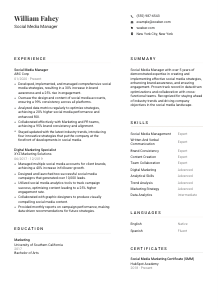
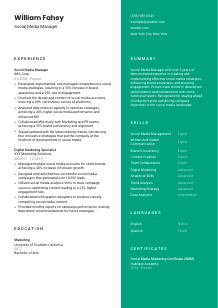
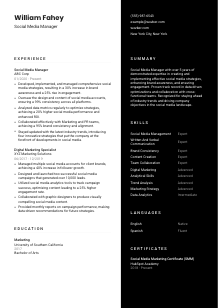
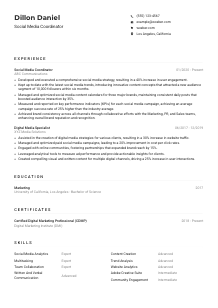
Captained viral campaigns, but your CV isn't trending? Scroll through this Social Media Manager CV example, created with Wozber free CV builder. Learn how to present your online prowess to match job requirements, turning your profile into a trending topic in the job market!
Social media management is measured in public results. Brand voice, engagement quality, campaign timing, reporting discipline, and cross-team coordination all show up fast when the work is good, and just as fast when it is not. A Social Media Manager CV needs to show that you can plan strategy, run channels consistently, interpret performance data, and adjust content based on what the audience is actually doing.
When that experience is tailored well, the CV surfaces the right platform work, metrics, and collaboration patterns early enough for both recruiters and an ATS to recognize the match. Wozber's free CV builder helps you shape that into an ATS-compliant CV that reflects the language of the posting while making it easy to see your ability to grow reach, protect brand consistency, and improve social performance.
This section is simple, but it still affects how smoothly your application moves forward. For Social Media Manager roles, your contact details should look current, professional, and aligned with any practical requirements the employer lists, especially when location and communication matter.
Place your name at the top in a clean, readable format. Social media work depends on clear presentation, and your header should reflect that standard right away. Keep it prominent without turning it into a design element that competes with the content below.
Add "Social Media Manager" directly under your name when that is the role you are targeting. This helps frame your CV immediately around strategy, content oversight, engagement growth, analytics, and brand management rather than broader digital marketing work.
Use a reliable phone number and a professional email address, ideally a simple variation of your name. Since this role requires strong written and verbal communication, even small details like a polished email address reinforce that you present yourself professionally across channels.
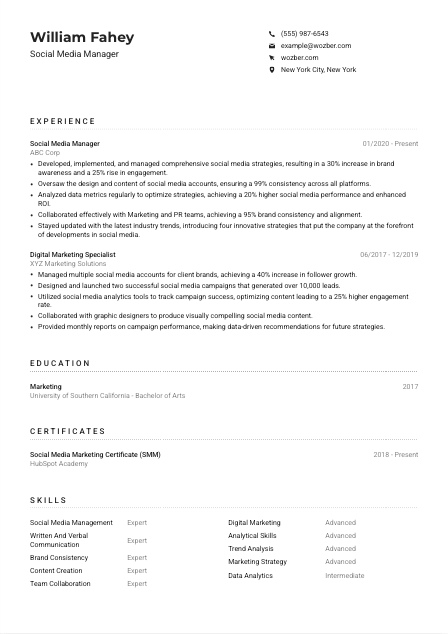
If a posting requires local presence, reflect that clearly in your header. Here, listing "New York City, New York" directly supports the employer's stated requirement and removes an avoidable question about availability. Only do this when it is true for you, or make your relocation status explicit.
A LinkedIn profile, portfolio, or personal website can add useful context, especially if it includes campaign examples, content strategy snapshots, reporting dashboards, or brand work. In social media hiring, a link is most useful when it shows the kind of execution your bullets claim, not when it sends the reader to an outdated profile.
Your personal details should remove friction, not add it. If the basics are accurate, professional, and aligned with the posting, the reader can move straight to the work that proves you can manage channels, content, and performance.




This is the section most likely to decide whether your CV moves forward. For Social Media Manager hiring, experience needs to show more than posting activity. It should connect strategy, channel management, creative coordination, reporting, and measurable outcomes such as brand awareness, engagement, lead generation, or ROI.
Start by marking the responsibilities that define the role: building social strategy, managing account content and updates, analysing metrics, collaborating with Marketing and PR, and keeping pace with platform trends. Those priorities tell you what your bullets need to emphasize. If your background includes adjacent digital marketing work, bring forward the parts tied to channel ownership, campaign performance, and brand consistency.
List jobs in reverse chronological order with job title, company name, and dates. For this field, career progression matters because it shows whether you moved from execution into strategy, reporting, and broader brand responsibility. A clean structure also supports ATS optimisation by keeping titles and dates easy to parse.
Each bullet should show what you owned and what changed because of your work. "Managed social media accounts" is weak on its own. Stronger bullets show what platforms or campaigns you handled, how you shaped content or strategy, and what that produced in engagement, reach, follower growth, leads, or conversion performance. The sample CV does this well by tying strategy work to a 30% increase in brand awareness and a 25% rise in engagement.
Social media teams are usually measured through audience growth, engagement rate, impressions, share of voice, campaign response, content output, lead generation, and return on spend or ROI where paid social is involved. Quantified bullets give hiring teams a clearer read on scale and effectiveness. Metrics like a 20% lift in performance, 10,000 leads generated, or 95% brand alignment are stronger than broad claims about success.
Keep bullets tightly connected to the work the role requires. If you have experience across digital marketing, SEO, email, or general communications, keep the social media parts closest to the top and trim anything that does not support your candidacy. For this opening, experience with strategy development, analytics tools, content oversight, and cross-functional work should outweigh unrelated responsibilities.
A Social Media Manager CV works best when the experience section reads like a record of channel growth, content judgment, and data-led decisions. Show what you managed, how you worked with other teams, and what improved because you were running the work.
Education is rarely the most persuasive section for an experienced Social Media Manager, but it still matters when the employer has named a degree requirement. Keep it direct, accurate, and aligned with the marketing or communications foundation the role asks for.
If the posting asks for a bachelor's degree in Marketing, Communications, or a related field, make sure your degree and field are easy to spot. In the example, "Bachelor of Arts in Marketing" directly supports that requirement without needing extra explanation.
List the school, degree, field of study, and graduation year or date. This is enough for most mid-level social media roles and keeps the section easy to read in an ATS-friendly CV format. Avoid overloading it with unnecessary detail unless your academic work is especially relevant.
If your degree is in a related field rather than marketing, you can strengthen the section by referencing coursework or academic projects tied to communications, branding, content strategy, consumer behaviour, media planning, or analytics. This is especially useful earlier in your career.
Capstone projects, campaign work, or student-led brand initiatives can be worth mentioning if they connect directly to social media strategy, audience research, or content production. For more experienced candidates, these details usually matter less than recent performance in professional roles.
Academic honors, leadership roles, or relevant extracurricular work can stay if they reinforce communication, marketing, or digital media strengths. Keep them brief so the section supports your candidacy without pulling attention away from campaign results and platform experience.
This section only needs to confirm the academic foundation the employer requested. When the degree, field, and dates are clear, the reader can stay focused on the social strategy, content execution, and analytics work that matter most.
Social media changes quickly, and certifications can help show that your skills have kept pace with platform updates, content strategy shifts, and reporting practices. They are most useful when they strengthen your case for current, job-relevant expertise rather than filling space.
Choose certificates tied to social media marketing, digital strategy, analytics, content marketing, paid social, or platform-specific tools. A credential like the HubSpot Academy Social Media Marketing Certificate supports the kind of strategy and channel management this role requires.
A short list of strong, current certifications is better than a long list of loosely related courses. Hiring teams looking for a Social Media Manager care more about whether you stay current on channel strategy and measurement than whether you have collected every general marketing badge available.
Dates help show recency, which matters in a field shaped by frequent platform changes, new ad formats, and evolving content trends. If a certification is active, renewed, or recently completed, include that information clearly.
Keep this section fresh with learning that reflects where the field is moving, such as short-form video strategy, creator partnerships, analytics, social listening, community management, or platform advertising. That matters more than generic professional development when the role expects you to stay ahead of emerging trends.
A well-chosen certification section tells employers that your knowledge of content strategy, analytics, and platform changes is current. That is especially useful when the role calls for someone who can keep the brand competitive as social channels evolve.
The best skills sections for Social Media Managers are specific enough to be useful. They should reflect the mix of strategy, execution, analytics, communication, and collaboration the role actually demands, not a broad list of generic strengths.
Pull your skills from the language of the job description first. Here, that includes social media management, analytics tools, trend awareness, written and verbal communication, cross-functional collaboration, and strategic planning. This keeps your skills section aligned with both hiring priorities and ATS matching.
Only include skills that appear again in your work history or summary. If you list content creation, brand consistency, data analytics, or team collaboration, the experience section should show where you used them through campaigns, reporting, creative coordination, or stakeholder work. The example CV handles this well by pairing skills like brand consistency and analytical skills with quantified results in the experience section.
Aim for a balanced list that covers platform strategy, content and brand execution, reporting, and communication. Avoid overloading the section with every tool or soft skill you have touched. A tighter list is easier to scan and gives a more accurate picture of how you operate in a social media role.
This section should quickly tell the reader whether you can manage social channels, interpret performance, maintain brand standards, and work across teams. If each skill connects to real experience, the section will support the rest of the CV instead of repeating it.
For many Social Media Manager roles, language ability matters because tone, clarity, and audience communication are central to the job. Even when only one language is required, listing language skills can add value if they support content work, community engagement, or broader audience reach.
If the posting explicitly requires English communication, list your English proficiency clearly. Since this job asks for the ability to articulate effectively in English, that language should appear first and be labeled accurately as Native or Fluent, depending on your background.
Additional languages can strengthen your profile when the brand serves multilingual communities, international audiences, or regionally diverse customer bases. Spanish, for example, may be useful for audience engagement, campaign adaptation, or community management, even when it is not a formal requirement.
Describe each language accurately with levels such as Native, Fluent, Intermediate, or Basic. Overstating language ability can become a problem quickly in interviews or on the job, especially in a role where copy quality and community interaction matter.
If your language skills have supported localized campaigns, multilingual content, influencer coordination, or community response, that can be worth reinforcing elsewhere in the CV. For social media hiring, the value is in audience communication, not in listing languages for their own sake.
Language skills can signal cultural awareness and wider audience fluency, both of which matter in social media strategy. Keep the section grounded and factual so it strengthens your profile without overstating its role.
If language ability helps you write, adapt, or engage more effectively across communities, it belongs on the CV. Present it clearly, and let it support the broader picture of you as a communicator who can manage public-facing brand work well.
Hiring teams often decide within a few lines whether a Social Media Manager has the right mix of strategy, execution, and performance awareness. Your summary should make that clear fast by naming your level, your core strengths, and the kind of results you have driven.
Before writing the summary, identify the main themes of the target job: social strategy, content oversight, analytics, brand consistency, and collaboration with teams like Marketing and PR. Those are the points your opening lines should reflect, because they define how the role contributes to the business.
Start with a direct line that states your title or specialty and your years of experience. A phrase like "Social Media Manager with 5+ years of experience" works because it immediately establishes level, while the next words can narrow your strengths to strategy development, engagement growth, analytics, or multi-channel brand management.
Use the remaining space to highlight outcomes or strengths that map closely to the posting. The example summary points to effective strategy development, stronger brand awareness, data-driven optimisation, and cross-functional collaboration, all of which match the target role well. Keep this selective so the summary stays sharp.
Aim for a short paragraph that can be scanned in seconds. Avoid broad claims like "passionate professional" or "results-driven marketer" unless they are backed by specifics. Social media hiring responds better to clear language about channel strategy, engagement performance, campaign execution, and reporting discipline.
A well-written summary gives the reader a fast, accurate picture of your level and your strengths in social strategy, content oversight, and performance analysis. When those first lines are tailored well, the rest of the CV lands with more context and credibility.
A tailored Social Media Manager CV should now make a few things easy to see: you can plan strategy, manage content across platforms, read performance data, and work with marketing and PR to keep brand execution consistent. That is what hiring teams need to recognize quickly.
Use Wozber's AI CV builder to sharpen role-specific wording, align your content for ATS optimisation, and present your work in an ATS-friendly CV format that keeps your metrics, channel experience, and collaboration history easy to read. The finished CV should make your readiness for social media ownership clear from the first screen.




