



Use Wozber and land your dream job
Create CV
No registration required
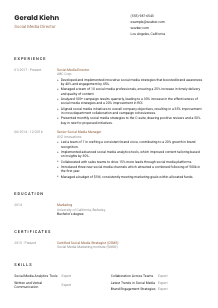
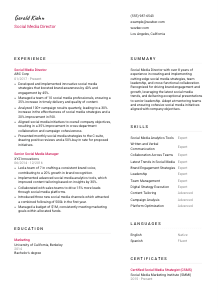
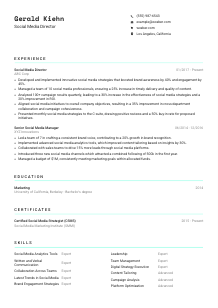
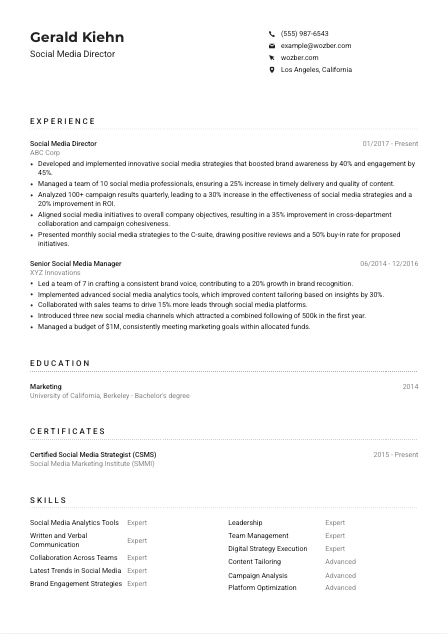
Crafting digital narratives, but ready to trend your career? Check out this Social Media Director CV example, created with Wozber free CV builder. It shows how to capture your strategic clicks and content curation in a way that connects with job requirements, making your professional journey as Insta-worthy as your social insights!
Social Media Directors are expected to turn brand presence into business movement. Hiring teams look past surface-level platform familiarity and want proof that you can set channel strategy, shape a consistent voice, guide content teams, and adjust plans when engagement, reach, or ROI shifts.
When that story is tailored well, your CV quickly separates you from candidates who have only managed posting calendars or community replies. Wozber's free CV builder helps you align your language with the role, strengthen ATS optimisation, and make it easier to spot leadership scope, analytics fluency, and brand-growth results from the first screen.
For a Social Media Director, the header should read like a clean brand masthead. It needs to confirm who you are, how to reach you, and whether you meet any practical filters before a hiring manager gets into campaign performance or team leadership.
Use your full name in a larger, readable font so it anchors the page immediately. This section does not need design flair. It needs clarity and polish, the same qualities expected from a leader responsible for brand voice across multiple channels.
Place "Social Media Director" under your name when that is the role you are pursuing. Exact title matching helps with ATS parsing and signals that your background is already operating at strategy and leadership level, not only at coordinator or manager scope.
Include a reliable phone number, a professional email address, and relevant links such as LinkedIn or a portfolio site if they strengthen your case. For this profession, a portfolio can be especially useful when it shows campaign work, audience growth, content direction, or executive-facing strategy examples rather than just social links.
If a role specifies a location requirement, reflect that plainly in your header. Here, Los Angeles, California is a stated requirement, so listing it removes a common screening question right away. Keep this practical rather than overexplained.
Do not add age, marital status, headshots, or other details that do not help evaluate your ability to lead social strategy, manage teams, or report on performance. Keep the section focused on professional identity and accessibility.
This section should confirm the basics without slowing the reader down. If your name, title, contact details, and any stated location requirement are handled cleanly, the hiring team can move straight to the parts that show strategic range and results.




This is the section that carries the most weight for a senior social media hire. Companies want to see whether you have led multi-channel strategy, improved performance with analytics, kept execution on schedule, and worked across marketing, sales, creative, and executive stakeholders.
Read the posting for the operating expectations behind the title. In this case, the employer is asking for 7+ years in social media, leadership experience, analytics fluency, executive communication, and cross-functional collaboration. Those points should shape which roles you feature, which bullets rise to the top, and which achievements get quantified.
List your most recent roles first and make the scope of each one obvious. For a Social Media Director, that means naming the company, title, and dates, then showing whether you owned strategy, managed calendars, led a team, controlled budget, or reported results to senior leadership.
Generic bullets such as "managed social media accounts" do not say enough at this level. Focus on outcomes tied to awareness, engagement, growth, efficiency, ROI, or team performance. The sample CV does this well by showing a 40% increase in brand awareness, a 45% lift in engagement, and stronger content delivery across a 10-person team.
Metrics matter because social media leadership is measured through performance, not activity alone. Use numbers tied to campaign effectiveness, audience growth, lead generation, ROI, budget ownership, or reporting cadence. Strong examples include reviewing 100+ campaigns quarterly, improving ROI by 20%, or launching new channels that reached a 500k combined following in the first year.
Prioritise experience that supports director-level hiring decisions. If an older role focused mainly on execution, rewrite it to highlight planning, optimisation, stakeholder collaboration, and platform insight where those were real parts of the work. Every bullet should help answer whether you can lead strategy and people, not just publish content.
Your experience section should show a progression from hands-on channel management to business-facing leadership. When the bullets connect strategy, analytics, team direction, and measurable growth, the CV reads like a director candidate rather than a strong individual contributor.
Education will not outweigh proven results for a Social Media Director, but it still matters when the posting names a degree requirement. Use this section to confirm the academic foundation behind your marketing, communications, or brand strategy work.
If the employer asks for a Bachelor's degree in Marketing, Communications, or a related field, list your degree in direct terms. In the example, a Bachelor's degree in Marketing aligns cleanly with the requirement and supports the strategic side of the role.
Include degree, field of study, school, and graduation year or date. This section should be easy to scan and should not compete with your experience section for space, especially when you already have several years of leadership work behind you.
A degree in Marketing, Communications, Journalism, Business, or a related discipline can reinforce strengths relevant to social media leadership such as audience analysis, messaging, brand development, and campaign planning. Mention the field clearly instead of assuming the school name will carry the context.
Relevant coursework, capstones, or academic projects can help if you are moving up from manager level or if your degree is recent. For an experienced director candidate, this is usually optional unless the work directly supports content strategy, analytics, digital media, or consumer behaviour.
Honors, student leadership, or notable projects can stay if they are genuinely relevant and concise. For senior candidates, these details should only remain when they strengthen your brand strategy or communications profile rather than filling space.
For this role, education is mainly a confirmation point. Once the degree requirement is clear, the rest of the CV should carry the heavier proof through campaign outcomes, leadership history, and strategic execution.
Social media changes quickly, especially across platforms, analytics methods, and content formats. Relevant certifications can strengthen your CV by showing that you stay current on strategy, measurement, and channel best practices.
Start with credentials that connect directly to social strategy, paid social, content marketing, analytics, or digital leadership. While this posting does not require certification, a relevant credential such as the listed Certified Social Media Strategist can support your credibility, especially when paired with measurable campaign results.
A short, focused list works better than a long catalogue of unrelated courses. Include certifications that reinforce the capabilities expected at director level, such as interpreting performance data, shaping channel strategy, or leading modern digital campaigns.
Include the issue date, renewal period, or current status where appropriate. In a field where platform norms, ad products, and reporting practices shift often, recent dates help show that your knowledge is current rather than historical.
Certifications can also signal that you keep refining your approach as the discipline evolves. That matters for a Social Media Director who may need to guide a team on new formats, algorithm changes, creator partnerships, or updated measurement frameworks.
Certifications work best as supporting proof of current practice. They should reinforce your strategic and analytical range, not distract from the leadership and performance results already established elsewhere on the CV.
A director-level skills section should read like an operating toolkit, not a list of generic strengths. The strongest mix usually combines channel strategy, analytics, content leadership, communication, and team management.
Start with the skills the employer names directly, then add the capabilities required to do the work well. Here that includes social media analytics tools, written and verbal communication, collaboration across teams, trend awareness, leadership, and content planning. These terms help ATS matching when they reflect your actual background.
List the abilities that show you can lead a function, not just execute tasks. Director-level CVs should usually foreground strategy development, platform optimisation, campaign analysis, brand voice management, stakeholder communication, and team leadership before narrower execution tools.
Organise your skills so a reader can quickly understand your range. You might separate them into strategy, analytics, leadership, and communication, or keep a single list with the most important items first. The sample CV handles this well by balancing analytics, brand engagement, collaboration, leadership, and campaign analysis instead of leaning too heavily on platform names alone.
Every skill listed here should be visible somewhere else in your experience or summary. When the language lines up across sections, the CV presents a coherent picture of someone who can lead social media as a business function.
Language ability can matter in social media because audience growth often depends on cultural awareness, market nuance, and message adaptation. Still, this section should stay grounded in the actual needs of the role and your real proficiency.
If the posting calls for proficient English speaking skills, include English clearly with an honest proficiency level. That confirms you can lead presentations, guide team communication, and represent social strategy with senior stakeholders.
List required or most useful languages first, followed by additional ones. For roles tied to diverse consumer markets, community engagement, or international campaigns, this helps employers quickly see where you can extend audience reach or coordinate cross-market messaging.
Additional languages are worth listing when they could help with multilingual content, regional campaigns, creator partnerships, or audience insight. In a market such as Los Angeles, Spanish may strengthen your profile if it connects to the brand's customer base or content strategy.
Terms such as "Native," "Fluent," "Intermediate," and "Basic" are enough. Avoid vague wording. A hiring team needs a realistic sense of whether you can present strategy, edit copy, manage community tone, or collaborate in that language.
Language skills should support the broader story of audience understanding and communication range. Include them when they add something useful to your candidacy, not simply to lengthen the CV.
For a Social Media Director, language ability matters most when it supports communication, audience expansion, or market relevance. Keep the section honest and concise, and let it reinforce the scope of campaigns you can help lead.
The summary is where you frame your value before the reader reaches the detail. For a Social Media Director, it should establish years of experience, strategic scope, leadership level, and the kind of brand or performance outcomes you are known for.
Review the posting before writing a single sentence. If the role emphasizes multi-channel strategy, analytics, team leadership, and executive communication, those themes should be visible in the summary instead of generic claims about being creative or passionate.
Your first line should quickly place you in the market. A statement like "Social Media Director with over 8 years of experience" works because it immediately confirms seniority and relevance. It also addresses the 7+ years requirement without making the sentence feel mechanical.
Use the next lines to bring in the strengths that matter most for the target job. Good options here include building social strategies that drive brand growth, leading managers and creators, using analytics to improve ROI, and presenting recommendations to senior leadership. The sample summary covers these well by tying strategy, mentorship, engagement growth, and cross-functional alignment together.
Aim for a compact paragraph of 3 to 5 sentences. This section should read with confidence and precision, using role-relevant language such as brand awareness, engagement, social strategy, performance insights, and team leadership. Save the full campaign story for the experience section.
A well-written summary tells the reader what kind of social media leader they are about to evaluate. If it clearly establishes seniority, strategic ownership, and measurable impact, the rest of the CV has a strong direction from the start.
A Social Media Director CV needs to show more than platform familiarity. It should connect strategy, content leadership, analytics, team management, and business outcomes in language that matches the role you are targeting.
Use Wozber's free CV builder to shape that story into an ATS-compliant CV, strengthen section-by-section alignment, and refine your wording with the ATS CV scanner. The finished CV should make it easy to judge whether you can lead brand growth, guide a social team, and turn performance data into better decisions.




