



Use Wozber and land your dream job
Create CV
No registration required
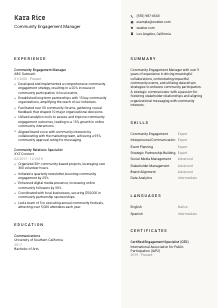
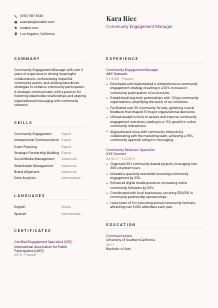
Bringing communities together, but your CV feels like a solo act? Check out this Community Engagement Manager CV example, created with Wozber free CV builder. Learn how to blend your collaboration skills with job specifications, shaping a career that resonates with the heartbeat of every neighborhood you touch!
Community engagement work sits where public trust, organizational goals, and local realities meet. Hiring teams want to see whether you can build durable relationships, run forums that surface useful feedback, and turn community concerns into programs, messaging, or partnerships that actually move participation. Your CV should make that operating range visible, not just list outreach tasks.
A tailored CV also changes how quickly your background makes sense in screening. When your wording reflects the role's mix of stakeholder relations, public-facing communication, and engagement reporting, Wozber's free CV builder helps you shape an ATS-compliant CV that surfaces the right experience early. That makes it easier to see whether you've handled the kind of community conversations, cross-team coordination, and measurable outcomes this role depends on.
Community-facing roles start with credibility and accessibility. Your personal details should confirm that you are easy to reach, professionally presented, and, when the posting asks for it, available in the right market from the outset.
Use your full name as the clearest heading on the page. Keep it larger than the body text so hiring teams can immediately connect your application to your public-facing experience, especially in roles where relationship building and visibility matter.
Add "Community Engagement Manager" beneath your name when that is the role you are pursuing. This simple line helps position your background around outreach strategy, stakeholder management, and public engagement rather than leaving readers to infer your direction from past titles alone.
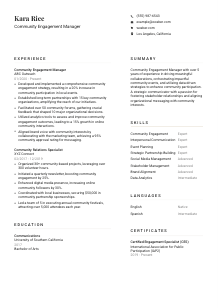
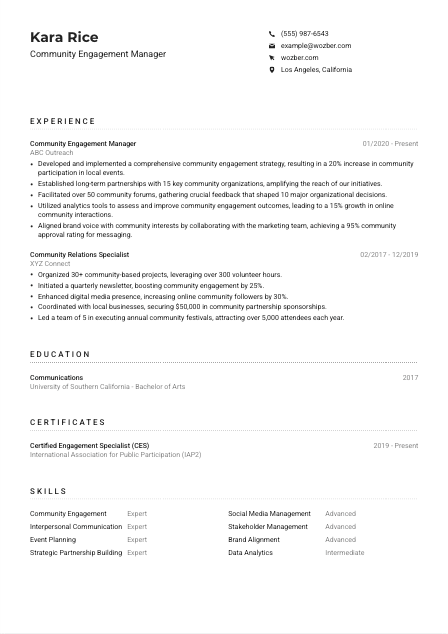
If the employer requires a specific location, include it clearly. In this example, listing Los Angeles, California immediately addresses the stated local requirement and reassures the employer that you can work within the community, partner network, and public meeting context they need.
A LinkedIn profile or portfolio can help when it includes relevant public-facing work such as partnership initiatives, event campaigns, speaking appearances, or community programs. Make sure the dates, titles, and accomplishments match your CV so your professional story stays consistent across both.
Keep this section clean and practical. It should answer basic access questions fast and, where relevant, remove doubts about location, role focus, and professional presentation before the CV moves into your engagement work.




For Community Engagement Manager roles, experience carries most of the hiring weight. This is where employers look for proof that you have built partnerships, facilitated public conversations, handled feedback responsibly, and turned outreach efforts into measurable participation, stronger sentiment, or clearer internal action.
Read the posting closely and identify the operating priorities behind it. Here, the core themes are engagement strategy, stakeholder relationships, community forums, feedback analysis, and collaboration with marketing or communications. Use those themes to decide which accomplishments deserve space and which older bullets can be cut.
List your most recent position first, followed by earlier relevant roles. For each entry, include employer, title, and dates, then use bullets to show the scale of your work, such as the number of forums run, partnerships maintained, volunteers coordinated, or campaigns supported. A clear structure also supports ATS-friendly CV format without sacrificing detail.
Focus each bullet on work that maps to community engagement responsibilities. Good material includes launching outreach initiatives, maintaining relationships with nonprofits or local agencies, leading listening sessions, or aligning public messaging with community priorities. The sample CV does this well by highlighting strategy development, partnerships with 15 organizations, and facilitation of more than 50 forums rather than describing generic coordination work.
Metrics matter in this field when they show engagement quality or program results. Strong examples include increases in event attendance, online interaction, volunteer participation, sponsorship value, approval ratings, or the number of decisions informed by community feedback. In the example, a 20% increase in event participation and a 95% community approval rating tell a hiring team far more than "improved outreach."
Prioritise accomplishments that show public trust, stakeholder coordination, facilitation skill, and follow-through with internal teams. If an achievement does not help explain how you engage communities, influence messaging, or translate feedback into action, it likely belongs off the page. Relevance is especially important for candidates coming from adjacent areas like PR, events, or communications.
By the end of this section, readers should be able to picture you running engagement plans, managing relationships across the community, and reporting outcomes that matter to leadership. That is the level of proof this role calls for.
Education matters here because it often anchors your communication training and shows whether your background aligns with outreach, public messaging, or stakeholder-facing work. Keep it concise, but make sure it supports the professional story your experience is already telling.
When a posting calls for a bachelor's degree in Communications, Marketing, Public Relations, or a related field, list your degree in a way that makes the match easy to spot. A degree such as a Bachelor of Arts in Communications, like the one shown in the example, fits naturally with community messaging and outreach work.
Include your degree, school, and graduation year in a clean order. This section does not need decorative detail. It should be easy for both hiring teams and ATS systems to read without searching for the basics.
If your field directly supports the role, name it clearly. Communications, Public Relations, Marketing, Sociology, Public Administration, and similar disciplines can all be relevant, but the wording should accurately reflect your record and help frame your preparation for public-facing work.
Early-career candidates can include relevant coursework, student organisation leadership, or community-based projects if those experiences show event planning, stakeholder outreach, public speaking, or campaign coordination. Once you have several years of experience, those details usually matter less than your actual engagement outcomes.
If you have completed workshops or short programs in public participation, conflict resolution, digital engagement, or data-informed communications, they can reinforce your professional range. This works especially well when your formal degree is related but not directly centered on community engagement.
Your education section should confirm that your academic background supports the communication, outreach, and stakeholder-facing demands of the job. Keep it clear, relevant, and proportional to your level of experience.
Certifications are not always required for community engagement roles, but the right ones can add practical weight. They work best when they point to methods you use on the job, such as public participation, facilitation, conflict management, or engagement measurement.
List certificates that reinforce how you run community programs, facilitate dialogue, or manage stakeholder input. A credential such as the Certified Engagement Specialist shown in the example supports the candidate's positioning because it relates directly to participation practice rather than to general professional development.
A short, relevant list is more effective than a crowded one. If you hold several certificates, lead with those tied to community outreach, communications, social media engagement, data analysis, or public facilitation, depending on what the target role emphasizes.
Add the year earned or the active date range when applicable. This helps hiring teams understand whether your training is current, especially for areas that evolve with digital tools, public participation practices, or reporting standards.
If you are targeting more senior engagement positions, look for certifications or training in stakeholder strategy, crisis communication, DEI-informed outreach, community-based research, or facilitation. Ongoing learning can sharpen your profile when two candidates have similar experience on paper.
Use certifications to deepen your story, not to pad it. The best ones show that your community engagement approach is informed by current practice and supported by training you can apply in the field.
This section should reflect how community engagement actually gets done. Employers usually look for a blend of relationship management, communication craft, digital outreach, event or forum facilitation, and enough analytical ability to report what the community is saying and how participation is changing.
Start with the employer's own wording. In this case, that includes interpersonal communication, written and verbal communication, social media proficiency, and familiarity with data analytics tools. Then add adjacent skills you genuinely use, such as stakeholder management, event planning, public speaking, content coordination, or survey analysis.
Your skills list should echo what your experience section proves. If your bullets show forum facilitation, partnership building, and engagement reporting, those skills belong near the top. The sample CV handles this well by emphasizing community engagement, strategic partnership building, social media management, and data analytics instead of filling the section with generic office software.
Use a clean format and group skills logically if needed. You might separate communication and relationship skills from platform or analytics skills, especially when the role spans both public interaction and performance reporting. Clear structure helps hiring teams spot the mix of people skills and operational tools the job requires.
This section should show that you can connect with communities, manage outreach channels, and track what your efforts produce. Keep the list grounded in real work, not in broad claims that your experience does not support.
Language ability can matter a great deal in community engagement, especially when organizations serve multilingual neighborhoods or run public sessions with diverse stakeholders. Even when only one language is required, listing languages clearly helps employers understand your communication range.
If the posting calls for English proficiency, include it clearly and use an accurate level such as Native or Fluent. This removes any uncertainty for roles centered on public communication, written outreach, presentations, and stakeholder meetings.
Lead with the language tied to the job requirement, then follow with others in descending order of usefulness or proficiency. For this position, English belongs at the top because it is named directly in the requirements.
Extra languages can strengthen your application when they help you reach local residents, partner organizations, or volunteer groups. In the sample CV, Spanish adds useful context because bilingual communication can be valuable in many community-facing environments, even when it is not formally required.
Be accurate about whether you are Native, Fluent, Advanced, Intermediate, or Basic. Community engagement often involves live conversations, written materials, and public meetings, so overstating fluency can quickly become a problem in practice.
If you have worked with multilingual communities, note the languages you can use professionally and make sure your experience section shows where that mattered. Language skills carry the most weight when they clearly support outreach, trust building, and access to information.
Handled well, your languages section shows more than fluency. It can reinforce your ability to communicate across communities, support inclusive outreach, and meet the communication demands of the role.
Your summary should give a fast, credible read on the kind of community engagement professional you are. In two to four lines, it should connect your years of experience with the outreach work, stakeholder environment, and measurable results that define your profile.
Before writing, identify the main responsibilities the employer is hiring for. Here, that means engagement strategy, stakeholder relationship building, public forum facilitation, feedback analysis, and collaboration with communications teams. Those themes should shape the language of your opening lines.
Open with your title or specialty and your years of relevant experience. For example, "Community Engagement Manager with 5+ years of experience in outreach strategy, stakeholder partnerships, and public-facing communications" gives a much clearer picture than a generic statement about being people-oriented.
Choose achievements or strengths that reflect the work most central to the target role. You might mention increasing participation, managing community forums, improving digital engagement, or aligning messaging with community priorities. The example summary works because it combines collaboration, event leadership, and data-driven engagement instead of relying on broad personality claims.
Aim for concise language with concrete terms. Avoid filler like "results-driven" unless you immediately back it up with something tangible, such as growth in participation, partnership development, or feedback-informed decision making. A focused summary helps set up the rest of the CV with the right expectations.
Your summary should quickly position you as someone who can represent an organisation in the community, build productive relationships, and turn engagement activity into useful outcomes. Once that framing is clear, the rest of the CV can prove it in detail.
A Community Engagement Manager CV should leave little doubt about how you work with communities, partners, and internal teams. If your sections clearly show strategy, facilitation, communication range, and measurable engagement outcomes, hiring teams can picture you in the role.
Use Wozber's free CV builder, ATS-friendly CV templates, and ATS CV scanner to tighten your wording, improve ATS optimisation, and align your experience with the posting. The finished CV should make it easy to judge your ability to build trust, guide public dialogue, and turn community insight into action.