



Use Wozber and land your dream job
Create CV
No registration required
Weaving virtual threads, but your CV feels offline? Shore up your social skills with this Community Manager CV example, created with Wozber free CV builder. Learn how to showcase your community engagement so it better matches the social-savvy demands of your career journey!
Community managers sit at the intersection of audience trust, brand voice, and daily customer sentiment. Hiring teams want to see how you handle the ongoing work behind that responsibility: shaping engagement strategies, responding to conversations at scale, turning feedback into insight, and keeping community interactions aligned with the wider business.
A tailored CV changes how quickly that story comes through. When your wording reflects the employer's language around community strategy, engagement, reporting, and cross-functional collaboration, an ATS-compliant CV is easier to rank for the right reasons and easier to read for the team behind it. Wozber's free CV builder helps structure that alignment cleanly, so your CV shows whether you can grow and retain a community, not just manage a feed.
For a Community Manager, the header does more than identify you. It establishes whether you match practical requirements quickly and whether your professional presence feels consistent with a role built on communication, accessibility, and audience-facing work.
Use your full name in a clear, readable format so it is easy to spot at the top of the page. Community management is a public-facing function, and your CV should reflect that same clarity. Avoid nicknames or overly styled formatting that competes with the rest of the document.
Place "Community Manager" directly under your name when that is the role you are pursuing. This helps frame your experience immediately, especially if your background includes adjacent titles such as Social Media Manager, Customer Marketing Specialist, or Community Lead.
Include a phone number and a professional email address that you check regularly. If you have a relevant LinkedIn profile, portfolio, or personal site with examples of community programs, event work, or engagement campaigns, add that too. For this profession, a visible online presence can reinforce your communication style and credibility.
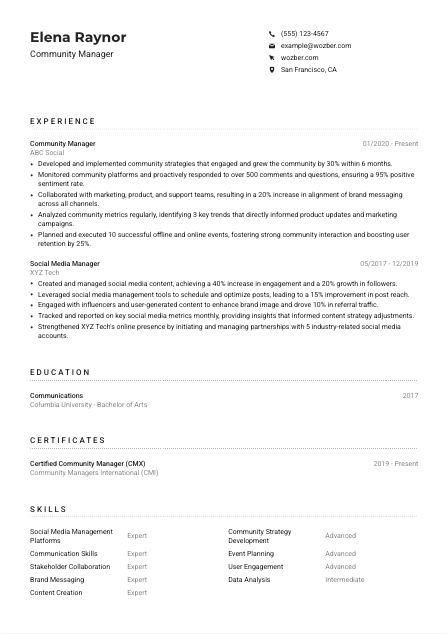
Some community roles are flexible, but others need a local hire for office collaboration, events, or in-person member touchpoints. In the example posting, San Francisco, CA is a stated requirement, so listing that location directly helps remove avoidable uncertainty early in the review process.
A personal website, LinkedIn page, or creator profile should strengthen your case with relevant material such as community event recaps, brand collaborations, moderation work, newsletters, or social campaigns. Skip links that are unfinished or unrelated. For a Community Manager, every public touchpoint should feel intentional.
Your personal details should confirm the basics without friction: who you are, how to reach you, whether you meet any location requirement, and whether your public professional presence supports the role.




This is where hiring teams decide whether you have actually built, moderated, and grown communities, or simply worked nearby in social media or content. The strongest experience sections show how you increased engagement, handled member interactions, collaborated across teams, and turned community activity into measurable business insight.
Read the posting for the work patterns behind the title. For Community Manager roles, that usually includes community growth, member retention, timely responses, cross-functional coordination, events, and reporting on engagement trends. Those themes should guide which achievements you highlight first.
List your most recent position first and make each entry easy to scan with company name, title, and dates. If you moved from social media into community work, that progression can work in your favor, especially when the bullet points show increasing ownership of engagement strategy, moderation, and member programs.
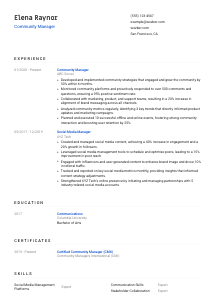
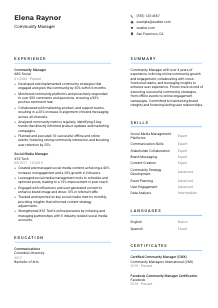
Bullet points should show what changed because of your work. Instead of saying you "managed community platforms," show the result: higher engagement, faster response handling, improved sentiment, stronger retention, or clearer alignment with marketing and product. The sample CV does this well with specifics like a 30% community growth lift and a 95% positive sentiment rate.
Use numbers that are native to the role. Good metrics include engagement growth, response volume, retention, event attendance, sentiment, referral traffic, follower growth, campaign participation, or the number of trends surfaced through reporting. Community work often gets underestimated when it is described only as relationship building, so metrics help show operational scale and business value.
You do not need to document every content calendar, platform post, or side project. Keep the focus on work that proves you can engage members, manage conversations, partner with marketing or support, and act on community insight. If an older role was more social-media-heavy, select bullets that still connect to audience growth, platform management, and brand interaction.
Your experience section should make one thing clear: you have already done the work of growing and supporting a community, and you can show the results in metrics, programs, and cross-functional impact.
Education matters here mainly as a qualification checkpoint and as context for your communication background. For a Community Manager, this section should confirm the degree requirement cleanly and, when useful, support your strengths in communications, marketing, audience behaviour, or digital media.
When a posting asks for a bachelor's degree in Communications, Marketing, or a related field, make sure your degree is easy to find. If your field is closely related, such as Media Studies, Public Relations, or Journalism, present it clearly without overexplaining.
List school, degree, field of study, and graduation year or completion date in a consistent order. This is one of the easiest sections for recruiters and ATS tools to review, so clarity matters more than detail-heavy formatting.
If your degree directly supports the role, name it precisely. "Bachelor of Arts in Communications," like the example CV uses, immediately aligns with a posting focused on written communication, interpersonal skill, and brand messaging.
Early-career candidates can include relevant coursework, capstone projects, student-led communities, or research tied to digital engagement, communications strategy, or event planning. If you already have several years of community management experience, keep this section tighter and let your work history carry more weight.
Student organizations, ambassador programs, publication roles, or event committees can help if they demonstrate audience engagement, moderation, or community-building instincts. Use them when they add something your professional experience does not already cover.
For most Community Manager applications, education should quickly confirm that you meet the baseline requirement and support the communication strengths the role depends on.
Community management changes fast with platform shifts, moderation standards, and new engagement practices. Relevant certifications help show that you stay current and take the discipline seriously, especially when a posting lists community credentials as a plus.
If the employer mentions certifications such as CMX or Facebook Community Manager Certification, move those to the top of the section. When a preferred credential appears in the job description, matching it directly can strengthen both ATS alignment and recruiter confidence.
Choose certificates tied to community strategy, platform management, moderation, social media, customer engagement, or digital communications. A shorter list of relevant credentials reads better than a crowded section filled with broad online course completions.
Dates help hiring teams understand how recent the training is and whether the credential is still current. In the sample CV, listing certificates as active from 2018 or 2019 onward supports a pattern of ongoing professional development in community work.
Review this section regularly, especially if your work involves evolving platform tools, community governance, or event-led engagement. Updated credentials can reinforce that you are keeping pace with how online communities are actually managed today.
Relevant certificates should tell a simple story: you have built practical community skills and kept developing them in ways that matter for the role you are targeting.
Community management blends communication, platform fluency, relationship handling, and data awareness. Your skills section should reflect that mix without turning into a generic keyword dump. Focus on the tools and capabilities that support engagement, moderation, reporting, and cross-team coordination.
Start with the skills named directly, such as written communication, interpersonal ability, and proficiency with social media management platforms. Then add adjacent skills the responsibilities clearly require, including community strategy, sentiment monitoring, stakeholder collaboration, event planning, and analytics.
Use terminology that matches the posting when it reflects real experience. If you have worked with social media management platforms, community engagement programs, reporting dashboards, or brand messaging workflows, name those capabilities in the same language the employer uses. That improves ATS optimisation without sounding forced.
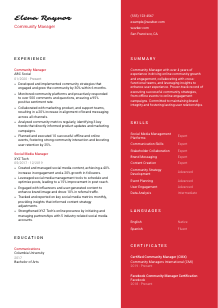
Do not overload this section with every soft skill you have ever used. Community Manager CVs benefit from a balanced list: communication skills, community strategy development, user engagement, stakeholder collaboration, event planning, content creation, brand messaging, and data analysis are all stronger than vague terms like "hard worker" or "team player." The example CV gets this balance right by combining platform, communication, and execution skills.
Every skill you list should be backed up somewhere else by a metric, project, platform, or accomplishment that shows how you used it in real community work.
Language skills can matter a great deal in community-facing roles, especially when your work involves moderation, support, events, or member engagement across regions. Even when only one language is required, this section should make your communication range easy to understand.
If the posting specifies English fluency, list English at the top with an accurate proficiency level. That gives recruiters an immediate answer to a stated requirement and prevents a basic qualification from being overlooked.
Additional languages can be valuable when communities span customer segments, markets, or support channels. For example, Spanish may be useful in many audience-facing environments, but include extra languages because they are relevant to your actual capabilities, not as filler.
If you have supported diverse user groups, hosted multilingual events, or worked with international audiences, your language section can reinforce that experience. For community work, broader language range often connects directly to inclusivity, responsiveness, and member trust.
Use clear labels such as Native, Fluent, Professional, Conversational, or Basic. Community roles often rely on nuance in tone and response handling, so it is better to be exact than optimistic.
Not every Community Manager role is global, but some companies value candidates who can engage more than one audience segment. If your extra language skills support the employer's member base, mention them. If not, keep the section brief and accurate.
This section works best when it confirms required fluency and, where relevant, shows that you can communicate across a broader member base with confidence.
Your summary should quickly place you in the market as someone who can grow and support a community with intention. For this role, that usually means combining audience engagement experience with collaboration, reporting, and a clear sense of brand voice.
Start with the employer's version of the job in mind. If the posting emphasizes engagement, retention, platform responsiveness, and event-led interaction, those are the themes your opening lines should reflect instead of generic marketing language.
Lead with a direct professional identity, such as "Community Manager with 4+ years of experience" or a closely related title if your background has evolved from social media or content roles. This helps the reader place your level immediately.
Highlight strengths that matter in community work, such as building engagement strategies, improving retention, collaborating with product and support teams, or using community insights to influence campaigns and updates. The example summary works because it mentions both growth and cross-functional partnership rather than relying on broad personality traits.
Aim for a short paragraph that can be read in seconds. Three to five lines is enough if the wording is specific. Focus on what you have managed, improved, or delivered, and avoid empty claims about passion unless the rest of the sentence shows how that translated into results.
A well-written summary should tell the reader, within a few lines, that you can manage community engagement as an operational function and contribute to growth, retention, and brand consistency.
A Community Manager CV should read like the work itself: clear, responsive, audience-aware, and grounded in outcomes. When your sections reflect community growth, engagement handling, collaboration with marketing or support, event execution, and reporting on trends, hiring teams can quickly understand the scope of what you have done.
Before you send it out, compare your wording against the target posting and tighten any gaps in terminology, metrics, or role emphasis. Wozber's AI CV builder can help you align phrasing, strengthen ATS optimisation, and turn your experience into a cleaner ATS-friendly CV format. The final version should make it easy to judge whether you can build and sustain a healthy community from day one.




