



Use Wozber and land your dream job
Create CV
No registration required
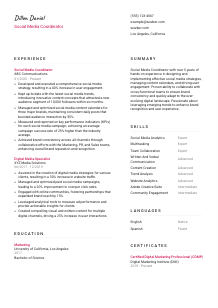
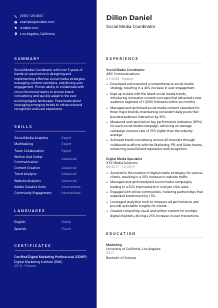
Pinning posts, but your CV isn't getting likes? Scroll through this Social Media Coordinator CV example, created with Wozber free CV builder. Learn how to line up your online engagement skills with job requirements, making your career profile trend as high as your best-performing hashtags!
Social media coordination sits at the intersection of planning, publishing, audience engagement, and performance reporting. Hiring teams want to see that you can keep a content calendar moving, adapt to platform shifts quickly, and connect day-to-day posting to brand and campaign goals rather than simply "manage social media."
When the CV is tailored well, the first read makes your channel experience and KPI ownership clear instead of burying them in generic marketing language. Wozber's free CV builder helps organise that story into an ATS-compliant CV, so terms like content calendar management, engagement growth, and social media analytics are easy to scan and easy to connect to actual campaign results.
For a Social Media Coordinator, the header should confirm availability, professionalism, and digital presence in seconds. Keep it clean, accurate, and aligned with how brands expect someone in a communication-heavy role to present themselves.
Your name should be the most visible line on the page. Use a clear font and slightly larger size so it anchors the CV right away, much like a recognizable brand signature on a campaign asset.
Place "Social Media Coordinator" directly under your name when that is the role you are pursuing. Matching the posted title helps position you correctly from the start, especially when employers are sorting between adjacent profiles such as content specialist, digital marketer, and community manager.
Include a current phone number and a professional email address. This role depends on polished communication, so even small details matter. Make sure hiring teams can reach you easily and that your contact information reflects the same judgment you would bring to public-facing brand channels.
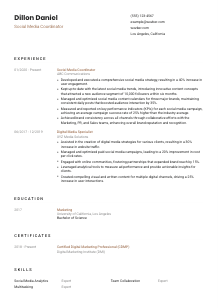
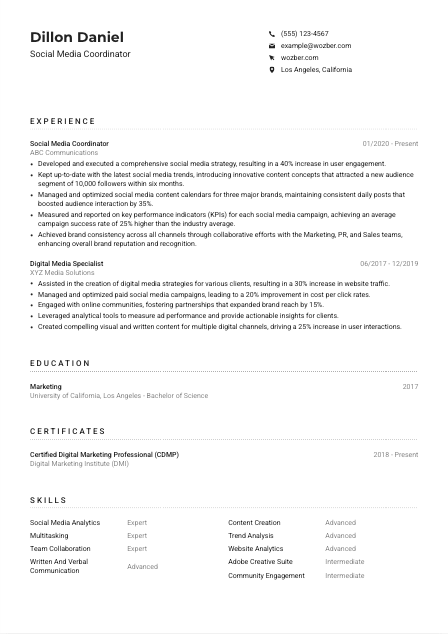
If a job specifies a location requirement, include your city and state in the header. In the example, listing "Los Angeles, California" directly addresses the employer's stated need. For other openings, follow the same rule only when location affects eligibility or local availability.
A LinkedIn profile, portfolio, or professional website can strengthen this section, especially if it shows campaign samples, content work, or measurable audience growth. Keep it updated and consistent with your CV so the hiring team sees the same story across both.
Your personal details should answer the practical questions immediately: who you are, what role you want, how to contact you, and whether you meet any stated location requirement.




This is where Social Media Coordinator candidates separate themselves. Hiring teams are looking for more than platform familiarity. They want to see content planning, execution rhythm, campaign measurement, audience growth, and cross-functional coordination translated into outcomes.
Read the job description for the operating work behind the title. Here, the core themes are social media strategy, content calendar ownership, campaign KPI reporting, trend awareness, and collaboration with Marketing, PR, and Sales. Those are the responsibilities your bullet points should echo with specific examples from your own work.
Start with your most recent position and work backward. For each role, include company name, title, and dates, then use bullets to show how your responsibilities expanded from execution into planning, optimisation, and reporting. A progression from digital media support work into full social coordination reads well for this field.
Bullet points should show what changed because of your work. The example does this well by pairing duties with outcomes such as a 40% increase in user engagement, a 35% boost in audience interaction, and 10,000 new followers in six months. Metrics like engagement rate, follower growth, reach, click-through rate, conversions, or cost per click are far more persuasive than generic statements about posting content.
Social teams are expected to report on performance, not just publish. Mention the analytics tools, dashboards, or KPI reviews you handled, then connect them to decisions you made. Even a short line about tracking campaign results, identifying high-performing content, or improving ROI through reporting shows stronger ownership than saying you "monitored social media."
Choose achievements that support the work of a Social Media Coordinator. Prioritise strategy execution, daily publishing cadence, engagement management, campaign analysis, trend-based content ideas, and cross-team brand consistency. Leave out wins that do not strengthen that picture, even if they were impressive in another context.
Your experience section should make it easy to picture you running calendars, improving campaign performance, and working across teams without losing the brand voice or the reporting discipline the role requires.
Education usually will not outweigh hands-on campaign results in social media hiring, but it still matters when the posting names a degree requirement. Keep this section clear enough to confirm qualification quickly, then let your experience carry the heavier proof.
If the employer asks for a bachelor's degree in Marketing, Communication, or a related field, name your degree and field directly. In the example, "Bachelor of Science" with a Marketing major lines up cleanly with the requirement and removes ambiguity during screening.
List the school, degree, field of study, and graduation year. That is usually enough for a Social Media Coordinator CV unless you are early in your career and need relevant coursework or projects to support limited experience.
Be specific about what you studied. "Marketing" or "Communications" is more useful here than a broad or abbreviated label because it connects directly to content strategy, audience messaging, and campaign thinking that employers associate with the role.
If you completed coursework, projects, or a thesis related to digital marketing, media strategy, audience research, or brand communications, include it only when it adds real substance. Otherwise, keep the section brief and let the CV stay focused on execution and results.
If you have added professional learning beyond college, such as digital marketing or analytics coursework, it can reinforce that you stay current with platform changes and campaign tools. The CDMP example fits well because it complements a marketing degree without overcrowding the section.
Education should quickly confirm that you meet the academic baseline, especially when a bachelor's degree is listed as a requirement. After that, your campaign work, analytics fluency, and content results should do the heavier lifting.
Certifications are useful in social media when they show current knowledge in digital marketing, analytics, content, or paid media. They are not always required, but the right one can reinforce that you keep up with tools, reporting practices, and channel changes.
If the job does not require a specific certification, focus on ones that support the actual work of the role. Digital marketing, analytics, social strategy, paid social, or content marketing credentials all make more sense here than unrelated general business courses.
Include certifications that support your case as someone who can plan campaigns, interpret metrics, and manage fast-moving channels. A smaller list of relevant credentials is stronger than a long list that does not connect to social media performance or brand communication.
Dates help employers judge how current the credential is, which matters in a field where platform features, ad formats, and reporting tools change quickly. Recent or actively maintained certifications carry more weight than older items with no context.
Social media work changes fast, from algorithm shifts to new content formats and measurement practices. Certifications can show that you keep refining your approach. The CDMP in the example works because it supports a broader story of staying current in digital marketing.
A relevant certification can reinforce your technical range and current industry knowledge, especially when it connects directly to analytics, campaign strategy, or digital content execution.
The skills section should read like the toolkit behind your results. For a Social Media Coordinator, that means platform work, analytics, content execution, and collaboration, presented in the language employers actually use in their postings.
Start with skills named or strongly implied in the posting. Here, that includes social media analytics, written and verbal communication, multitasking, and the ability to manage strategy and daily content operations. Matching this language helps both ATS screening and human review connect your background to the role faster.
Social media work blends execution and coordination. Pair hard skills such as analytics tools, content creation, scheduling platforms, or Adobe Creative Suite with collaboration skills such as team communication and cross-functional coordination. The example gets this balance right by combining analytics, content, collaboration, and trend analysis.
Do not turn this section into an inventory of every tool you have touched. Lead with the skills that explain your best experience bullets, such as social analytics, community engagement, content planning, campaign reporting, and audience growth. That keeps the section aligned with the performance story in your CV.
Every skill listed should help explain how you build calendars, create content, track KPIs, and work with other teams to keep social output consistent and effective.
Language skills matter in social media because tone, responsiveness, and audience understanding shape how brands are perceived. If a posting names a language requirement, make it easy to find. If you speak additional languages, include them when they could support broader community engagement or multilingual content work.
This role explicitly requires strong English. List English first and mark your level clearly, whether that is Native or Fluent. For a communication-driven role, this is a core qualification, not a side note.
If you speak additional languages, include them after English. They can be especially relevant for brands serving diverse communities, regional markets, or bilingual audiences. In the example, Spanish adds useful reach without distracting from the main requirement.
Choose straightforward ratings such as Native, Fluent, Intermediate, or Basic. Hiring teams should be able to judge quickly whether you can write content, respond to comments, or support community management in that language.
Extra languages are most valuable when they relate to audience interaction, localized messaging, or community engagement. If a language helped you manage comments, adapt content, or support a multilingual campaign, that is worth reinforcing elsewhere in the CV too.
Only list languages you can actually use in a professional context. Social media roles often move quickly, and if audience responses or internal coordination happen in that language, your stated proficiency should hold up in real work.
List languages in a way that supports the communication demands of the role. For social media work, that means clarity about what you can actually write, manage, and respond to.
The summary should give a hiring manager a quick read on your level, strengths, and type of impact. For Social Media Coordinator roles, the best summaries link channel management and content execution to measurable engagement, reporting, and cross-team brand consistency.
Before writing the summary, identify the few priorities that matter most in the target role. In this case, strategy, content calendar management, KPI tracking, communication, and collaboration are the strongest themes to reflect back in your own words.
Start directly with who you are and how long you have been doing the work. "Social Media Coordinator with 5+ years of experience" is clearer and more useful than a generic personal statement. It tells the reader immediately what lens to use for the rest of the CV.
Mention the areas where your experience is strongest, such as engagement growth, content planning, trend-driven campaign ideas, or social analytics. The example summary works because it ties strategy and calendar management to user engagement and brand consistency instead of staying broad.
Aim for three to five lines that can be scanned quickly. Focus on the combination that matters most for the role: platform execution, performance measurement, and collaboration with marketing or sales partners. Save finer details for the experience section, where results can be quantified properly.
By the end of the summary, a hiring team should already understand your level of social media ownership, the kind of outcomes you have driven, and the channels of work you are ready to manage.
A Social Media Coordinator CV should show that you can plan content, publish consistently, respond to performance data, and work across teams to keep the brand voice steady. When each section is tailored to those realities, the application reads less like a general marketing profile and more like someone ready to manage active channels.
Use Wozber's free CV builder to shape that story in an ATS-friendly CV format, and refine the wording with its ATS CV scanner so the language around strategy, analytics, and content operations matches the role you are targeting. The final read should make your campaign judgment, communication range, and day-to-day channel ownership easy to see.