



Use Wozber and land your dream job
Create CV
No registration required
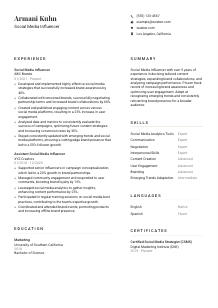
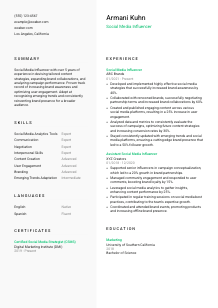
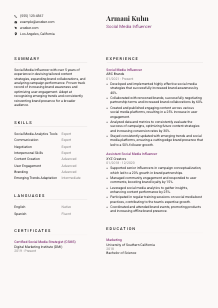
Leading trends, but your CV lacks followers? Check out this Social Media Influencer CV example, created with Wozber free CV builder. It shows how to spotlight your digital charisma to match job preferences, making sure your career narrative is as engaging as your content!
Social media influencer hiring moves quickly, but the bar is higher than posting polished content and growing a following. Employers want to see how you shape brand presence, turn audience attention into engagement, and handle partnerships in a way that protects both performance and reputation. Your CV needs to show the commercial side of the work clearly, from content strategy and campaign results to collaboration with brands and trend awareness.
When that story is tailored well, the hiring team can quickly tell whether you are a creator who understands business goals or simply someone with online visibility. Wozber's free CV builder helps you align your language with the posting, keep the structure ATS-friendly, and surface the metrics, platform work, and partnership results that matter most for a Social Media Influencer role.
For influencer roles, the top of the CV should feel clean, credible, and easy to trust. This section does not need personality copy or branding language. It needs accurate contact details, a role title that matches the work, and any location information the employer specifically asked for.
Use your full name in the largest, clearest text on the page. Keep it simple and professional. In a field built around personal brand recognition, your name should be instantly visible without competing design elements or nickname styling.
Place "Social Media Influencer" directly below your name if that is the role you are applying for. This helps both recruiters and ATS systems categorize you correctly. If your background includes adjacent titles like content creator or brand ambassador, use the target title here when your experience genuinely supports it.
Make it effortless for brands, agencies, or hiring managers to reach you for interviews, portfolio reviews, or campaign discussions.
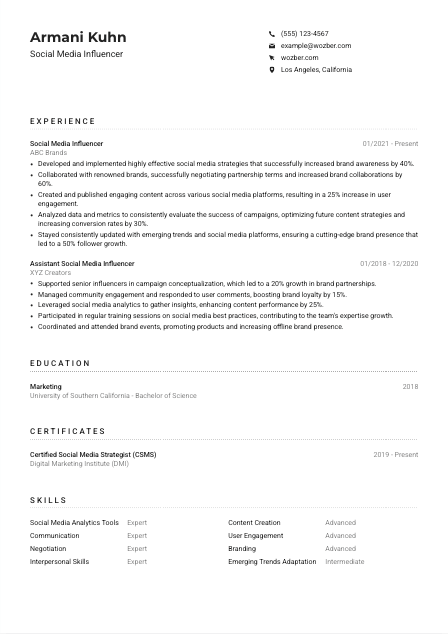
If the employer asks for a specific location, state it plainly. In this example, listing "Los Angeles, California" immediately addresses the stated requirement and avoids uncertainty about availability for local shoots, events, or brand meetings.
A portfolio, creator website, LinkedIn profile, or selected social channel can strengthen this section, especially when the job asks for a portfolio of content and collaborations. Only include links that are current and consistent with the campaign results, partnerships, and audience work described elsewhere in your CV.
At a glance, this section should confirm who you are, how to reach you, and whether you meet any basic logistical requirements. That gives the hiring team a clear path into your campaign work and collaboration history.




This is the section that carries the most weight for influencer hiring. Employers want to see what you created, who you collaborated with, how you measured performance, and whether your work translated into stronger engagement, conversions, or brand reach. Vague content-creator language will not do much here. Specific campaign outcomes will.
Start by marking the responsibilities that appear most often or carry the most business value. For this role, those priorities include social media strategy, brand collaboration, content creation, analytics, and staying current with platform trends. Use those themes to choose which achievements to feature and how to phrase them.
Put your most recent work first so the reader sees your current platform knowledge, brand activity, and audience-building work right away. For influencer positions, recent experience matters because formats, algorithms, and engagement patterns change fast.
Each bullet should show a business result tied to your work. Instead of saying you "created content for brands," show what that content achieved. The example CV does this well with points like increasing brand awareness by 40% and boosting brand collaborations by 60%, which connect strategy and negotiation to clear outcomes.
Numbers make your impact easier to understand when they reflect how this work is actually measured. Strong examples include follower growth, engagement rate, click-through performance, conversion lift, campaign reach, partnership volume, or audience retention. A line such as "resulting in a 25% increase in user engagement" gives more hiring value than a generic claim about strong content.
Keep the section centered on platform strategy, audience growth, brand partnerships, analytics, community engagement, and trend response. If an older role included useful transferable work, frame it through influencer-relevant outcomes. The assistant influencer example works because it highlights community management, analytics use, and partnership support rather than unrelated administrative duties.
Your experience section should make it easy to trace the line from your ideas to audience response and brand results. If a hiring manager can quickly see strategy, execution, analytics, and partnership impact, this section is doing its job.
Education matters most here when it reinforces your understanding of marketing, communications, audience behaviour, or digital media. It will rarely outweigh campaign results, but it can strengthen your profile when the employer asks for a degree or when your academic background clearly supports the business side of influencing.
If the posting asks for a bachelor's degree in Marketing, Communications, or a related field, make that easy to find. In the example, "Bachelor of Science in Marketing" aligns cleanly with the requirement and supports the strategy and brand-facing nature of the role.
List your degree, school, field of study, and graduation year in a clean structure. Hiring teams should be able to scan this section in seconds without searching for basics.
Do not bury the part that matters most. If your degree is in Marketing, Communications, Media Studies, or another related field, spell that out clearly because it helps connect your academic training to content strategy, branding, and audience analysis.
Include honors, projects, societies, or campaigns only when they reinforce your professional direction. Useful examples might include digital marketing projects, student media leadership, campaign research, or branded content work. If your professional experience is already deep, keep this concise.
Relevant courses can help early-career candidates or career changers, especially if they cover social media strategy, consumer behaviour, analytics, branding, or digital advertising. Once you have several years of measurable creator or campaign work, coursework becomes less important than performance.
This section works best when it quietly confirms that your creative work is backed by formal knowledge of branding, communication, or audience strategy. Keep it relevant and easy to scan.
Certifications are useful in influencer CVs when they sharpen your professional profile rather than pad it. They can help show current knowledge in strategy, analytics, advertising platforms, or digital marketing practices, especially in a field where tools and formats change constantly.
Choose certifications that support the actual work of the role, such as social media strategy, digital marketing, content marketing, analytics, or creator monetization. A credential like "Certified Social Media Strategist (CSMS)" signals focused training that fits this kind of opening well.
A short, relevant list is stronger than a long collection of generic courses. Employers care more about whether a certification strengthens your ability to plan campaigns, interpret metrics, or work with brands than about volume alone.
Dates matter when the credential reflects recent learning in a fast-moving field. If your certification is active, renewed, or recently completed, include that information so your CV reflects current platform and campaign knowledge.
Add new credentials when they support the direction of your applications. If you want more brand partnership work, focus on negotiation, campaign strategy, or creator marketing. If analytics is a selling point, pursue certifications that deepen reporting and optimisation skills.
A well-chosen certification section tells employers you keep pace with the tools, trends, and strategy work behind successful social campaigns. Relevance matters more than quantity.
For this role, the skills section should balance creative execution with business and analytical ability. Employers are usually looking for someone who can create engaging content, interpret performance data, communicate well with brands, and adapt quickly to changing platform behaviour.
Pull both direct requirements and implied capabilities from the job description. Here, that includes social media analytics tools, communication, negotiation, interpersonal skills, content creation, and trend awareness. Those terms should guide the structure of your skills section.
Only include strengths you can support with campaign results, collaborations, or day-to-day platform work. In the example CV, analytics tools, communication, and negotiation all connect to experience bullets about campaign optimisation and brand partnerships, which makes the skills section believable.
Lead with the capabilities most central to the opening. For an influencer role, that usually means analytics, content creation, brand collaboration, audience engagement, communication, and platform strategy before broader soft skills. Keep the list focused enough that every item adds something useful.
A hiring team should see both sides of the job here: creator ability and commercial judgment. When your skills reflect content, analytics, partnerships, and audience engagement together, the section reads like a working influencer profile instead of a generic media CV.
Language ability can matter in influencer hiring when it affects audience reach, content delivery, or brand communication. If a posting names a required language, treat that as a core qualification. Additional languages can be valuable when they expand your audience or support multicultural campaigns.
If the job specifically requires strong English communication, list English clearly and use an honest proficiency level. In this case, showing "Native" English directly addresses the employer's requirement to articulate well in English.
Extra languages can strengthen your profile when they support community growth, cross-market campaigns, or bilingual content. Listing Spanish, for example, can suggest wider audience access and stronger value for brands targeting multilingual communities.
Use clear levels such as Native, Fluent, Advanced, or Intermediate. Language claims are easy to test during interviews, partnership calls, or live content work, so precision matters.
If your audience, collaborations, or content style benefit from multilingual communication, let that come through naturally. This is especially useful for creators involved in regional campaigns, community-led engagement, or international brand work.
Mention a developing language only when you can apply it in a practical way, such as basic audience interaction or simple content support. Do not add it just to fill space. For most influencer roles, fluency that affects reach or collaboration is what carries weight.
This section should clarify whether you can meet stated communication requirements and whether you bring added audience range. Keep it honest and tied to real content or brand value.
A Social Media Influencer summary should read like a concise professional pitch, not a personal bio. In a few lines, show your experience level, the kind of results you deliver, and the parts of the job you handle especially well, such as strategy, partnerships, analytics, or audience growth.
Start by naming your role and your experience in a way that sets context fast. The sample summary does this effectively with "Social Media Influencer with over 5 years of experience," which immediately tells the reader where you are in your career.
Use the summary to feature two or three strengths that map closely to the posting. For this kind of role, useful themes include growing brand awareness, expanding collaborations, increasing engagement, or optimising campaigns through analytics. Keep the language close to the employer's priorities.
Aim for a short paragraph that delivers substance quickly. Three to four lines are usually enough to cover your experience, core strengths, and one clear performance angle without repeating your experience section.
You do not need catchphrases or influencer-style self-promotion here. A polished tone with specific achievements will do more work than personality-heavy wording. The best summaries sound commercially aware and current with the platforms, audience behaviour, and brand expectations of the role.
Your summary should make the reader expect strong platform judgment, credible partnership work, and measurable audience results. If those points are clear in a few lines, the rest of the CV has a strong opening.
A Social Media Influencer CV should show more than content output. It should connect your platform presence to audience growth, campaign performance, and brand collaboration in language that feels specific and measurable.
Use Wozber's AI CV builder to tighten that alignment, improve ATS optimisation, and shape an ATS-compliant CV that reflects the terms, metrics, and collaboration signals employers actually scan for. The final version should make it easy to judge how you create, partner, and perform.




