



Use Wozber and land your dream job
Create CV
No registration required
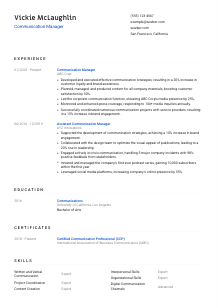
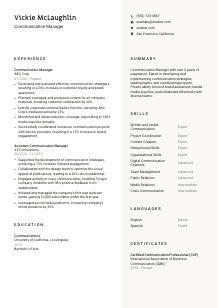
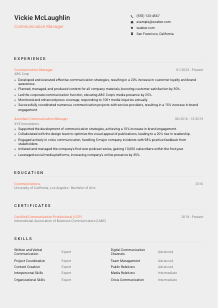
Crafting messages, but your CV's signals seem crossed? Check out this Communication Manager CV example, created with Wozber free CV builder. Learn how to present your communication expertise so it matches job specifics, broadcasting your career aspirations loud and clear!
Communication Managers are expected to bring order to a busy message environment. One week can involve campaign planning, publication oversight, media response, and cross-functional coordination with marketing or digital teams. A CV for this role needs to make that operating range easy to see through clear examples of strategy, execution, and measurable results.
Hiring teams often sort communication candidates by scope. They look for signs that you have owned messaging programs, managed content production, handled media activity, or led a communications function rather than simply contributed to it. Wozber's free CV builder helps you shape that experience into an ATS-compliant CV using role-specific language, so your application quickly shows whether you can lead communication work at manager level.
For a Communication Manager, the top of the CV should feel as organised as the materials you would publish on the job. Keep it clean, direct, and easy to scan so the hiring team can confirm your identity, target role, and availability without hunting for basics.
Place your full name at the top in a clear, readable font that stands slightly above the rest of the text. Communication roles value presentation, so even this first line should reflect good judgment around hierarchy and clarity.
Add "Communication Manager" directly under your name if that is the role you are pursuing. Matching the target title helps position you correctly from the first glance, especially when employers are sorting between communications specialists, PR managers, content leads, and broader corporate affairs profiles.
Include a reliable phone number and a professional email address. If you have a LinkedIn profile or personal site featuring press work, publications, campaigns, or portfolio samples, add it here and make sure the content aligns with the CV's dates, titles, and achievements.
If a job specifies a location requirement, show your city and state in this section. The example posting asks for San Francisco, California, so listing that upfront removes a practical screening barrier early in the process. For other openings, tailor location details to the employer's stated expectation rather than treating one city as a standard requirement.
A website, portfolio, or LinkedIn profile can strengthen your case if it shows communication work in action, such as media mentions, campaign assets, newsletters, executive messaging, or brand content. Keep those links current and consistent so they reinforce your communication credibility instead of raising questions.
This section should confirm the essentials in seconds. When your title, contact details, and location are presented neatly, the reader can move straight to the communication work you have led.




This is the section that carries the most weight for a Communication Manager. Employers want to see how you have shaped messaging, managed deliverables, worked with stakeholders, and produced business-facing outcomes such as stronger brand awareness, better media presence, or higher customer engagement.
Read the job description closely and identify the work that defines success. For this opening, that includes communication strategy, publications management, media response, team leadership, and coordination with service providers and partner teams. Your experience bullets should map to those areas in plain language rather than staying broad or generic.
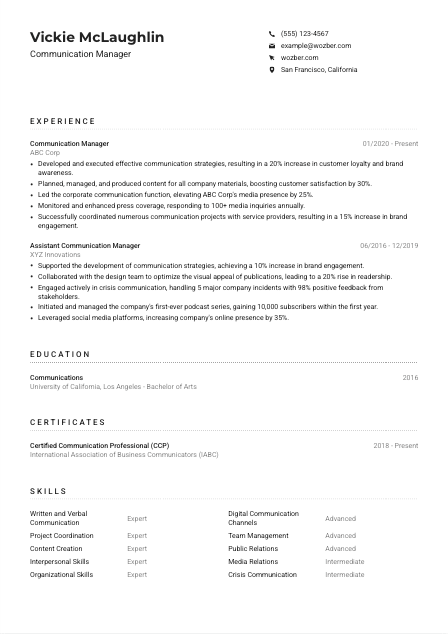
List roles in reverse chronological order and make each entry easy to scan with job title, employer, and dates. For management positions, titles matter. "Communication Manager" and "Assistant Communication Manager" in the sample CV immediately show progression into greater ownership, which is exactly the kind of growth employers look for in a mid-career communications hire.
Focus each bullet on what changed because of your work. Instead of saying you were responsible for content or media relations, show what your communication strategy achieved. The sample does this well with results like a 20% increase in customer loyalty and brand awareness, a 30% lift in customer satisfaction, and 100+ media inquiries handled annually. Those details tell a hiring team how you perform under real communication demands.
Numbers help when they reflect how communications work is actually measured. Useful metrics include brand engagement, readership, subscriber growth, media response volume, customer satisfaction, share of voice, campaign reach, event attendance, or publication output. The example's podcast growth, media inquiry volume, and brand engagement gains are strong models because they connect communication activity to audience response.
Trim experience that does not support your case for leading communication work. Prioritise bullets showing strategic planning, editorial oversight, external messaging, crisis response, collaboration with marketing or PR, and team management. If you include earlier roles, frame them to show the foundation for manager-level responsibilities rather than listing unrelated wins.
A hiring team should be able to track your progression from contributor to owner. When your bullets show strategy, execution, collaboration, and measurable communication results, your experience section does the heavy lifting.
Most Communication Manager postings still expect a formal background in communications, journalism, public relations, or a related field. Your education section does not need flourish, but it should make the academic requirement easy to confirm.
If you hold a bachelor's degree in Communications, Journalism, Public Relations, or a related discipline, list it clearly. In the example, a Bachelor of Arts in Communications aligns directly with the posting requirement and supports the candidate's foundation in messaging, writing, and audience-focused communication.
Present your degree, field of study, school, and graduation year in a straightforward structure. This keeps the section easy to scan and avoids distracting from the more important experience section above it.
When the posting names a degree area, mirror that wording if it truthfully reflects your background. If your degree is in a related field such as Journalism or Public Relations, name it precisely rather than trying to force an exact match. Clear alignment is useful. Accuracy matters more.
Most experienced Communication Managers do not need to list classes unless they support a relevant niche, such as corporate communications, media relations, digital publishing, crisis communication, or brand strategy. This is more useful for earlier-career applicants or for roles with specialised communication demands.
Academic honors, publication work, student media leadership, or communications-focused extracurriculars can help if they reinforce writing, editorial, or leadership ability. Keep them only if they add something your experience section does not already show.
Education is usually a checkpoint section for this role. Once the degree requirement is easy to confirm, the reader can return to the communication results and leadership scope that matter most.
Certifications are rarely the deciding factor for a Communication Manager, but the right one can reinforce professional range. They work best when they support a clear strength, such as corporate communications, public relations, business writing, crisis response, or leadership.
If the job does not require a certificate, use this section to reinforce relevant expertise rather than to fill space. A credential such as the Certified Communication Professional shown in the example adds credibility because it connects directly to strategic communication practice.
Choose certifications that support the kind of communication work you want to lead. One or two relevant credentials are more persuasive than a long list of loosely related online courses. For this field, relevance matters more than volume.
Show the year earned and, if applicable, the renewal period. Current dates can be especially helpful for credentials tied to ongoing professional development, association membership, or updated communication practices across digital channels and media environments.
Communication work shifts with new platforms, changing audience habits, and faster response cycles. Recent certifications in areas like digital communications, media relations, content strategy, or leadership can show that your methods are current, especially if your formal degree is several years old.
This section should strengthen your professional profile, not compete with it. A well-chosen certification adds depth when it clearly supports the communication scope in your experience.
A Communication Manager skills section should read like a snapshot of how you operate. Employers are looking for a mix of communication craft, channel fluency, project leadership, and people management, not a generic list of workplace traits.
Start with the language used in the posting, then keep only the skills you genuinely use. Here, that means communication strategy, written and verbal communication, digital communication channels, team management, organizational skills, and cross-functional coordination. This is also where Wozber's AI CV builder can help surface relevant terms and strengthen ATS optimisation without making the section feel stuffed with keywords.
Communication managers need more than strong writing. Include the practical mix that supports execution, such as content creation, public relations, media relations, project coordination, stakeholder communication, team leadership, and digital channel management. The sample CV handles this balance well by pairing communication craft with management and coordination strengths.
Group your strongest, most relevant skills first and avoid overloading the section with every capability you have ever used. A concise list of high-value skills gives a clearer picture of your operating range, especially when the same themes are backed up by results in your experience section.
The best skills list supports the rest of the CV. When it reflects strategy, content, media, digital channels, and team leadership, it reads like a Communication Manager profile rather than a general communications CV.
Language ability matters in communications because tone, clarity, and audience control are part of the job itself. If a posting names a required language, make that easy to confirm and then use additional languages to show broader audience reach where relevant.
If the role explicitly requires English proficiency, list English at the top of this section with an accurate level. In the provided posting, English communication is a critical requirement, so it should never be buried below secondary languages.
Use clear labels such as "Native," "Fluent," "Advanced," or "Intermediate." Communication roles depend on nuance, so vague language here can work against you. Choose levels that reflect how confidently you can write, present, interview, or respond in real business settings.
Extra languages can strengthen your CV when the company serves diverse communities, international markets, or multilingual customer bases. The example's Spanish fluency is a good supporting detail because it suggests broader communication range, even though English remains the required core skill.
If another language has helped with media outreach, customer communication, stakeholder briefings, or regional campaigns, that context may be worth reflecting elsewhere on the CV too. For most candidates, though, a clean language list is enough.
Do not overstate proficiency in a role built on precise messaging. If you would not be comfortable handling written materials, media calls, or executive communication in that language, choose a lower level or leave it off.
For communication roles, language proficiency is operational, not decorative. Present it clearly so the employer can quickly confirm whether you can communicate at the level the job requires.
Your summary should quickly establish seniority, communication scope, and the kind of outcomes you deliver. For this role, a few targeted lines can frame you as someone who plans messaging, manages teams, and improves how the organisation is seen by customers, media, and stakeholders.
Before writing, identify the two or three priorities that define the role. In this case, they are strategic communications, management of content and publications, media handling, and team leadership. Build the summary around those themes instead of writing a broad statement that could apply to any communications professional.
Start with your current professional identity and years of experience, such as "Communication Manager with 6+ years of experience." That immediately places you at the right level and helps distinguish you from specialist or coordinator profiles.
Mention the capabilities most relevant to the target role, then support them with one or two business outcomes. The example summary works because it names communication strategy, team leadership, media handling, and brand awareness growth without turning into a long paragraph. If you have strong metrics, use one concise figure to add weight.
Aim for three to five lines. This section should not repeat your full experience history. It should act as a fast read on your communication scope, leadership level, and the results employers can expect when you are running messaging, content, and cross-functional communication work.
A sharp summary gives the reader an immediate sense of your level and your communication range. By the time they reach the experience section, they should already expect to see strategy ownership, team leadership, and measurable brand or media results.
A Communication Manager CV works when it shows more than polished writing. It should connect your strategy work, content oversight, media handling, team leadership, and audience outcomes in a way that feels easy to trust.
Use Wozber to build an ATS-friendly CV format that reflects the language of the job description, strengthens ATS alignment, and keeps each section focused on the communication work you can actually lead. The final result should make your management scope, brand impact, and communication judgment clear from the first read.




