



Use Wozber and land your dream job
Create CV
No registration required
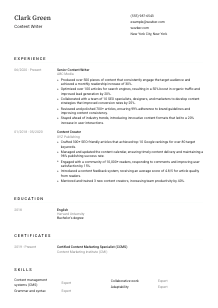
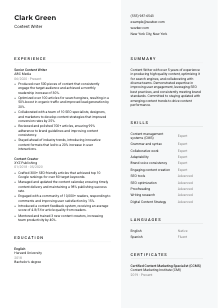
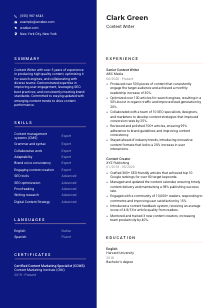
Stringing words, but your CV feels jumbled? Check out this Content Writer CV example, created with Wozber free CV builder. Learn how to seamlessly weave your narrative prowess into the job verse, penning a professional profile as compelling as your prose!
Content writing is judged in the output. Hiring teams want to see published work that attracts readers, ranks in search, supports campaigns, and stays consistent with a brand voice. A CV for this field has to make that visible quickly by showing what you wrote, where it performed, and how your work contributed to traffic, engagement, conversions, or editorial quality.
When the CV is tailored well, the difference between a general writer and a content writer becomes obvious fast. Wozber's free CV builder helps you line up your wording with the posting, keep an ATS-compliant CV structure, and surface role-specific terms like SEO, CMS, content strategy, and lead generation so the reader can immediately connect your writing experience to digital content results.
The top of a Content Writer CV should read cleanly and professionally. This section is simple, but it still does real work by confirming who you are, how to reach you, and whether you meet any practical filters before the reader gets into your portfolio, metrics, or writing background.
Set your name at the top in a clear, readable format. Content roles are detail-sensitive, so even basic presentation matters. A cluttered header or overly stylized font can undermine the polished editorial impression you want to create before anyone reads your experience.
Place "Content Writer" beneath your name when that is the role you are pursuing. This keeps the positioning clear and aligns your CV with the posting right away. If your recent title was broader, such as "Content Creator," you can still use the target title here as long as your experience supports content writing work across articles, campaigns, landing pages, or other digital formats.
Include a reliable phone number, a professional email address, and a relevant website or portfolio link if you have one. For content positions, a portfolio often carries as much weight as the CV itself because it gives hiring teams direct access to your writing range, tone adaptability, and published work. If your samples include SEO articles, blog posts, product copy, or thought leadership pieces, make them easy to find.
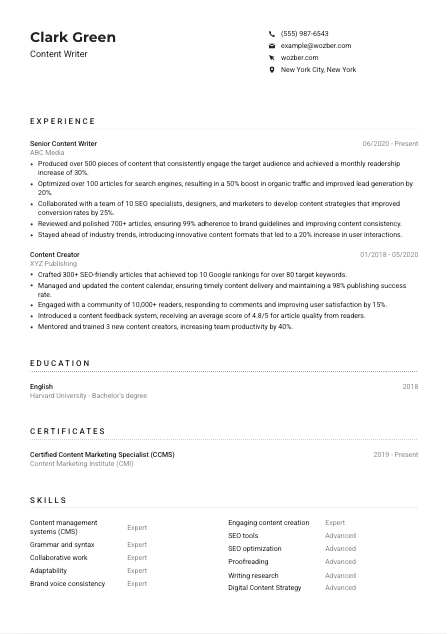
Some employers treat location as a firm filter, especially for hybrid or office-based content teams. In the example here, New York City, New York is explicitly required, so listing that location removes a basic point of friction. Treat this as tailoring to the posting, not as a rule for every content writing CV.
Skip details such as age, gender, marital status, or a full street address. None of these help prove you can research topics, maintain brand standards, or produce SEO-ready copy in a CMS. Keeping this section lean gives more room to the qualifications that matter in content hiring.
Your header should confirm the basics without distracting from your writing track record. For a Content Writer, that means professional presentation, working contact details, and any posting-specific requirement that helps move your CV straight into real consideration.




This is the section most likely to decide whether you move forward. Content hiring teams look past job titles and focus on what you produced, how it performed, and how closely your work matches their editorial and marketing needs. Strong bullets connect writing output to search visibility, audience growth, conversions, and collaboration with SEO or design partners.
Read the posting like an editor studying a brief. Highlight the recurring responsibilities, deliverables, and tools. Here, the pattern is clear: research and ideation, SEO-optimised writing, collaboration with marketers and designers, proofreading, and staying current with content trends. Those are the themes your experience bullets should reflect. The sample CV does this well by matching the posting's language around SEO, brand standards, and cross-functional teamwork.
List your most recent position first and keep the structure easy to scan: company, title, dates, then accomplishments. For content writers, career progression often shows up through broader editorial ownership, more strategic content planning, or stronger performance outcomes. A move from "Content Creator" to "Senior Content Writer," for example, naturally suggests increased responsibility for strategy, quality control, and results.
Avoid generic lines like "wrote blog posts" or "helped with content." Show what you created and why it mattered. Good content bullets mention article volume, audience growth, keyword ranking, lead generation, publishing cadence, or brand consistency. In the example, "Produced over 500 pieces of content" works because it is paired with a 30% readership increase, turning output into measurable editorial impact.
Metrics carry real weight in this profession when they reflect how content is evaluated. Prioritise figures tied to organic traffic, keyword rankings, engagement, conversion rates, publishing accuracy, or readership growth. The sample CV uses this well with results like a 50% boost in organic traffic and a 25% improvement in conversion rates. Those numbers tell a hiring manager that the writing performed in market, not just on the page.
Cut or minimize older work that does not support the role unless it adds useful writing, editing, research, or audience communication experience. If a past position involved newsletters, editorial calendars, campaign copy, or community engagement, frame those pieces clearly. Every bullet should help answer a practical hiring question: can you produce polished content that meets brand goals and performs across digital channels?
A Content Writer CV becomes persuasive when experience bullets connect writing to results. If your reader can see what you created, how you optimised it, who you worked with, and what improved because of it, this section is doing its job.
Education matters most here when it confirms a foundation in writing, communication, or editorial thinking. For many content roles, a degree will not outweigh a strong portfolio and performance metrics, but it still helps when the posting explicitly asks for formal study in English, Journalism, Communications, or a related field.
If your degree aligns with the posting, make that connection easy to see. In this example, a Bachelor's degree in English matches the employer's requirement directly, so it deserves straightforward placement. When your field is adjacent, such as media studies or communications, list it clearly and let your experience section handle the rest of the case.
Use a simple structure: degree, field, school, graduation year or date. Education sections do not need editorial flair. Hiring teams should be able to confirm the credential in seconds and move back to the parts of the CV that show writing quality, SEO knowledge, and digital content results.
If you are early in your career, coursework in journalism, copywriting, rhetoric, digital media, or content strategy can help fill out your profile. The same goes for student publications, writing labs, or editorial internships. Once you have several years of professional content work, keep this section lean unless those details add something distinctive.
Honors, editorial positions, or university media work can be worth adding when they show real communication skill. Leading a student publication, editing a journal, or producing high-volume campus content tells a more relevant story than unrelated extracurriculars. Choose items that connect naturally to research, writing, editing, and deadline-driven production.
Most of the time, your school and degree speak for themselves. Add a short clarifying note only if your program had a strong concentration in writing, publishing, digital communications, or another area closely related to the role. Keep it brief and useful, not descriptive for its own sake.
For a Content Writer, education works best when it quickly confirms writing-related training and then gets out of the way. Let it support the bigger story told by your portfolio, your published work, and the performance of your content.
Certifications are usually a supporting section for Content Writers, not a deciding one. They help most when they reinforce skills the role depends on, such as content marketing, SEO, analytics, or platform knowledge, especially if those subjects appear in the job description.
Start with credentials that connect to content production and distribution, not generic professional development. In this posting, SEO performance and digital content execution matter, so a certification like "Certified Content Marketing Specialist (CCMS)" makes sense as supporting proof. Use certifications to deepen your profile, not to distract from stronger experience sections.
A short, focused certification section is stronger than a long list of loosely related courses. Prioritise credentials in content marketing, SEO, analytics, copywriting, editorial workflow, or CMS-related areas. If a certificate does not help explain how you create better content or support campaign goals, it can stay off the CV.
Dates help show that your knowledge is current, especially in areas like search optimisation and digital publishing where best practices shift often. If a certification is active or recently completed, include that clearly. The example's date range works because it shows the credential is still relevant rather than outdated background information.
Content work changes with search behaviour, platform requirements, audience preferences, and editorial formats. You do not need to mention every webinar or short course, but keeping one or two current credentials on the CV tells employers you are staying connected to the discipline. That matters more when the role blends writing with SEO and performance goals.
Certifications should sharpen your profile, especially around SEO, content strategy, or digital publishing. They work best when they support the experience already on the page and give the reader one more reason to trust your command of modern content work.
A Content Writer skills section should read like the toolkit behind your published work. Hiring managers want to see the practical mix of writing craft, optimisation knowledge, editorial discipline, and collaboration that helps content move from brief to published asset and then perform after launch.
Start with the terms the employer already uses. In this case, that includes CMS proficiency, SEO tools, grammar, syntax, brand voice adaptation, and collaboration with marketers, designers, and SEO specialists. These phrases matter for both human readers and ATS optimisation because they reflect how the team describes the work internally.
Only list skills you can back up in your experience or portfolio. If you claim SEO optimisation, your bullets should show ranking gains, traffic growth, or keyword-driven content production. If you list brand voice consistency, the rest of the CV should reflect work across clients, campaigns, or publication styles. Alignment matters more than volume.
Prioritise the skills that support day-to-day execution in a content role. Useful examples include SEO writing, editing, proofreading, research, CMS platforms, content strategy, style guide adherence, keyword research, audience targeting, and cross-functional collaboration. The sample CV keeps this fairly tight by centering on CMS, grammar, brand voice, SEO tools, proofreading, and digital content strategy.
A useful skills list helps the reader picture how you work. For Content Writers, that means a visible balance of writing quality, optimisation knowledge, editorial accuracy, and team collaboration, all stated in the same language the target role uses.
Language ability can be a practical advantage in content roles when it supports audience reach, localization, or multilingual publishing. It is rarely the headline qualification unless the posting asks for it, but it can strengthen your profile when tied to real communication needs.
Look at the posting first. Some content jobs need bilingual writing, translation coordination, or regional audience support. Others do not. If no second language is requested, include your language skills only if they add credible value to the type of content or market the employer serves.
If a language is important to the audience, product, or region, move it to the top of the section. For example, Spanish can be useful in many content environments with multilingual readership or localized campaigns. Prioritise based on business relevance, not personal preference.
Use straightforward levels such as Native, Fluent, Intermediate, or Basic. Content roles depend on nuance, tone, and accuracy, so vague labels do not help. Clear proficiency levels let employers judge whether you can write, edit, or collaborate meaningfully in that language.
Do not overstate fluency if your experience is limited to conversational use. Writing for publication, adapting tone, or editing for brand voice requires a higher level of command than general speaking. Honest proficiency is especially important in roles where messaging quality and grammar are under close review.
If you have used another language in content creation, localization, community engagement, or market-specific campaigns, that context matters more than the language name alone. Even when not required, multilingual ability can suggest broader audience awareness and added flexibility for content teams working across segments or regions.
Language skills should help the employer understand your reach as a communicator. For Content Writers, that matters most when another language supports publishing, localization, audience engagement, or brand communication beyond one market.
The summary is where you frame your value before the reader reaches the detail. For a Content Writer, that usually means establishing your years of experience, the type of content you produce, your command of SEO and brand voice, and the business outcomes your writing supports.
Read the job description and pull out the two or three ideas that define the position. Here, the employer wants someone who can produce high-quality content, optimise it for search, and collaborate across functions. Your summary should open with that combination, especially if it reflects your actual background.
A first line such as "Content Writer with 5+ years of experience creating SEO-focused digital content" gives immediate context. It tells the reader both your level and your lane. The sample summary handles this well by combining years of experience with content production, search optimisation, and team collaboration in one compact statement.
Use the next sentence or two to highlight the areas that matter most for the role. This could include growing organic traffic, improving engagement, adapting to multiple brand voices, maintaining editorial quality, or contributing to lead generation. Keep the wording specific enough to sound credible, but concise enough that the reader can absorb it quickly.
Three to five sentences is enough. Skip broad claims about being passionate or creative unless they are backed by actual work. A strong summary gives the hiring team an immediate sense of your content niche, your operating strengths, and the outcomes your writing tends to produce.
Your summary should tell a hiring team, within a few lines, what kind of content writer you are and where your writing has delivered results. If it reflects the posting's priorities and echoes the strongest parts of your experience, it sets up the rest of the CV well.
A strong Content Writer CV shows more than clean prose. It shows published output, search-aware writing, editorial discipline, and measurable results that matter to marketing or brand teams.
Use Wozber's free CV builder to organise those strengths in an ATS-friendly CV format, refine wording with role-specific terminology, and check alignment with an ATS CV scanner before you apply.
When the CV clearly connects your writing to traffic, engagement, brand consistency, and collaboration, hiring teams can quickly see you in the role.




