



Use Wozber and land your dream job
Create CV
No registration required
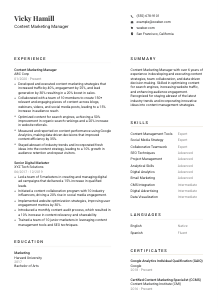
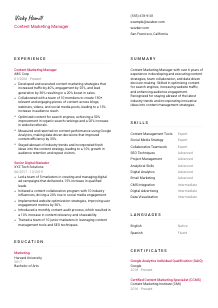
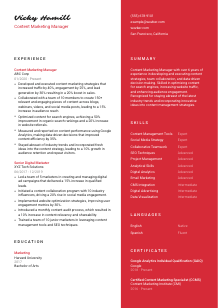
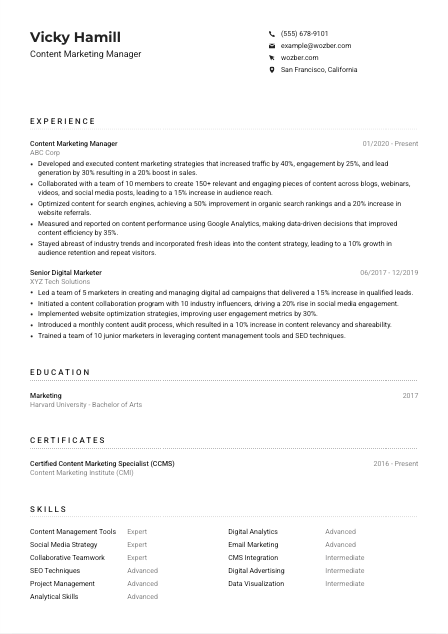
Crafting campaigns, but your CV is off-message? Check out this Content Marketing Manager CV example, created with Wozber free CV builder. It shows how easily you can shape your strategic storytelling to match job standards, keeping your career narrative on-brand and driving engagement!
Content marketing managers are hired to turn editorial work into business results. That usually means building a content engine that increases qualified traffic, lifts engagement, supports lead generation, and keeps messaging consistent across channels like blogs, webinars, video, email, and social. A CV for this work needs to show both strategic planning and day-to-day execution, not just a list of content tasks.
When your CV mirrors the language of the role, screening gets much easier on both the ATS and the hiring team reviewing performance-driven marketing experience. Wozber's free CV builder helps you shape that alignment into an ATS-compliant CV by matching your experience to priorities such as SEO, analytics, CMS work, and cross-functional content production, so the reader can quickly understand how you drive audience growth and pipeline impact.
This section does a simple but important job. It should identify you clearly, point to the role you want, and remove any friction for a hiring manager who may want to check your portfolio, website, or location right away.
Use your name as the main heading, then place "Content Marketing Manager" immediately below it. That title alignment matters in marketing hiring because it tells the reader, and the ATS, which lane you work in: strategy, editorial planning, SEO, channel performance, and content-led growth.
Include a professional email address, phone number, and any relevant professional link, such as LinkedIn or a portfolio site. For content roles, a clean website link can be especially useful if it showcases writing samples, campaign work, webinar programs, newsletter strategy, or a content hub you helped manage in WordPress, HubSpot, or a similar CMS.
If a role has a location requirement, reflect it in this section. In the example here, "San Francisco, California" supports a stated job requirement, so including it helps remove an early screening obstacle. For other applications, only add location detail that is relevant to the employer's stated setup.
A portfolio, personal site, or professional profile should add proof, not noise. Link to work that shows channel range and results, such as blog programs, landing page content, SEO wins, lead magnets, editorial calendars, or campaign reporting. If the site is outdated or thin, leave it off until it helps your case.
Skip information unrelated to your ability to do the work, such as marital status, age, or religion. For a content marketing role, the focus belongs on audience understanding, channel execution, analytics fluency, and the ability to collaborate with brand, product, sales, and design teams.
Your personal details should give hiring teams exactly what they need to contact you and place you in the right context for the role. If this section is clear, professional, and aligned to the posting, the reader can move straight to your marketing impact.




This is the section where content marketing CVs usually win or lose attention. Hiring teams want to see the channels you owned, the content programs you ran, the metrics you improved, and how closely your work connected to pipeline, sales support, retention, or audience growth.
Pull the core themes from the posting before you write or revise bullets. For a content marketing manager, that often includes content strategy, digital channels, SEO, lead generation, analytics, and collaboration across functions. Your experience section should mirror those priorities using language you can honestly support from your own work.
List roles in reverse chronological order and make each one easy to scan with title, employer, and dates. Then use bullets that establish scope quickly: what channels you managed, what team you worked with, what audience you served, and what business objective the content supported. In the example, the current role makes that context clear by tying strategy execution to traffic, engagement, leads, and sales outcomes.
Do not stop at "managed blog content" or "created social media posts." Show what changed because of your work. Strong content marketing bullets include metrics like organic traffic growth, lead conversion lift, webinar attendance, engagement rates, content production volume, SQL contribution, or repeat visitor growth. The sample CV does this well with results such as a 40% traffic increase, 30% lead generation growth, and a 20% sales boost.
Content marketing managers are often expected to work comfortably inside CMS platforms, SEO workflows, and reporting tools. If you have hands-on experience with WordPress, HubSpot, Google Analytics, search optimisation, editorial calendars, or keyword research platforms, include them where they naturally support the achievement. A bullet about improving organic rankings or reporting on performance becomes stronger when the tooling and method are visible.
Most content programs are collaborative. Mention partnerships with design, product marketing, demand generation, sales, customer success, or external contributors when those collaborations helped launch campaigns or scale production. The example's reference to producing 150+ content pieces with a 10-person team gives the reader a clear sense of coordination, output, and channel breadth.
A content marketing experience section should leave no doubt about what you owned and what your work delivered. If your bullets connect strategy, execution, channel mix, and measurable outcomes, hiring teams can quickly picture you running the next content program.
Education usually will not outweigh your campaign history in a mid-level or senior content marketing search, but it still matters when a posting sets a degree requirement. Keep this section direct, relevant, and easy to verify.
If the role asks for a bachelor's degree in Marketing, Communications, or a related field, make that easy to find. List your degree, school, field of study, and graduation year. In the example, a bachelor's degree in Marketing aligns cleanly with the employer's stated baseline.
Education should be one of the easiest sections to scan. Use a straightforward format with institution, degree, field, and date. That keeps the emphasis where it belongs and avoids distracting from stronger evidence elsewhere, like SEO wins, content strategy ownership, and reporting impact.
If your coursework, concentration, thesis, or major projects connect directly to digital marketing, editorial strategy, analytics, or communications, include that detail only if you are early in your career or it genuinely strengthens your case. For experienced content marketers, this section usually works best when it stays compact.
Honors, leadership roles, or standout extracurricular work can be useful if they reinforce communication, media, publishing, or marketing skills. Keep them if they add substance, such as leading a campus publication or running a digital campaign. Leave them out if they compete with more relevant professional results.
Specialised learning in analytics, SEO, content strategy, or marketing automation is valuable, but it usually reads better in a dedicated certificates section. Mention them here only if you have a combined education format or need to strengthen a thinner background.
For content marketing roles, education should quickly confirm that you meet the stated requirement and then get out of the way. The heavier proof still comes from campaigns, channel performance, and content outcomes.
Certifications can sharpen your profile when they point to real capability in SEO, analytics, content strategy, or platform knowledge. They are most useful when they support the kind of work the role actually requires.
A content marketing manager does not need a long list of badges. Pick certifications that support the work described in the posting, such as content strategy, Google Analytics, SEO, marketing automation, or platform-specific CMS expertise. In this example, content marketing and analytics certifications strengthen the digital focus of the role.
Two or three well-chosen certifications often do more than a crowded list. Hiring teams care more about whether the credential relates to channel performance, search visibility, reporting, or demand generation than how many courses you completed.
Digital marketing tools, search practices, and reporting standards change quickly. Add issue or renewal dates when they help show that your knowledge is current, especially for analytics, ad platforms, SEO, and automation tools.
Content marketing rewards people who keep up with changing search behaviour, distribution channels, audience trends, and measurement practices. A current certificate can reinforce that you are still building capability in areas that affect content performance, not just collecting credentials.
Relevant certifications add credibility when they echo the work already shown in your experience. They are strongest when they confirm practical strengths in content strategy, optimisation, and reporting.
The best skills sections for content marketers are specific enough to align with the job and compact enough to stay believable. Focus on capabilities that support planning, production, optimisation, distribution, and performance analysis.
Read the job description closely and group the requested capabilities into practical categories. Here, the obvious priorities are content management tools, SEO, analytics, project management, and strong communication in digital channels. That gives you a clear shortlist instead of a generic marketing inventory.
Include hard skills such as SEO, content strategy, CMS management, digital analytics, editorial planning, keyword research, and reporting. Then add role-relevant collaboration strengths like cross-functional teamwork, stakeholder management, or campaign coordination. The example strikes this balance by pairing technical tools and analysis with teamwork and project management.
Do not load this section with every marketing term you have touched once. Prioritise the skills you use to build and improve content programs, and make sure the rest of the CV backs them up with real examples. If you list SEO or analytics, your experience should show ranking improvements, traffic growth, reporting cadence, or optimisation decisions tied to those skills.
A useful skills section helps the reader see your operating range fast. When the listed skills match your experience in content planning, search optimisation, CMS work, and reporting, the section strengthens your credibility instead of feeling decorative.
Language fluency matters in content marketing because tone, clarity, audience nuance, and brand consistency all depend on it. This section is especially useful when the role explicitly names a working language or when multilingual ability supports audience growth.
If the posting states that you must operate effectively in English, list English clearly with an accurate proficiency level. For a content marketing manager, this is not a minor detail. It affects writing quality, editing judgment, stakeholder communication, and campaign execution across channels.
Additional languages can strengthen your profile when they support regional campaigns, multilingual content, localization work, or broader audience research. Spanish, for example, may be relevant in some markets if your work touches bilingual audiences or international growth.
Use clear levels such as Native, Fluent, Intermediate, or Basic. Avoid vague labels. In a role that often includes messaging, editorial review, webinars, and cross-team communication, exaggerated fluency claims are easy to expose.
If multilingual experience has helped you adapt messaging, localize content, or collaborate across regions, let that context appear elsewhere in the CV. The language section itself should stay brief, but it can support a broader story about audience awareness and market adaptability.
Even when English is the primary requirement, another language can still be a practical advantage for audience research, community engagement, partnership content, or expansion efforts. Include it when it supports the kind of content work you actually do.
For content marketing roles, language proficiency should be simple, accurate, and relevant. It should help the employer understand how well you can write, collaborate, and communicate with the audiences the business serves.
A content marketing summary should read like a concise positioning statement. In a few lines, it needs to tell the employer what level you operate at, which parts of the content engine you handle, and what kind of commercial or audience outcomes usually follow your work.
Start with a direct line that establishes seniority and specialization, such as a Content Marketing Manager with 5+ years in digital content strategy, SEO, and performance marketing. The sample summary does this effectively by framing both experience level and functional focus right away.
Use the next sentence to anchor the summary in the role's main requirements. For this kind of posting, that means content strategy, search optimisation, digital channels, analytics, and collaboration across teams to create blogs, webinars, videos, and social content. Choose the themes that are central to your own background, not every possible keyword.
A short summary becomes more credible when it includes proof. Mention a representative result such as growing traffic, improving organic rankings, increasing engagement, or lifting lead generation. You do not need a full metric stack here. One or two business outcomes are enough to set the tone for the rest of the CV.
Aim for three to five lines with no filler. Avoid broad claims like "results-driven professional" unless you immediately show what results you delivered. In content marketing, specificity wins: strategy execution, audience growth, SEO performance, content production leadership, and data-informed optimisation all say more than generic marketing language.
A well-written summary should make it obvious that you can plan content, run distribution across digital channels, and measure what the work contributes. When those points are clear up front, the rest of the CV has a much easier job.
A strong Content Marketing Manager CV should connect content strategy to outcomes the business cares about: traffic, engagement, leads, search visibility, and retention. Each section should help the reader understand your channel mix, your tools, your collaboration style, and the metrics you moved.
Use Wozber's free CV builder to organise that story in an ATS-friendly CV format, then refine the wording with its ATS CV scanner so your experience lines up naturally with the role's SEO, CMS, analytics, and digital content requirements. The final result should make your ability to run high-performing content programs easy to judge.