



Use Wozber and land your dream job
Create CV
No registration required
Crafting narratives, but your CV reads like a draft? Check out this Blog Writer CV example, created with Wozber free CV builder. Learn how to align your online chronicles with job expectations, putting your literary talent centre stage for career success!
Blog writing gets hired on published work that performs, not on vague claims about being creative. A CV for this field needs to show that you can research unfamiliar topics, shape them into readable articles, adapt to a brand voice, and produce content that supports traffic, engagement, or lead goals. Hiring teams want to see how you work as a writer and what your content actually moved.
When your CV mirrors the language of the posting, the first read becomes much clearer. Wozber's free CV builder helps you shape an ATS-compliant CV around the keywords, CMS terms, SEO language, and editorial priorities that matter for blog writing, so your background is read in the context of search performance and content production rather than as generic writing experience.
For a Blog Writer, the header should read like the byline area of a polished article: clear, professional, and easy to trust. Keep it simple, accurate, and aligned with any practical requirement named in the posting.
Place your name at the top in a slightly larger font so it stands out immediately. In a writing role, presentation matters, and a clean header sets the tone before anyone reaches your clips, SEO wins, or editorial experience.
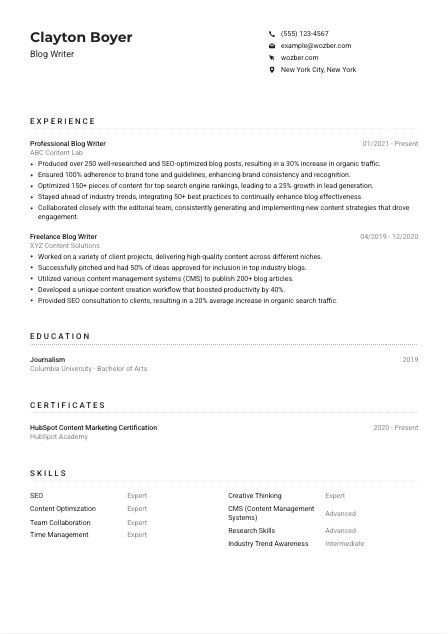
Add "Blog Writer" directly under your name when that is the title you are applying for. This helps position your background around blog content, SEO writing, and editorial collaboration instead of leaving room for broader labels like "Content Specialist" or "Freelance Writer" unless the posting uses those terms instead.
Include a phone number and a professional email address, and double-check both. If an editor or marketing lead wants to move quickly after reviewing your portfolio or traffic results, broken contact details create unnecessary friction.
Some blog writing roles are remote, while others want someone based near the team. Here, the employer asks for New York City, New York, so listing that location directly in your header helps confirm a logistical requirement without taking space from stronger content-related details.
If you have a portfolio, personal site, Muck Rack profile, or strong LinkedIn page with published work, include it. For writers, a live body of work often answers questions faster than a CV can, especially when it shows topic range, brand voice, and SEO-focused articles.
This section should confirm the basics quickly: who you are, what writing role you are pursuing, how to reach you, and whether you meet any stated location requirement. Then the reader can move straight to your content results and editorial background.




This is the section hiring teams read most closely for blog writing roles. They are looking for proof that you can produce researched articles consistently, work within editorial standards, and create content that contributes to search visibility, audience growth, or lead generation.
Start with every writing-related role you have held, then narrow the list to the work that best matches blog production. Prioritise positions involving article writing, topic research, SEO optimisation, CMS publishing, editorial calendars, and collaboration with marketing or content teams. If you have broader writing experience, keep the pieces that show transferable blog skills rather than every assignment you have ever completed.
Put your latest blog or content writing work first. For this profession, current experience often says the most about your familiarity with search updates, content workflows, publishing platforms, and modern brand style guides. Recent roles also make it easier to show whether you are writing at the pace and quality level the employer needs.
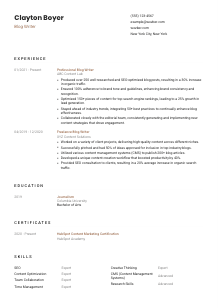
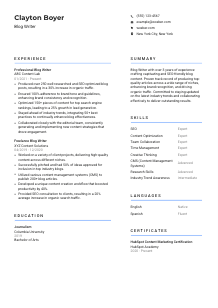
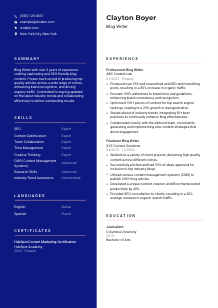
Each bullet should show what you produced and what changed because of it. Replace broad lines like "wrote blog posts" with statements about researched articles published, niches covered, editorial standards maintained, content strategies supported, or leads generated. The sample CV does this well by tying blog production to organic traffic growth, brand consistency, and new content strategy execution.
Metrics carry real weight in blog writing when they match how content is measured. Useful numbers include articles published, percentage growth in organic traffic, ranking improvements, lead generation gains, productivity improvements, pitch acceptance rates, or volume of optimised legacy content. For example, "Produced over 250 well-researched and SEO-optimised blog posts" says far more than simply calling yourself prolific.
Choose examples that speak directly to the employer's priorities. For this role, that means research depth, SEO execution, concise writing, CMS use, and collaboration with editorial and marketing teams. A freelance background can work well here if you frame it around deliverables, publishing volume, client niches, and measurable search results rather than around independence alone.
A strong experience section for a Blog Writer makes your output visible and your impact measurable. By the end of it, the reader should understand what you wrote, how you worked, and how your content performed in search, engagement, or lead terms.
Education is usually a supporting section in blog writing, but it still matters when a posting names a degree requirement. Keep it straightforward and make it easy to see that you meet the academic background the employer asked for.
Check the posting for the exact education baseline before editing this section. Here, the employer requests a bachelor's degree in English, Communications, Journalism, or a related field, so a directly relevant degree should be listed clearly and without extra clutter.
List your degree, field of study, school, and graduation year or date in a consistent format. Blog writing roles rarely require a long academic narrative. What matters is that the information is easy to scan and supports the requirements cleanly.
If your degree is in Journalism, English, Communications, or a similar discipline, make sure that field is visible at a glance. In the example CV, "Bachelor of Arts" paired with "Journalism" immediately aligns with the employer's request and supports the candidate's editorial foundation.
Most experienced blog writers do not need to list classes, but recent graduates can add a few relevant ones if they support the role. Prioritise subjects like reporting, feature writing, digital media, content strategy, or research methods, especially when professional experience is still growing.
Awards, student publications, or editorial roles can help if they relate to writing, audience development, or content production. Include them when they add substance, not just filler. If your strongest proof already sits in your work history, let education stay concise.
For most Blog Writer CVs, education confirms the academic baseline and then steps aside for stronger proof from published work and SEO results. Clear formatting is enough, especially when your degree already aligns with the posting.
Certifications are especially useful in blog writing when they reinforce skills that affect performance, such as SEO, content marketing, analytics, or platform fluency. They are rarely the main hiring factor, but they can sharpen your positioning.
Review the posting and pick certifications that support the actual responsibilities. For a Blog Writer, that usually means SEO, content marketing, inbound strategy, analytics, or digital publishing rather than generic professional development badges.
Include certifications that connect clearly to blog creation and performance. The sample CV's HubSpot Content Marketing Certification works because it supports content planning, audience targeting, and lead-focused writing, all of which relate naturally to blog work tied to search and conversion goals.
Search algorithms, content standards, and publishing practices change quickly, so dates matter here. Showing when you earned or renewed a certification helps signal that your SEO and content knowledge is current rather than outdated.
Writers who stay current often produce stronger content because they track changes in search intent, SERP features, content refresh practices, and editorial trends. If you regularly update your training in SEO or content marketing, your certifications can reinforce that habit of keeping your work current and effective.
A relevant certification section adds another layer to your CV by backing up the strategy side of your writing. It is especially helpful when it confirms you understand how blog content supports traffic, brand goals, and lead generation.
A Blog Writer's skills section should look like a working toolkit, not a catchall list. Focus on the abilities that shape content quality, search performance, publishing workflow, and collaboration with editors or marketers.
Start with the required and preferred skills in the job description, then select the ones you truly use in your work. For this role, that includes SEO, research, content optimisation, blogging platforms or CMS tools, and collaboration with editorial and marketing teams. Matching the employer's language helps both ATS parsing and human review.
Lead with the capabilities most central to blog performance. SEO, content optimisation, research, CMS proficiency, and brand-tone writing usually deserve priority over broader traits. Soft skills still matter, but they should support the craft rather than overshadow the technical and editorial side of the role.
Arrange skills so the first few lines reinforce the strongest case for the job. In the example CV, SEO and content optimisation appear before broader skills like creative thinking, which makes sense for a position focused on search-friendly content and lead generation. Keep the section tight and targeted rather than trying to cover every ability you have.
Your skills section should quickly confirm that you know how to research, write, optimise, publish, and collaborate in a real content environment. If those abilities are easy to spot, the rest of the CV reads with more credibility.
Language skills are not mandatory for every Blog Writer role, but they can be useful when a company serves multilingual audiences, covers international topics, or values broader communication range. Include them when they add something real to your profile.
Look at the brand, audience, and subject matter before deciding how much emphasis to give this section. If the employer publishes for diverse markets or wants writers who can research and communicate across language contexts, multilingual ability becomes more relevant than it would in a narrow single-audience role.
Order languages based on actual usefulness for the position. For most U.S.-based blog writing jobs, English will lead because it is the core writing language. Additional languages should follow in a sequence that reflects audience value, not personal preference.
Write your level plainly, such as Native, Fluent, Intermediate, or Basic. Blog writing depends on precision, so avoid vague descriptions. If you can conduct interviews, review sources, or adapt messaging in another language, your proficiency label should make that credible.
This section works best when it expands your editorial usefulness. Spanish, for example, may support research across sources, broader audience understanding, or bilingual content environments. If a language does not meaningfully relate to your writing work, it does not need a prominent place.
For some employers, language range can support localization, trend research, audience insight, or content repurposing across markets. That benefit is worth noting, but keep it grounded. Treat languages as an added editorial asset, not a decorative extra.
If this section stays on the CV, it should clarify how you can reach, research, or understand more of the audience the company serves. That is the kind of detail that can separate one writer from another.
The summary should give a quick, credible read on the kind of writer you are. In a few lines, it needs to connect your experience, subject-matter range, SEO strength, and measurable outcomes without repeating your bullets word for word.
Start with a direct description of your professional identity and years of experience. A line such as "Blog Writer with 3+ years of experience creating SEO-focused content across multiple niches" gives immediate context and anchors the rest of the summary in the work you actually do.
Use the next sentence to connect your strongest qualifications to the job's priorities. For this opening, that means research, concise writing, SEO optimisation, brand tone consistency, CMS familiarity, and collaboration with editorial or marketing teams. Keep the wording natural, but stay close to the employer's language where it reflects your real background.
A summary becomes much more convincing when it includes a measurable outcome. The example CV uses strong material for this, including traffic growth, lead generation gains, and large-volume blog production. Pick one or two metrics that best represent your value instead of stacking too many achievements into a small space.
Aim for three to five lines with no filler. Avoid generic claims about passion, creativity, or hard work unless they are tied to something concrete. By the end of the summary, the reader should already understand your writing niche, your SEO competence, and the kind of business results your content supports.
When the summary is done well, it gives hiring teams a fast read on your level, your strengths, and your track record with blog content. That opening snapshot should make the rest of your CV feel consistent and worth a closer look.
A Blog Writer CV should now show much more than writing ability. It should show how you research topics, work inside a CMS, optimise for search, follow brand standards, and produce content that drives traffic or leads.
Use Wozber's ATS CV scanner and AI CV builder to tighten role-specific wording, improve ATS optimisation, and present your experience in an ATS-friendly CV format that reflects how blog writing roles are actually reviewed. The final read should make your editorial value and SEO impact easy to recognize.




