



Use Wozber and land your dream job
Create CV
No registration required
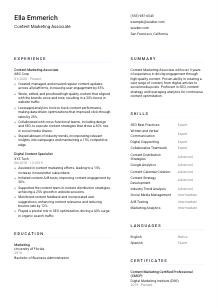
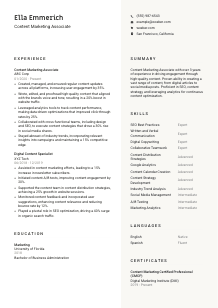
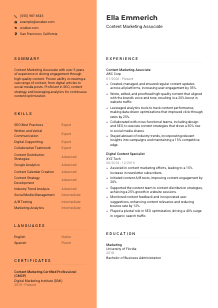
Crafting narratives and strategies, but your CV feels like a rough draft? Sharpen your storytelling with this Content Marketing Associate CV example, created with Wozber free CV builder. Learn how to present your content creativity in a way that draws in both readers and recruiters, making your career journey as compelling as the campaigns you helm!
Content marketing work gets judged quickly by what it produces. Hiring teams want to see that you can plan a steady publishing rhythm, write in a consistent brand voice, and improve performance once the numbers come in. A CV for a Content Marketing Associate needs to make that operating range visible, from editorial planning to SEO-informed execution.
For this kind of role, tailoring changes how fast a reader understands whether you create content that performs across channels rather than simply writing well. Using Wozber's free CV builder and an ATS-friendly CV format helps you align your language with the posting, surface terms like content calendar, SEO, analytics, and cross-functional collaboration, and make your track record easier to read as practical marketing contribution.
The top of the CV should establish that you are easy to contact and already aligned with the basics of the opening. For content marketing roles, that also means showing a professional online presence and removing small credibility issues before the hiring team even reaches your experience section.
Your name should be the clearest element on the page, just as a byline is easy to spot on published content. Use clean formatting and keep it professional. In a marketing CV, visual clutter at the top can undercut the polished communication standards the role expects.
Place "Content Marketing Associate" directly under your name when that is the role you are pursuing. This immediately frames your background around content production, distribution, and optimisation instead of leaving the reader to guess whether you are aiming at a broader marketing, social media, or copywriting path.
Add a reliable phone number, a professional email address, and if relevant, a LinkedIn profile or portfolio link. Since content work is often reviewed through writing samples, campaign pages, blogs, or published assets, a portfolio can strengthen your case far more than a decorative personal detail ever could.
If an employer asks for a specific location, list it clearly. In the example here, San Francisco, California matters because the posting names San Francisco, CA as a requirement. Handle this as a tailoring move for that opening, not as a rule for every content marketing application.
A content marketing CV gets stronger when it connects claims to actual output. Link to a site, portfolio, Medium profile, campaign archive, or selected writing samples that show range across blog posts, landing pages, email, or social content. Keep the link current and make sure the work reflects the brand quality you describe elsewhere in the CV.
This header area should confirm three things immediately: who you are, which role you are targeting, and how to reach or review you. For content marketing, a portfolio link and any location requirement can do real screening work right here.




This section carries most of the hiring weight. Content marketing teams want more than proof that you wrote copy. They want to see planning, channel awareness, SEO understanding, collaboration with design or search teams, and measurable results such as traffic, engagement, click-through rate, subscriber growth, or social reach.
Before writing bullets, identify the operating priorities in the posting. Here, those priorities include managing a content calendar, creating and editing content, using analytics, collaborating across teams, and staying current on SEO and social trends. Build your experience section around those same workstreams so the match is obvious without sounding copied.
List each job with title, company, and dates in reverse chronological order. For content marketing candidates, title progression matters because it helps show whether your work moved from support tasks into ownership of campaigns, editorial planning, distribution, or performance optimisation.
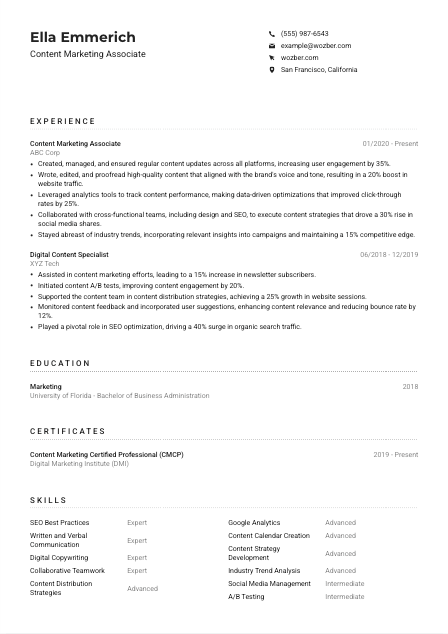
Write bullets that start with action and end with business effect. The example CV does this well with lines such as increasing user engagement by 35%, boosting website traffic by 20%, and improving click-through rates by 25% through analytics-driven changes. That kind of phrasing shows both the work performed and what changed because of it.
Choose accomplishments that relate directly to publishing, messaging, audience growth, SEO, conversion, or channel performance. If a bullet does not help explain how you plan, produce, distribute, or optimise content, it probably belongs in a different version of your CV. Content teams scan for relevance fast.
Content outcomes rarely happen in isolation, so mention the mechanics when they matter. Refer to SEO work, analytics platforms, A/B testing, editorial calendars, social distribution, or collaboration with design and SEO partners. In the sample, the strongest bullets do not stop at "wrote content". They connect execution to analytics, optimisation, and cross-functional delivery.
By the end of this section, a reader should be able to tell what kind of content you owned, how you helped it perform, and which channels or workflows you can handle right away. That is the difference between a generic marketing CV and one that reads as ready for content marketing work.
Education matters here mainly as qualification context. Most Content Marketing Associate openings ask for a bachelor's degree in marketing, communications, journalism, or a related field, so your job is to show that foundation clearly and avoid making the section harder to scan than it needs to be.
List your bachelor's degree in a way that closely matches the posting when it genuinely does. In this example, a Bachelor of Business Administration in Marketing aligns well with the employer's request for a marketing, communications, journalism, or related background. Clear alignment is enough. No extra framing is needed.
Include degree, school, field of study, and graduation year or date. Hiring teams rarely need more than that unless you are early in your career. Straightforward formatting helps them confirm the qualification quickly and move back to the experience and portfolio evidence that usually matter more for this profession.
Not every strong content marketer studied marketing or journalism. If your degree is in an adjacent discipline such as English, business, media studies, or public relations, keep the education entry factual and use your summary or experience bullets to show how that background translated into content strategy, writing, or audience engagement work.
If you are early in your career, selected coursework in SEO, digital marketing, brand communication, or analytics can add useful context. Once your professional work is stronger, keep the focus on results and use certifications for newer specialty training instead of expanding the education section too much.
Student media, campaign projects, editorial work, or audience-growth assignments can be worth listing if they resemble the work of the target role. A blog strategy project, publication leadership role, or campaign analysis can help bridge limited experience, especially for candidates near the two-year threshold.
Education should answer the qualification requirement quickly, then step out of the way. In content marketing hiring, it supports your profile best when it is clear, relevant, and proportionate to your professional experience.
Certifications are useful in content marketing when they show current knowledge in areas that change quickly, especially SEO, analytics, content strategy, and platform-specific practice. They are rarely the deciding factor on their own, but they can reinforce that your methods are current and intentional.
Start with credentials that support the responsibilities named in the posting. If the role emphasizes SEO, analytics, content production, or distribution strategy, those are the certifications worth showing first. A content marketing credential makes more sense here than a broad business course with no direct connection to audience growth or digital publishing.
A short, relevant list works better than a long catalogue of online courses. Focus on certifications that back up your writing, optimisation, and channel strategy experience. In the example, the Content Marketing Certified Professional credential supports the candidate's positioning without crowding the section.
Include the year earned and, if relevant, the active date range. In fields shaped by algorithm shifts, changing search behaviour, and evolving distribution tactics, a recent certification can reassure employers that your knowledge is not stuck in an older playbook.
Content marketing changes fast, so ongoing learning carries weight when it connects to the role. A well-chosen certification can support your case if you are building deeper SEO skills, learning analytics tools, or formalizing editorial strategy experience that your job titles alone do not fully communicate.
This section works best when it reinforces current digital marketing knowledge and supports the claims in your experience section. Keep it relevant to content performance, search visibility, analytics, or editorial execution.
A Content Marketing Associate needs a mix of production skills, optimisation skills, and collaboration skills. Your skills section should reflect the actual mechanics of the role, from SEO and copywriting to analytics, content planning, and working with design or search partners.
Use the job description to identify the terms the employer already uses for the work. In this case, SEO best practices, content distribution strategies, written and verbal communication, analytics tools, and cross-functional collaboration are all worth mirroring if they match your background. This improves both ATS optimisation and human readability.
Lead with the skills most central to day-to-day content work, such as SEO, digital copywriting, content calendar management, content strategy, analytics, and editing. Then include supporting skills such as teamwork, social media management, or A/B testing. That ordering helps the section read like a content operator's toolkit rather than a random inventory.
Only include skills you can support in your experience, portfolio, or summary. The sample CV works because skills like Google Analytics, content calendar creation, and SEO best practices are echoed by measurable bullets in the experience section. That consistency matters more than listing every platform you have touched.
A recruiter should be able to scan this section and understand how you contribute to content output and content performance. Keep it tight, relevant, and closely connected to the work you have already shown.
Language matters more in content marketing than in many adjacent marketing jobs because the work often depends on tone, clarity, editing judgment, and audience nuance. If the posting names a language requirement, treat it as a core qualification rather than an optional detail.
If professional English is required, list English clearly and accurately. For a Content Marketing Associate, this is not just about conversation. It often means writing polished copy, editing for tone and grammar, and communicating with stakeholders across marketing, design, and SEO functions.
After the required language, include any others that could broaden your value in content distribution, localization support, community engagement, or multilingual campaigns. In some companies this is a bonus rather than a requirement, but it can still strengthen your profile when the brand serves varied audiences.
Choose clear levels such as Native, Fluent, Intermediate, or Basic. Content roles depend on precision, so overstating language ability can create problems quickly if the job includes editing, stakeholder communication, or audience-facing writing in that language.
If an additional language has supported your work, that context can be valuable. For example, multilingual social media support, translated campaign adaptation, or audience research across markets can make the language section feel more tied to business value than a simple list of proficiencies.
If you are actively improving a language that could matter for market expansion or audience communication, include it only when it is real and relevant. Keep the emphasis on the level you can currently use in professional settings, especially for content review or written communication.
For content marketing, language skills help define writing range and communication reach. At minimum, this section should remove any doubt about your ability to work in the role's required language.
The summary is where you establish your angle before the reader gets into the details. For this role, that usually means combining years of experience with the kind of content work you handle well and the outcomes you influence, such as engagement, traffic, organic growth, or content performance across channels.
Read the posting closely and identify the two or three themes that define the job. Here, those themes are consistent content production, SEO awareness, performance tracking, and collaboration across teams. Use those priorities to decide what belongs in your opening lines.
Start with a direct description of who you are professionally. A line such as "Content Marketing Associate with 3+ years of experience creating and optimising digital content" gives immediate context and places you in the right lane from the first sentence.
Bring in measurable proof or distinctive strengths. The example summary mentions engagement, SEO, content strategy, and analytics-driven optimisation, which matches the experience bullets well. If you have metrics tied to traffic, subscriber growth, click-through rate, or organic search, use them selectively to add weight.
Aim for a compact summary of about three sentences. Avoid soft claims that could apply to any marketer. A hiring team should come away knowing what kind of content work you do, how you improve results, and which strengths they are about to see supported in the CV.
A well-written summary gives the reader an accurate headline for the rest of the CV: your level, your content strengths, and the results you tend to drive. For this profession, clarity around channels, SEO, analytics, and performance matters from the first lines.
A Content Marketing Associate CV works best when it shows how you plan, write, distribute, and improve content with measurable results. Keep the language close to the posting, use metrics that reflect real audience or channel performance, and make sure each section supports the same story.
Wozber's AI CV builder can help you tighten that story with stronger tailoring, cleaner ATS optimisation, and an ATS-compliant CV that reflects the role's actual priorities. The finished document should make it easy to judge whether you can step into the content calendar, uphold brand voice, and improve performance from day one.




