



Use Wozber and land your dream job
Create CV
No registration required
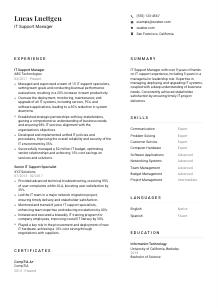
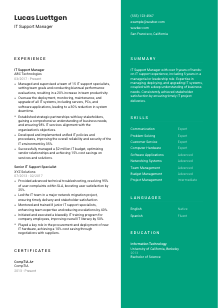
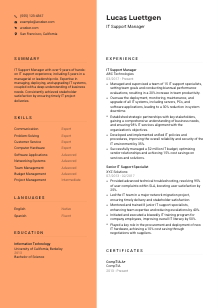
Leading tech squads, but your CV feels like a bug in the system? Check out this IT Support Manager CV example, created with Wozber free CV builder. Learn how to present your managerial strengths to match job specs, putting your career growth on a fast and stable track!
IT Support Managers are hired to keep business operations running when systems fail, users escalate, or infrastructure changes introduce risk. A CV for this role needs to show more than general troubleshooting ability. It should make your leadership visible through service reliability, team oversight, policy ownership, stakeholder support, and the way you steady day-to-day IT operations.
When your CV mirrors the language of the job description, the hiring team can quickly separate hands-on support experience from actual management scope. Wozber's free CV builder helps you shape that story into an ATS-compliant CV, so terms like IT systems, vendor management, security procedures, and support leadership are easy to read and easy to connect to the work you have already done.
For IT Support Manager roles, the top of the CV should remove basic questions immediately. Hiring teams should see your target role, how to reach you, and whether you meet practical requirements such as location without digging through the page.
Place your name prominently at the top in a clean, readable format. IT leadership CVs are often reviewed quickly alongside other operations and infrastructure candidates, so clarity matters more than styling tricks.
Put "IT Support Manager" directly under your name when that is the role you are pursuing. Matching the job title helps frame the rest of your CV around support leadership, service delivery, and team ownership instead of leaving readers to guess whether you are applying as a specialist, administrator, or manager.
Include a reliable phone number and a professional email address, ideally in a simple format such as firstname.lastname@email.com. Double-check every detail. If a hiring manager wants to discuss your experience leading support teams or handling infrastructure upgrades, your contact information should never be the reason that conversation stalls.
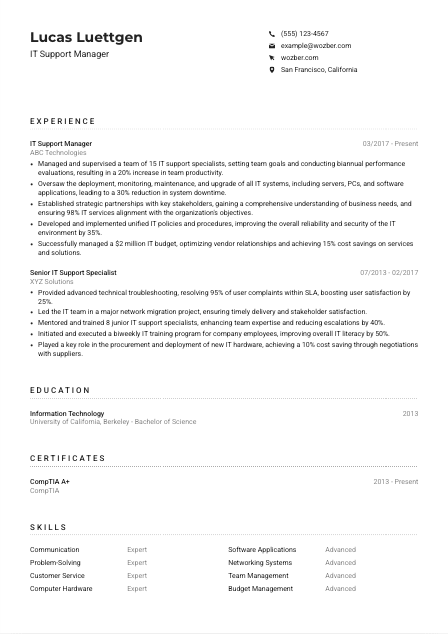
If the job requires you to be based in a specific city, include that clearly. In the example, listing "San Francisco, California" directly supports a stated location requirement. Use this only when it is relevant to the posting, not as a universal rule for every IT Support Manager CV.
A LinkedIn profile or professional website can support your CV if it is current and consistent with it. For IT support leadership, that profile should reinforce the same career progression, management scope, and technical environment shown on the CV, not introduce conflicting dates or titles.
This section should confirm the basics fast: who you are, what role you are targeting, and how easily the employer can move you forward. For an IT Support Manager, that clean start supports the rest of the CV.




This section carries the most weight for an IT Support Manager. Hiring teams want to see how you led support delivery, improved uptime, managed people, handled projects, and kept IT services aligned with business needs.
Read the posting like an operations brief. Mark the responsibilities that define the role, such as leading support staff, maintaining systems, managing projects, aligning with stakeholders, improving security and reliability, and controlling budgets or vendors. Those are the themes your experience bullets should reflect.
List your most recent position first with job title, employer, and dates. That structure helps reviewers quickly track your move from hands-on support work into leadership. In the example, the progression from Senior IT Support Specialist to IT Support Manager immediately shows increased scope and responsibility.
Each bullet should show what you managed, what changed, and why it mattered. For this profession, strong outcomes include reduced downtime, faster ticket resolution, stronger SLA performance, higher user satisfaction, lower escalation volume, smoother rollouts, or better service alignment. The example does this well by tying team supervision to a 20% productivity increase and system oversight to a 30% drop in downtime.
Metrics carry weight when they reflect how support organizations are actually judged. Use figures tied to team size, budget, ticket resolution, uptime, project delivery, cost savings, compliance improvement, or stakeholder satisfaction. A bullet about managing a $2 million IT budget or resolving 95% of user issues within SLA tells a much clearer story than "responsible for IT operations."
Prioritise experience that shows leadership, technical oversight, and service management. If an older role is less relevant, keep it brief unless it explains a core strength such as infrastructure support, user support escalation, or vendor coordination. The page should stay focused on why you can lead an IT support function now.
Your experience should leave no doubt about the size of the team, systems, projects, and business impact you have handled. For this role, leadership is strongest when it is backed by operational results.
Education is usually a supporting section for experienced IT Support Managers, but it still matters when the posting calls for a specific degree. Keep it direct and make it easy to confirm that you meet the academic requirement.
Start with the educational requirement in the job description. Here, the employer asks for a bachelor's degree in Information Technology or a related field. If you have that match, make it explicit instead of assuming the reader will infer it from an abbreviated entry.
List your degree, field of study, school, and graduation year. This is not the place for long explanations. Hiring teams reviewing support managers usually want to confirm the credential quickly and return to your leadership and technical record.
If your degree directly matches the posting, say so clearly. The example's "Bachelor of Science" in "Information Technology" aligns neatly with the stated requirement and removes ambiguity during screening.
Relevant coursework, capstone projects, or academic honors can help if you are earlier in your career or changing into management from a technical track. For a candidate with years of support leadership, these details are usually secondary to experience unless they connect directly to infrastructure, networking, systems administration, or security.
Include notable projects or related training only if they add something your work history does not already cover. A systems deployment project or network administration concentration can be worth mentioning when it supports the technical breadth expected of an IT Support Manager.
This section does not need to do heavy persuasion. It needs to show that you meet the educational baseline and support the technical foundation behind your support leadership experience.
Certifications are not always mandatory for IT Support Manager roles, but they can strengthen your case by showing current technical grounding and ongoing professional development. That matters when you are leading teams across hardware, software, networks, and support processes.
Some employers ask for certifications outright, while others leave them optional. If none are required, choose the ones that best support the role's technical scope. For IT support leadership, that often means credentials tied to endpoint support, systems, networking, service management, or security.
Order certifications by relevance, not by age. A support-focused certification such as CompTIA A+ can still be useful when it reinforces your technical foundation, especially if your experience already shows management responsibility on top of that base.
List issue dates and, if relevant, renewal or active status. In IT, current knowledge matters because platforms, security expectations, and support environments change quickly. Dates help hiring teams understand whether a certification reflects recent capability or older training.
Use this section to show that your technical knowledge has kept pace with your management path. As you move deeper into leadership, recent certifications or training can reassure employers that you still understand the systems, tools, and risks your team handles every day.
For an IT Support Manager, certifications work best when they reinforce both credibility and currency. They should support the technical side of your leadership profile, not sit on the page as unrelated extras.
The skills section should present the mix of technical depth and management ability the role actually requires. For IT Support Manager positions, that means balancing systems knowledge with people leadership, service quality, and operational control.
Start with the skills the employer already values, then add adjacent capabilities you genuinely use. In this posting, that includes computer hardware, software, networking systems, project management, communication, problem-solving, customer service, and team leadership. Those terms belong in your CV if they reflect real experience.
Do not separate yourself into either a technical candidate or a people manager if the role expects both. Include support-relevant hard skills such as networking systems and software applications alongside team management, stakeholder communication, vendor management, and budget oversight when those are part of your work.
Avoid turning this section into a long inventory of every tool or trait you have ever used. Choose the skills that support the target role most clearly. In the example, skills such as Communication, Problem-Solving, Computer Hardware, Networking Systems, Team Management, and Budget Management work because they map directly to the job's responsibilities.
A hiring team should be able to scan this section and see the operating mix the job requires: technical support knowledge, leadership ability, and the judgment to keep IT service reliable.
Language ability matters in IT support because much of the work depends on clear communication with users, executives, vendors, and technical staff. List languages in a way that reflects actual workplace value, not just personal background.
If the posting specifies language ability, address it directly. Here, strong English communication is part of the requirement, so English should appear clearly with an honest proficiency level.
Lead with English when it is required for stakeholder communication, documentation, support updates, and team management. That simple ordering helps the hiring team confirm a key expectation at a glance.
Additional languages can be valuable in companies with multilingual users, regional offices, or diverse support teams. In the example, Spanish adds practical communication range, but whether that matters depends on the employer's environment.
Use levels that reflect how you actually communicate on the job. If you can lead meetings, write documentation, and handle escalations in a language, say so with confidence. If not, avoid overstating it. Language claims are easy to test during interviews.
If the position involves cross-functional coordination, user training, or global support coverage, language range can strengthen your profile. For many IT Support Manager roles, though, the key point is still strong professional English for incident communication and stakeholder updates.
This section should support how you communicate in the workplace. For IT Support Manager roles, clear English often matters most, with additional languages adding value where the user base or team structure calls for them.
Your summary sits at the top of the CV and shapes how the rest of the page is read. For an IT Support Manager, it should quickly establish your years of experience, leadership level, technical environment, and the business outcomes you are trusted to deliver.
Before writing the summary, identify the few themes that define the role. In this case, they are support leadership, technical breadth across systems and networks, project delivery, stakeholder alignment, and strong communication. Build around those, rather than trying to summarise your entire career.
Start with your professional identity and the amount of experience that matters to the role. A line like the example's "IT Support Manager with over 9 years of hands-on IT support experience, including 5 years in a managerial or leadership role" works because it answers a core screening question immediately.
Add two or three strengths that match the opening closely, such as leading support teams, overseeing system deployments and upgrades, improving service reliability, or partnering with business stakeholders. Keep the language grounded in work you have actually done.
Aim for a short paragraph that reads cleanly in a first pass. Four focused lines are usually enough. The summary should prepare the reader for the details in your experience section, not repeat every bullet or drift into vague claims about being results-driven.
A well-written summary should make the rest of the CV easier to interpret. For this role, that means showing early that you can lead support teams, manage technical operations, and keep IT services aligned with business needs.
An effective IT Support Manager CV shows how you run support, not just how well you solve tickets. Team leadership, service reliability, systems oversight, stakeholder coordination, and cost control should all be easy to spot in your experience and summary.
Use Wozber's free CV builder to tighten the structure, strengthen ATS optimisation, and align your wording with the role. With an ATS-friendly CV format and focused tailoring, your CV should make it easy to judge whether you can lead the support function from day one.




