



Use Wozber and land your dream job
Create CV
No registration required
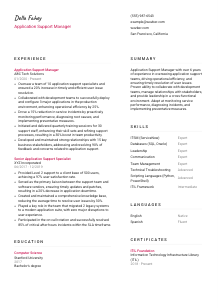
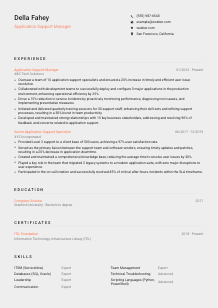
Juggling apps, but your CV feels buggy? Check out this Application Support Manager CV example, created with Wozber free CV builder. It shows how to clearly present your support strategies to match job demands, keeping your career as stable as the software you manage!
Application Support Manager hiring usually turns on one practical question fast: can you keep production systems stable while leading a team through incidents, escalations, and recurring service issues. CVs for this role need to make that operational control visible through team oversight, incident management, root-cause work, stakeholder communication, and measurable service results.
When those details are tailored to the target role, your CV reads less like a general IT profile and more like a production support leader who can run a dependable support function. Wozber's free CV builder helps structure that story in an ATS-friendly CV format, so tools and hiring teams can quickly connect your background to service performance, application reliability, and support leadership.
This section is brief, but it still carries practical hiring information. For an Application Support Manager, the header should immediately confirm who you are, what role you target, and whether basic logistics like location and contact access line up with the opening.
Use your full name as the most visible text in the header. Keep the formatting clean and professional so the CV starts with clarity, not decoration. For a leadership role in IT operations, simple presentation works better than visual styling tricks.
Place "Application Support Manager" directly under your name if that is the role you are pursuing. This helps position you correctly from the first line, especially when employers are sorting between support managers, production support leads, and broader IT operations candidates.
Add a phone number you answer and a professional email address you check regularly. This sounds basic, but missed callbacks and typos still cost candidates interviews. For support leadership roles that depend on responsiveness and clear communication, even your contact section should reflect attention to detail.
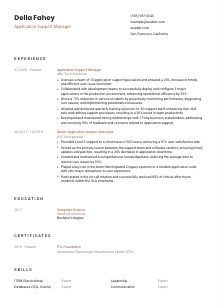
If the posting requires candidates to be in a specific place, show that clearly in your personal details. Here, "San Francisco, California" is worth listing because the job asks for local availability. Treat location as a tailoring point tied to the opening, not something every Application Support Manager CV must emphasize.
Include a LinkedIn profile or professional website only if it reinforces your application. A strong profile can support your CV with additional context on systems, environments, team leadership, or major production support projects. Make sure the information matches your CV closely.
Your contact section should confirm the basics without friction. Hiring teams should be able to see your target role, reach you quickly, and understand any location requirement right away.




For Application Support Manager roles, experience carries most of the decision weight. Hiring teams want to see how you handled production support, how you led people through incidents and service issues, and whether your work improved uptime, response speed, user satisfaction, or support efficiency.
Read the job description for the work patterns behind the keywords. In this case, the important threads are team oversight, incident resolution, production application support, root-cause diagnosis, preventative action, stakeholder management, and collaboration with development teams. Those are the areas your bullets should cover first.
Start with your most recent role and include company name, title, and dates in a clear structure. For support leadership positions, this order helps reviewers quickly trace your progression from hands-on support into management, escalation ownership, and broader service accountability.
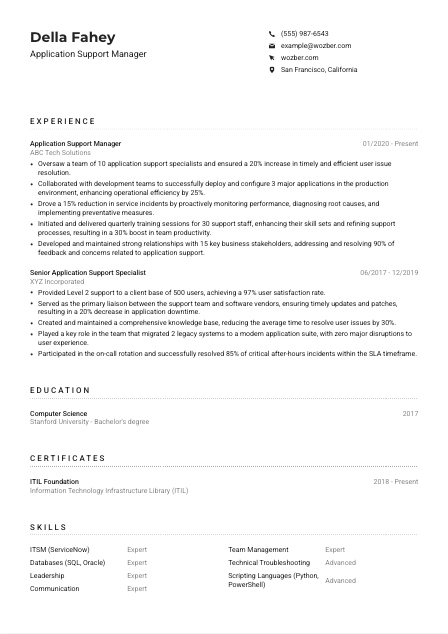
Do not stop at listing duties such as "managed support team" or "worked with developers." Show what changed because of your work. The sample CV does this well with bullets like improving timely issue resolution by 20% and reducing service incidents by 15% through monitoring and preventative measures. That kind of framing shows execution, not just participation.
Quantify results with measures that are native to application support. Good examples include SLA performance, incident reduction, resolution time, downtime reduction, user satisfaction, support volume, team size, training reach, or productivity gains. A line such as leading 10 specialists or resolving after-hours incidents within SLA is far more persuasive than a vague claim about "delivering excellent service."
Trim achievements that do not support your case for application support leadership. Prioritise work tied to production environments, ITSM workflows, root-cause analysis, stakeholder communication, deployment support, and team development. If you include earlier specialist roles, frame them to show the foundation for management, such as Level 2 support depth, vendor coordination, or knowledge base ownership.
Your experience section should show that you can run support operations, improve service performance, and lead technical teams through real production demands. That is the proof most hiring teams look for first.
Education matters here because many Application Support Manager postings still use it as an initial screening requirement. Keep this section straightforward, while making sure your degree supports the technical credibility expected in roles tied to application environments, databases, and production support workflows.
If the role asks for a Bachelor's degree in Computer Science, Information Systems, or a related field, list your degree in that exact area when applicable. In the example, a Bachelor's degree in Computer Science from Stanford University aligns directly with the stated requirement and removes any ambiguity for the reviewer.
Include the degree, field of study, school, and graduation year or date. Hiring teams do not need a long academic narrative for this kind of role. They need to confirm the credential quickly and move back to your operational and technical experience.
When your academic background directly supports the role, make that connection easy to see. Computer Science, Information Systems, software engineering, or similar fields strengthen your case for managing application environments, troubleshooting platform issues, and working effectively with development teams.
Coursework, honors, or student projects are usually optional for a manager-level CV. Include them only if they add something genuinely relevant, such as database work, systems analysis, scripting, or leadership in a technical setting. Otherwise, let your professional record carry the section.
For experienced support leaders, ongoing learning often shows up more strongly in certifications and recent technical upskilling than in the education section itself. Keep the degree concise, then use other sections to show that your knowledge of ITSM, databases, scripting, or service management practices is current.
Education should confirm that you meet the role's academic requirement and have the right technical foundation. Once that box is checked, your CV can return focus to service operations and leadership results.
Certifications are especially useful in application support because they show structured knowledge in service delivery, incident handling, process discipline, or the technical platforms behind the environment. They are rarely the main reason someone gets hired for this role, but they can reinforce how you operate.
Prioritise certifications that connect directly to application support management. ITIL is a strong example because it supports language around incidents, problem management, service improvement, and operational process maturity. That aligns naturally with teams responsible for resolution quality and preventative action.
Focus on credentials that strengthen the same areas the posting highlights, such as IT service management, application environments, databases, scripting, or leadership in technical operations. You do not need a long list. A short, relevant selection is more credible than broad certification clutter.
List the year earned or active date range so hiring teams can judge how current the certification is. In support roles shaped by changing platforms, workflows, and tooling, dates help show whether your knowledge is recent enough to be useful in today's production environment.
This section can also show that you continue sharpening your approach to service delivery. If you have completed training in incident management, cloud operations, automation, or platform support, include it when it adds real weight to your background rather than filling space.
A focused certifications section strengthens your profile when it supports the way Application Support Managers actually work: structured service management, technical fluency, and continuous improvement in live environments.
Application Support Manager CVs need a balanced skill profile. Pure technical depth is not enough, and generic leadership claims are not enough either. The skill list should show that you can handle support tooling, application troubleshooting, and cross-functional coordination while leading a team that keeps services running.
Start with the technical and leadership skills named in the job description. Here that includes ITSM or ticketing platforms such as ServiceNow or JIRA, databases like SQL and Oracle, scripting capability, communication, leadership, and cross-functional collaboration. Those terms belong in your CV when they reflect your actual background.
List the abilities that matter in real support operations first. For this role, that means incident management, technical troubleshooting, database fluency, production application support, service desk tooling, and team management. The sample CV handles this well by pairing ITSM, SQL and Oracle, scripting, leadership, and communication rather than separating technical and people skills too sharply.
Organise your skills so a reviewer can read them quickly. You might group them into technical tools, support operations, and leadership capabilities, or keep them in a single clean list if the format is compact. Either way, avoid filler terms and make room for the systems, processes, and interpersonal strengths that drive support performance.
Your skills section should read like the operating toolkit of an Application Support Manager. It should show you can troubleshoot, coordinate, communicate, and improve service without relying on vague claims.
Language ability matters more in application support than many candidates assume. Managers in this function handle escalations, explain technical issues to business users, and coordinate across teams, so communication skills are part of operational performance, not just a nice extra.
If the role names English as a core requirement, list it clearly and use an honest proficiency level such as "Native" or "Fluent." For a manager handling incidents, user communication, and cross-functional coordination, this is a practical hiring requirement, not a minor detail.
After English, add other languages you can use professionally. They may help in companies with distributed teams, multilingual user groups, or international vendors. They are not mandatory for every Application Support Manager role, but they can widen the kind of stakeholder communication you can handle.
Use realistic labels for each language. Support leadership often involves live calls, written updates, incident communication, and training sessions, so overstating proficiency can create problems quickly. Accuracy is more useful than ambition here.
Extra languages carry more weight when the support function serves varied business units or global operations. If that applies to your target employer, the section can quietly strengthen your profile by showing broader communication range across users, vendors, or regional teams.
Present languages as part of how you lead and support, not as decoration. If you can train staff, manage escalations, or communicate system issues across language lines, that adds practical value to an application support environment.
List languages with the same accuracy you bring to incident reports and stakeholder updates. For this role, clear communication supports service quality as much as technical competence does.
The summary is where you establish your value in a few lines before the reader gets into the detail. For an Application Support Manager, it should quickly connect years of experience with production support leadership, technical depth, and service improvement outcomes.
Before writing the summary, pull out the few priorities that matter most in the target posting. Here, those include leading support staff, resolving user issues efficiently, collaborating with development teams, monitoring service performance, and addressing root causes. Those themes should shape the summary more than generic management language.
Start by identifying yourself as an Application Support Manager or as a support leader with relevant years of experience. The sample summary does this effectively by anchoring the profile in more than 6 years of experience and immediately tying that background to team oversight and operational efficiency.
Use the next lines to highlight strengths that belong to the job, such as incident management, production application support, stakeholder relationship management, and cross-functional work with engineering or development teams. Keep the language close to the employer's terminology where it reflects your real work.
Aim for a short paragraph with clear nouns and verbs, not broad claims about passion or ambition. A summary that mentions service performance, issue resolution, preventative measures, and leadership tells a hiring manager far more than one filled with general statements about being results-driven.
Your summary should make one thing clear immediately: you are equipped to lead application support in a live production environment and improve the way that support function performs.
A strong Application Support Manager CV shows how you lead people, stabilize production environments, work across support and development teams, and improve service outcomes with measurable results. When each section reflects the language and priorities of the target role, the document becomes far easier to read as a match for real operational responsibility.
Use Wozber to build and refine that story in an ATS-compliant CV, whether you are tightening the wording with its AI CV builder features or checking alignment through its ATS CV scanner. The finished CV should make it easy to judge your readiness to run application support at scale.