



Use Wozber and land your dream job
Create CV
No registration required
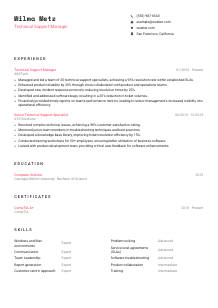
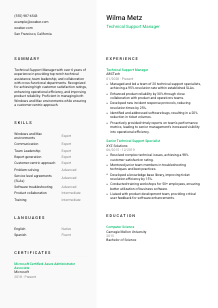
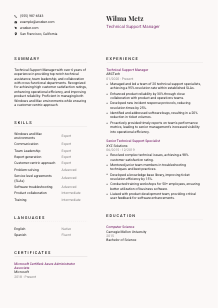
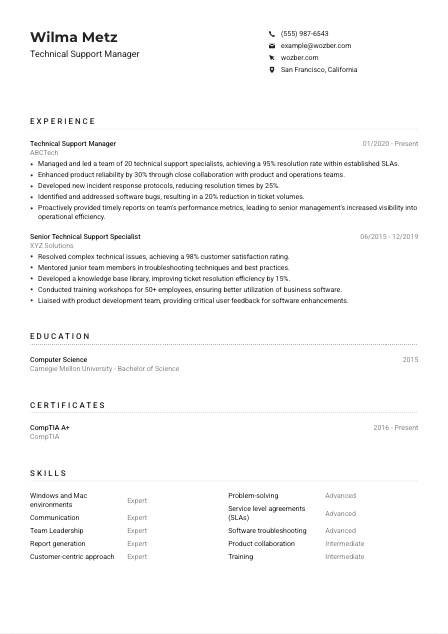
Solving techie tangles, but your CV seems stuck in buffering? Check out this Technical Support Manager CV example, built with Wozber free CV builder. It shows how to match your managerial strengths with job requirements, keeping your career's tech support running smoothly and not stuck on hold!
Technical Support Managers sit at the point where customer disruption, team performance, and product reliability meet. Hiring teams want to see whether you can run a support function with discipline, keep incident response moving, and turn ticket patterns into process or product improvements. Your CV should make that operational range visible early, especially your leadership scope, troubleshooting depth, and ownership of service standards.
When the CV is tailored to the role, it becomes much easier to distinguish someone who has simply handled escalations from someone who has managed SLAs, coached support staff, and reported performance trends to leadership. Wozber's free CV builder helps you shape that story into an ATS-compliant CV by aligning your language with the posting and keeping the structure clean enough for both screening systems and hiring managers to quickly understand your support leadership.
Technical support leadership starts with clear communication, and that standard applies to the first lines of your CV too. Your personal details should be clean, accurate, and aligned with the role so the hiring team can move straight into your support management background without friction.
Use your full name in a slightly larger font than the rest of the page so it anchors the CV immediately. For a Technical Support Manager, the presentation should feel organised and professional, much like a well-run support operation with clear escalation paths and no missing information.
Place "Technical Support Manager" under your name if that is the role you are targeting. This helps frame the rest of the document around team leadership, incident resolution, SLA ownership, and support operations rather than broader IT or individual contributor work.
Include a phone number you answer, a professional email address, and check both carefully for errors. If a company needs to move quickly after reviewing candidates with support leadership experience, inaccurate contact information can undo otherwise strong experience in ticket management, troubleshooting, or team oversight.
If the job calls for a specific location or relocation readiness, include your city and state. In the example, listing "San Francisco, California" directly supports a stated requirement, but treat that as posting-specific tailoring rather than something every Technical Support Manager CV needs.
Include LinkedIn or a professional website if it reinforces your CV with certifications, leadership progression, or technical scope across platforms such as Windows, Mac, cloud administration, or support tooling. Make sure what the employer sees there matches the CV's job titles, dates, and core achievements.
Your personal details should remove basic questions immediately and support the role you're applying for. When this section is accurate and tailored, the hiring team can focus on your support operations experience rather than administrative gaps.




This is the section that carries the most weight for a Technical Support Manager. Hiring teams look here for proof that you have led support staff, improved resolution performance, handled cross-functional work with product or operations, and translated ticket activity into measurable service improvements.
Identify the operational themes in the posting and mirror them where they match your background. For this role, that includes team leadership, Windows and Mac support, SLA management, ticket analysis, cross-functional collaboration, and reporting to senior management. That language helps both ATS matching and human review when it reflects work you actually did.
List roles in reverse chronological order with job title, employer, and dates. That structure is especially important in support leadership hiring because reviewers want to see progression from hands-on support into supervision, process ownership, or management responsibility without having to reconstruct the path themselves.
Under each role, write bullets that show what changed because of your work. Good Technical Support Manager bullets often cover resolution rate, response time, backlog reduction, knowledge base improvements, escalation handling, tooling changes, and team development. The example does this well by showing leadership of 20 specialists, faster incident response, and lower ticket volume after bug-related issues were addressed.
Metrics give your experience credibility when they match real support performance indicators. Resolution rate, CSAT, SLA attainment, time to resolution, ticket deflection, training reach, and reliability improvements are all stronger than vague claims about success. A line such as "reduced resolution times by 25%" tells a hiring manager far more than "improved support efficiency."
Keep the section focused on support environments, customer-facing issue resolution, team leadership, stakeholder collaboration, and process improvement. If an older bullet does not support your ability to run a technical support function, coach specialists, or improve service delivery, it can be shortened or removed in favor of stronger evidence.
Your experience section should show a support leader who improves team output and customer outcomes, not just someone who handled tickets well. Make your scope, metrics, and operational improvements easy to follow.
Education matters here because many Technical Support Manager roles still set a degree as a baseline requirement, especially when the work involves broader IT judgment, process design, and collaboration with product or operations teams. Keep this section straightforward so the qualification is easy to confirm.
Start with what the posting asks for. If the employer requests a bachelor's degree in Computer Science, Information Systems, or a related field, make sure your degree is listed clearly and uses the full field name when possible. In the example, "Bachelor of Science" and "Computer Science" align cleanly with the requirement.
Present your degree, field of study, school, and graduation year in a simple structure. Technical support management hiring rarely depends on decorative formatting here. It depends on whether the CV confirms the educational background without forcing the reviewer to search for it.
If your background matches the stated requirement, say so directly. "Bachelor of Science in Computer Science" gives more clarity than an abbreviated or partial label. That is useful in ATS parsing and in quick human screening for roles that blend support operations with technical depth.
If you are earlier in your career, or if your academic work clearly supports the role, a brief note about systems administration, networking, enterprise support, or team-based technical projects can help. For experienced managers, this is usually secondary to service metrics, leadership scope, and platform expertise.
Honors, scholarships, or relevant student leadership can stay if they add something meaningful and do not crowd out stronger professional content. For most mid-career Technical Support Managers, education should confirm the credential and move the reader back to the experience section quickly.
Education should confirm that you meet the stated baseline without taking attention away from your support leadership record. Keep it concise, accurate, and clearly connected to the technical demands of the role.
Certifications carry real weight in technical support management because they show current technical grounding beyond job titles alone. They are especially useful when a role spans endpoint support, cloud administration, network fundamentals, or team oversight across mixed environments.
If the job names certifications such as CompTIA A+, Network+, or Microsoft Certified: Azure Administrator Associate, surface those prominently when you hold them. That kind of direct alignment can help your CV move faster through screening, especially when the role combines people management with hands-on technical credibility.
List credentials that reinforce your ability to manage support teams and understand the systems they support. For this type of role, endpoint, networking, cloud, Microsoft, or service management certifications are usually more useful than unrelated technical badges.
Include issue or validity dates if they help show your certification is current. In fast-moving support environments, recent certification can support your case when the role involves modern business software, Azure administration, or current troubleshooting practices across Windows and Mac fleets.
Technical Support Managers are often expected to lead strategy, but they still benefit from up-to-date technical knowledge. Continuing education in cloud platforms, endpoint management, security, or IT service management helps you stay credible with both your team and senior stakeholders.
Use certifications to reinforce both technical range and professional currency. When they match the posting and support the environments you manage, they add immediate credibility to your leadership profile.
A Technical Support Manager skills section should read like the toolkit behind a functioning support operation. The right mix usually combines platform knowledge, service management, troubleshooting judgment, communication, and people leadership.
Read beyond the obvious keywords and identify the real working demands behind them. This posting names Windows and Mac support, problem-solving, communication, and a customer-centric approach, while also implying leadership, reporting, SLA ownership, and cross-functional collaboration with product and operations.
Prioritise the competencies that connect directly to day-to-day performance in the role. That often includes ticket triage, escalation handling, service level management, reporting, team coaching, root cause analysis, business software support, and stakeholder communication. The example skills list works because it blends technical environment knowledge with leadership and reporting capabilities.
Do not turn this section into a master inventory of everything you have ever used. Put the most job-relevant skills first, group them logically if needed, and make sure each one is supported somewhere else in the CV through experience, certifications, or summary language.
This section should quickly confirm that you can manage both the technical and operational sides of support. Focus on skills that match the platform environment, service expectations, and leadership demands of the target role.
Language skills matter in support leadership because the work depends on clear communication with customers, specialists, and internal stakeholders. For many Technical Support Manager roles, English proficiency is essential because it affects escalation handling, reporting quality, and day-to-day team coordination.
If the posting explicitly calls for English proficiency, list English clearly and rate it honestly. That matters for support managers because written updates, incident communication, coaching, and executive reporting all depend on precise language.
Order your languages by importance to the role. In this case, English should appear first because it is a stated requirement. Additional languages can follow if they support customer communication or team leadership in a multilingual environment.
Extra languages can strengthen your profile in companies serving broader customer bases or diverse internal teams. They are not a substitute for support metrics or leadership evidence, but they can add range, especially in customer-facing operations.
Choose clear terms such as "Native," "Fluent," "Intermediate," or "Basic." Avoid inflated ratings. In support roles, communication accuracy matters, so honesty here is more useful than trying to sound stronger than your real working level.
For some Technical Support Manager positions, language breadth is a bonus rather than a requirement. Use it to reinforce your ability to work across customer groups or internal teams, but keep the primary emphasis on the language proficiency the employer specifically asks for.
Present languages as a practical communication asset, not filler. For this role, clear English proficiency should be immediately visible, with any additional languages adding helpful range.
Your summary should establish your support leadership profile in a few lines, not repeat generic claims about being hardworking or results-driven. For a Technical Support Manager, this is the place to connect technical environment knowledge, team leadership, service performance, and customer outcomes into one clear opening statement.
Review the posting and identify the few themes that matter most. Here, that means leadership of technical support staff, issue resolution performance, support across Windows and Mac environments, collaboration with product and operations, and a customer-focused approach. Those should guide the wording of your opening lines.
Start with a concise description that tells the reader who you are and how experienced you are. A line such as "Technical Support Manager with 6+ years of experience leading support teams and improving service performance" is stronger than a vague personal statement because it immediately places you in the right lane.
Use the summary to surface the parts of your background that matter most to this type of role. That can include SLA achievement, CSAT, reduced resolution time, mixed-platform support, reporting to senior leadership, or process improvements driven by ticket analysis. The example summary is effective because it combines leadership, operational efficiency, and product reliability in a compact form.
Aim for 3 to 5 lines with concrete wording. Every sentence should add something useful, whether that is years of experience, team scope, platform expertise, or measurable service improvement. The summary should create a precise expectation for what the rest of the CV will prove.
A well-written summary gives the hiring team a quick, accurate picture of your support leadership profile and technical range. Keep it specific enough to match the role and concise enough to read in one pass.
A Technical Support Manager CV should show more than technical knowledge. It should show that you can lead a team, maintain service standards, work across functions, and improve the support operation with measurable results.
Use Wozber's free CV builder, ATS-friendly CV templates, and ATS CV scanner to align your experience with the posting, strengthen keyword coverage naturally, and present your work in an ATS-friendly CV format. The final result should make it easy to judge your readiness to lead support at scale.




