




Use Wozber and land your dream job
Create CV
No registration required
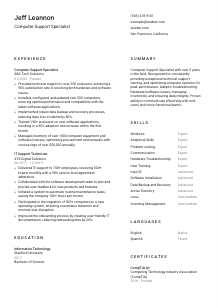
Debugging dilemmas, but your CV crashes on syntax? Browse this Computer Support Specialist CV example, created with Wozber free CV builder. It shows how to code your technical troubleshooting talents into a structure that matches job requirements, so your career never runs into a syntax error!
Computer support work sits at the point where user frustration, business continuity, and system reliability all meet. Hiring teams want a CV that makes your support scope visible fast, from troubleshooting hardware and software issues to rolling out devices, maintaining backups, and helping end-users stay productive without repeated escalations.
When that experience is tailored to the posting, the first read becomes much easier for both people and software to sort correctly. Wozber's free CV builder helps you align your wording with the job description, strengthen ATS optimisation, and present the operating systems, support volume, and support outcomes that matter most for a Computer Support Specialist role.
Support roles are practical, fast-moving, and often location-sensitive. Your Personal Details section should make it easy to contact you, confirm basic eligibility, and see right away that you're applying for a Computer Support Specialist position rather than a broader IT title.
Place your name prominently at the top in a clean, professional style. In IT support hiring, the CV often moves quickly from contact details to job titles and operating-system experience, so your header should be easy to scan without visual clutter.
Add "Computer Support Specialist" beneath your name when that matches the role you want. This helps frame the rest of your CV around end-user support, troubleshooting, installations, training, and maintenance rather than unrelated IT paths such as networking, software engineering, or systems architecture.
List a reliable phone number and a professional email address, then check them carefully. Support jobs depend on responsiveness and accuracy, and small errors in your contact details can undercut the steady, dependable impression you want to create.
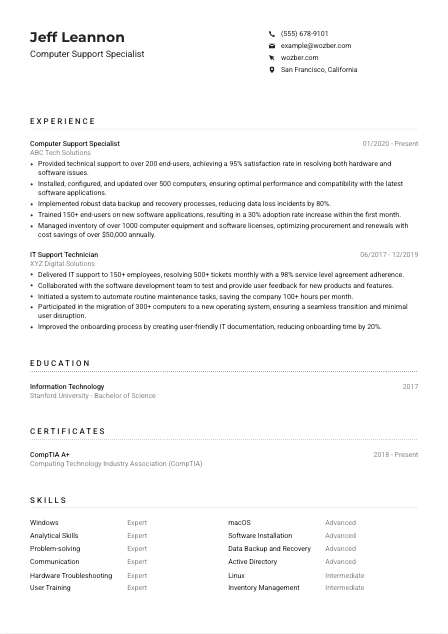
If the employer asks for local candidates, show your city and state clearly. Here, listing San Francisco, California directly addresses a stated requirement and removes doubt about whether you're available for an on-site or local support environment.
Include a LinkedIn profile or a professional site if it adds useful context, such as certifications, documentation samples, or a fuller work history. For support professionals, this should reinforce your IT background, not distract from it with unrelated personal content.
This section should confirm that you are reachable, professionally presented, and aligned with the opening's basic requirements. Once those details are clear, the hiring team can move straight to your troubleshooting history and support results.




Experience carries the most weight in most computer support searches because it shows how you handle live user issues, device rollouts, operating-system environments, and day-to-day service demands. The strongest entries do more than name duties. They show volume, tools, response quality, and what improved because you were there.
Read the posting closely and note the recurring work: end-user technical support, hardware and software troubleshooting, installation and configuration, backup and recovery, user training, and inventory control. Those themes should show up in your bullets using language that matches your real experience, which also improves ATS alignment.
Use reverse-chronological order and make the most relevant support roles easy to read. If you already held a title like "Computer Support Specialist" or "IT Support Technician," keep that context visible because it immediately connects your background to service desk work, desktop support, and hands-on user assistance.
Focus each bullet on a concrete support task plus a result. Good examples include resolving user issues, deploying new machines, reducing downtime, documenting onboarding steps, improving backup coverage, or keeping software licenses current. In the sample CV, bullets about training users, automating maintenance, and managing inventory work well because they show daily support value, not vague responsibility lists.
Use numbers where they reflect real performance: users supported, tickets resolved, SLA adherence, device counts, adoption rates, downtime avoided, or data-loss reduction. The example does this well with figures like 200+ end-users, 500+ tickets monthly, and an 80% drop in data loss incidents, which gives hiring teams a practical sense of scale and reliability.
Keep bullets that reinforce your fit for desktop support, help desk operations, endpoint maintenance, or user enablement. Remove or shorten details that do not support that narrative. For this kind of opening, a concise bullet on OS migration or license management helps more than unrelated project work with no direct user-support impact.
A well-shaped Experience section should show that you can handle technical issues, support users at volume, and keep systems functioning with minimal disruption. That is the level of detail employers need when choosing who can step into the queue and deliver from day one.
For computer support roles, education usually supports the application rather than leading it, but it still matters when the employer asks for a bachelor's degree in IT, Computer Science, or a related field. Present it clearly so the reader can confirm the requirement in seconds and move on to your hands-on experience.
If the posting asks for a bachelor's degree, list it clearly with your field of study. A "Bachelor of Science in Information Technology" matches this opening directly and shows you meet the formal education requirement without forcing the reader to interpret a vague credential.
Keep each entry simple: degree, field, school, and graduation year or date. In IT support hiring, clean structure matters because the education section is usually checked quickly before attention returns to operating systems, troubleshooting history, and support results.
Spell out the major when it strengthens relevance. Information Technology, Computer Science, Information Systems, or another closely related field helps connect your academic background to support environments, endpoint management, and technical problem-solving.
You do not need to turn this section into a transcript. Add selected coursework, labs, or projects only if they reinforce the role, such as system administration, networking, cybersecurity fundamentals, operating systems, or hardware support. This is especially useful for earlier-career applicants with less professional experience.
Honors, scholarships, or technical competitions can be worth mentioning when they add substance. Keep them if they show consistent technical discipline or initiative, but avoid crowding out the core degree information that the employer needs to confirm first.
Your education section should quietly confirm that you have the formal IT foundation the role asks for. Once that box is checked, the rest of the CV can do the heavier work of showing how you solve support problems in practice.
Certifications are especially useful in support roles because they can validate practical knowledge in hardware, operating systems, troubleshooting, and user support. Even when a posting does not require one, the right certification helps reinforce that your skills are current and grounded in recognized standards.
Prioritise credentials tied to desktop support, endpoint troubleshooting, operating systems, or user-facing IT service. CompTIA A+ is a strong example because it aligns naturally with hardware, software, and troubleshooting responsibilities common in Computer Support Specialist roles.
Include certifications that deepen your case for support work rather than listing every credential you have earned. Help desk, Microsoft, Apple, Linux, security, or device-management certifications can all add value when they connect clearly to the employer's environment and your actual background.
Include the earned date, and if the certification renews, note that status. Current dates help employers see that your knowledge is active, especially in areas where tools, operating systems, and support practices evolve over time.
A certificate section can also show that you keep building your skills beyond formal education. That matters in support work, where new devices, software versions, and security requirements often change the day-to-day job faster than job titles do.
This section should add practical weight to your CV, especially around troubleshooting, systems knowledge, and support discipline. Kept relevant and up to date, it strengthens the case that you can handle the technical demands of the role with less ramp-up time.
A Computer Support Specialist skills section should read like the environment you can actually support. Employers look for a mix of operating-system knowledge, troubleshooting ability, deployment and maintenance skills, and the communication needed to guide users through issues without creating more confusion.
Pull out the hard skills the employer names directly, then match them to your own experience. In this case, Windows, macOS, Linux, troubleshooting, backup and recovery, and user support all belong near the top because they reflect the daily work described in the role.
Do not separate support work from communication. A useful skills section combines tools and behaviors, such as hardware troubleshooting, software installation, Active Directory, analytical thinking, problem-solving, and user training. The sample CV handles this well by pairing system knowledge with communication and training strengths.
Resist the urge to add every platform or tool you have touched. A tighter list is more credible and easier for recruiters and ATS systems to process. Prioritise the skills most likely to matter in the target environment, then support them with proof in your experience bullets.
Your skills section should give a quick, accurate snapshot of the systems, support tasks, and user-facing strengths you bring. When it matches the language of the role and the evidence in your work history, it becomes far more convincing.
Language ability matters in support roles because the job often depends on explaining technical issues clearly, writing usable instructions, and helping people stay calm while a problem gets fixed. If the posting specifies English, answer that requirement directly, then include any additional languages that may help in the workplace.
When a role states that you must express ideas clearly in English, list your English level plainly and prominently. This responds directly to the requirement and supports the communication side of technical support, where clarity affects ticket handling, training, and follow-up documentation.
Order languages from strongest to weakest and use honest ratings such as Native, Fluent, Advanced, or Conversational. If you support a diverse user base, additional languages can be useful, but only when you present them accurately.
Do not overstate what you can do. In support work, language skill may be tested in real conversations with frustrated users or during training sessions, so credibility matters more than making the list look bigger.
A second language can strengthen your profile in companies with multilingual teams, customer-facing support, or broad employee populations. In the example, Spanish adds practical value because it suggests wider communication range without replacing the required English proficiency.
If the role is entirely internal and English-only, keep this section brief. If the environment involves distributed teams, global users, or frequent onboarding and training, your language skills may carry more weight and deserve clearer visibility.
For a support role, language skills are useful when they improve explanation, training, and day-to-day user interaction. Present them clearly, rate them honestly, and let them support the broader story of dependable end-user support.
Your summary should give a fast, concrete read on the kind of support work you do best. In a few lines, it should establish your years of experience, the technical environment you can handle, and the outcomes you regularly deliver for users and the business.
Start with a direct line that places you in the field, such as "Computer Support Specialist with 5+ years of experience." That immediately tells the reader whether you match the seniority level before they move into the rest of the CV.
Choose two or three points that align closely with the posting, such as end-user troubleshooting, cross-platform support, software and hardware deployment, backup processes, or user training. The sample summary works because it combines technical support, inventory management, and communication in a way that reflects the actual job.
Aim for a short paragraph, not a career autobiography. Use direct language and include only the details that sharpen your position for the role. If you mention achievements, choose the kind that matter in support work, such as service quality, adoption, uptime, or operational efficiency.
Support work is technical and people-facing at the same time. Your summary should reflect both, whether that means explaining your troubleshooting approach, your success with end-user training, or your ability to work across teams without losing focus on service quality.
A strong summary should make it easy to see your support background, your technical range, and the kind of user environment you can handle. If those points are clear in the first few lines, the rest of the CV has a strong foundation to build on.
You now have a clear framework for tailoring your Computer Support Specialist CV around the work employers actually need done: troubleshooting, installations, user support, backups, training, and inventory control. Keep the language close to the job description, keep the results measurable, and make sure your experience shows the scale and reliability of your support work.
Wozber's free CV builder can help you turn that experience into an ATS-compliant CV with sharper role alignment, cleaner structure, and faster revisions. With the right details in place, your CV should make one thing easy to judge: whether you can step into a support environment and keep users productive.




