



Use Wozber and land your dream job
Create CV
No registration required
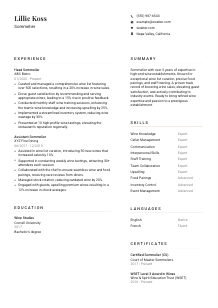
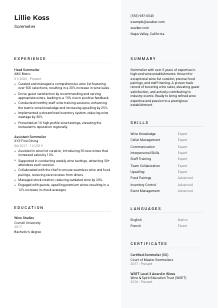
Pairing fine wines, but your CV lacks that exquisite bouquet? Uncork this Sommelier CV example, made with Wozber free CV builder. Learn how to showcase your vintner's expertise in sync with job tastes, crafting a career that ages as gracefully as a rare vintage!
A sommelier CV has to show more than a love of wine. In a hiring setting, the difference often comes down to whether you can translate deep product knowledge into guest recommendations, profitable wine program decisions, and smooth collaboration with the floor and kitchen. Your CV should make that operating range visible quickly, from wine list curation and cellar control to staff education and table-side service.
When the CV is tailored well, hiring teams can immediately place your background at the right level, whether you have mainly focused on guest-facing pairing service, cellar operations, or running a broader beverage program. Wozber's free CV builder helps you shape that experience into an ATS-compliant CV by aligning your wording with the posting and keeping the structure clean, so your strengths in wine sales, training, and hospitality come through clearly.
In hospitality, presentation starts before the first conversation. Your contact details should be polished, easy to scan, and aligned with the level of service expected from a sommelier in a fine dining or premium wine setting.
Place your full name at the top in a clean, readable format, then use "Sommelier" as the headline if that is the role you are targeting. This immediately frames your background around wine service and beverage expertise rather than general restaurant work.
Include a current phone number and a professional email address in a simple format such as firstname.lastname@email.com. Check every character carefully. In guest-facing roles where communication matters, a typo in your contact line suggests the same carelessness could show up in service details or inventory records.
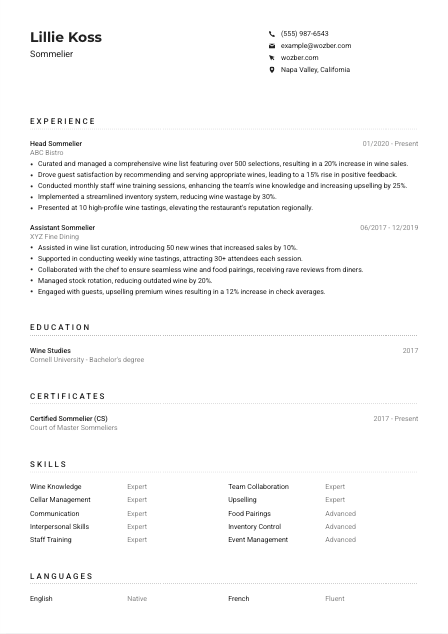
If the posting specifies a location, reflect that clearly in your personal details when it applies. In the example, listing Napa Valley, California immediately supports the employer's requirement for someone already based there or prepared to relocate. For other roles, only include location details that help remove a practical hiring question.
A website, LinkedIn profile, or portfolio can help if it shows industry events, beverage program work, press mentions, wine education, or hospitality leadership. Keep it current and consistent with your CV. If the link does not strengthen your case as a sommelier, leave it out.
Leave out details that do not affect your candidacy, such as age, marital status, or unrelated personal interests. Save the space for information that supports restaurant hiring decisions, such as availability, location, or a credible professional profile.
Your personal details should remove friction. The hiring team should immediately see who you are, how to reach you, and whether basic practical requirements are already covered.




For sommeliers, experience is where credibility is built. Hiring managers want to see how you handled wine sales, guest guidance, pairings, training, inventory, and list development in real service environments, especially in high-end restaurants or respected wine programs.
Before rewriting your experience, mark the duties the employer emphasizes most. For this role, that includes curating a wine list, recommending pairings, training staff, managing inventory, and staying active in tastings and industry education. Those points should guide which bullets you keep, cut, or expand.
List your most recent sommelier or restaurant role first, followed by earlier relevant positions. Include the employer name, your title, and employment dates. For beverage professionals, progression matters. Moving from assistant sommelier to head sommelier, for example, shows growing authority over service, cellar decisions, and program performance.
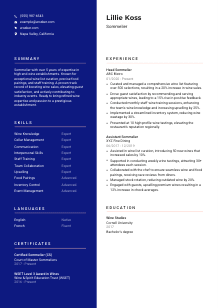
Use bullets that connect your actions to outcomes the restaurant can value. That might mean increased wine sales, stronger guest satisfaction, better check averages, cleaner stock rotation, reduced wastage, or stronger staff product knowledge. The example does this well by tying a 500-selection wine list to a 20% increase in wine sales and monthly training sessions to a 25% rise in upselling.
Quantify wherever the work supports it. Good metrics in this field include number of labels managed, sales growth, upsell rates, reduction in spoilage or aged stock, tasting attendance, positive guest feedback, or frequency of staff trainings. Specific figures give hiring teams a much clearer read on the scale and commercial impact of your beverage work.
Tailor your bullets to the kind of establishment you are pursuing. A fine dining employer will care about pairing judgment, premium bottle sales, polished guest communication, and collaboration with chefs. A wine bar or retail-focused venue may care more about events, education, and merchandising. In this example, achievements in pairings, cellar efficiency, and high-profile tastings align well with a high-end restaurant search.
Your experience section should show that you can run the parts of a wine program that affect both guest experience and revenue. By the end of this section, your level of responsibility should feel unmistakable.
Education matters in sommelier hiring when it strengthens the technical side of your background and supports the level of establishment you want to work in. It is especially useful when the posting asks for a bachelor's degree in hospitality, wine, or a related discipline.
Start by confirming what the employer actually asks for. Here, a bachelor's degree in Hospitality, Wine, or a related field is listed as a requirement, so your education section should make that match easy to find. If your degree is adjacent rather than exact, the field of study becomes even more important.
List the degree, field of study, school name, and graduation year. Keep the structure simple so the reviewer can scan it quickly. The example handles this clearly with a Bachelor's degree in Wine Studies from Cornell University, which immediately supports the role's academic preference.
If your studies directly connect to wine, hospitality, food and beverage management, or restaurant operations, make sure that wording is visible. A general degree title can miss the mark if the specialization is buried. In sommelier hiring, relevant academic focus can reinforce your command of regions, varietals, service standards, and guest experience.
If you are early in your career, relevant coursework, wine research, hospitality projects, or industry seminars can strengthen this section. Once you have several years of fine dining or cellar experience, those details become secondary unless they are unusually relevant to the target role.
Honors, scholarships, leadership in wine clubs, or hospitality-related academic recognition can add weight, especially for candidates with lighter experience. Keep these points selective. Choose details that reinforce discipline, subject knowledge, or early commitment to the wine trade.
This section should confirm that your academic foundation supports the level of wine knowledge and hospitality judgment the role calls for. Make the match visible without overloading the page.
Certifications carry real weight in sommelier hiring because they show structured training, tasting discipline, and professional commitment. In many restaurants and wine programs, recognized credentials help distinguish candidates who have studied seriously from those relying only on general service experience.
Lead with certifications that the employer is most likely to look for, especially credentials from established institutions. In this case, "Certified Sommelier (CS)" directly reflects the requirement, and WSET Level 3 also adds depth. If you hold multiple credentials, order them by relevance and recognition.
Add the year earned or the active date range where appropriate. This helps employers understand your training timeline and whether your professional development is current. In a field shaped by changing producers, vintages, and market trends, recent learning still matters.
Keep the emphasis on certifications that support beverage leadership, tasting knowledge, food pairing, cellar management, or advanced service. Short internal trainings or unrelated certificates usually do not belong here unless they directly support the role you are targeting.
If you are progressing toward a higher certification or regularly completing advanced tasting, service, or regional study, reflect that when it strengthens your profile. Ongoing education signals that your knowledge is active, which matters in roles involving list curation, guest recommendations, and staff training.
Your certificates should make your technical credibility easy to trust. For many sommelier roles, they help confirm that your expertise is formal, current, and relevant to the level of service expected.
A sommelier skills section works best when it reflects how the job is actually performed. The right mix includes beverage knowledge, cellar and list management, guest communication, and the commercial skills that influence sales and service standards.
Pull out the skills the employer names directly and the ones implied by the responsibilities. For this role, that includes wine knowledge, food pairing, inventory control, staff training, communication, and interpersonal ability. These are useful not only for human readers but also for ATS optimisation when they accurately reflect your background.
Do not present yourself as only a tasting expert or only a hospitality generalist. Employers usually need both. Pair hard skills such as cellar management, wine list curation, and varietal knowledge with soft skills like guest recommendation, team collaboration, and staff instruction. The example CV does this well by combining wine expertise, inventory control, upselling, and communication.
Avoid turning this section into a catalogue of everything you have ever done. Choose skills that support the exact kind of sommelier work you want next. If the role is guest-heavy, prioritise pairings, premium service, and communication. If it leans toward beverage operations, bring inventory systems, stock rotation, and program management higher on the list.
If someone reads this section alone, they should understand the kind of wine professional you are. The list should point clearly toward your strengths in service, program execution, and commercial contribution.
Language ability matters in sommelier work because service is conversational, nuanced, and often tied to international wine culture. Whether the requirement is basic or more expansive, list only the languages that genuinely support your work with guests, colleagues, suppliers, or events.
If the posting requires English, list it clearly and include your level. That is the case here, so English should appear first. In a service role, language proficiency affects recommendations, guest trust, and your ability to explain pairings or answer detailed questions about producers and vintages.
Extra languages can strengthen your profile when they support service with international guests, travel-related hospitality, producer relationships, or wine education events. French on the example CV is a strong addition because it connects naturally to wine terminology and global beverage culture, though it is not a universal requirement.
Use clear labels such as Native, Fluent, Intermediate, or Basic. Hiring teams need to know whether you can comfortably guide tables, host tastings, or handle supplier conversations in that language. Precise labels are far more useful than vague claims of familiarity.
The value of language skills depends on the establishment. In luxury dining rooms, destination restaurants, and wine tourism markets, multilingual ability may help with guest rapport and elevated service. In other settings, it may be a secondary advantage rather than a deciding factor.
Only include languages you would be comfortable using in a professional setting. For a sommelier, language skill matters most when it improves guest interaction, tasting communication, or cultural fluency around the wines you represent.
Your languages section should show whether you can communicate confidently in the environments the role serves. For customer-facing wine roles, that can be a real advantage when it is presented accurately.
The summary should give a concise read on your level, your wine program strengths, and the kind of service or commercial impact you bring. For a sommelier, that usually means a quick blend of experience, certifications, guest-facing ability, and measurable results.
Start with your job title and years of relevant experience, then anchor it in the environments where you have worked. "Sommelier with 5+ years in high-end restaurants" tells a hiring manager much more than a generic statement about passion for wine.
Choose two or three strengths that match the posting closely, such as wine list curation, pairing recommendations, cellar management, staff training, or event participation. The example summary does this effectively by emphasizing wine list curation, food pairings, and training rather than trying to mention every skill at once.
A summary becomes more credible when it includes results tied to the wine program. That could be growth in wine sales, stronger guest satisfaction, improved upselling, or success running tastings. Keep the numbers limited, but make them meaningful.
Close by pointing toward the contribution you want to make in the next role, especially if the target employer is high-end, hospitality-driven, or focused on a serious wine list. Avoid broad closing lines. A concise statement about bringing refined beverage knowledge and strong guest service to a premium establishment is enough.
By the time someone finishes your summary, they should already understand your level of wine expertise, your service style, and the business value you bring to a restaurant or wine program.
A well-tailored sommelier CV should make your wine knowledge, guest service judgment, and program impact easy to read section by section. When those elements are clearly presented, the hiring team can quickly see whether you can contribute to list performance, pairing quality, staff capability, and overall guest experience.
Use Wozber's free CV builder to organise that experience in an ATS-friendly CV format, then refine the wording with its AI CV builder and ATS CV scanner so the final document matches the role's language naturally. The finished CV should make one thing clear at a glance: you know how to turn wine expertise into memorable service and measurable results.