




Use Wozber and land your dream job
Create CV
No registration required
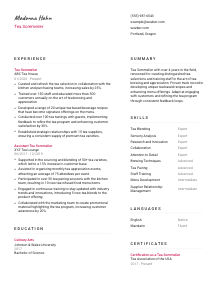
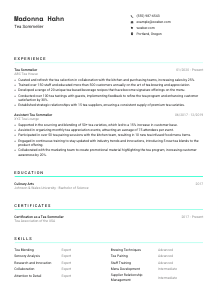
Steeping with flavors, but your CV tastes bland? Sip into this Tea Sommelier CV example, created with Wozber free CV builder. Learn how to blend your tea-tasting finesse with job requirements, brewing a career that's robust and steeped in success!
A Tea Sommelier is hired for judgment as much as knowledge. Employers want to see how you shape a tea program through sourcing, blending, brewing standards, staff education, and guest experience. Your CV should quickly show that you understand tea beyond product familiarity, with the palate, service discipline, and menu sense to turn that knowledge into a memorable offering.
CV tailoring changes how that expertise comes across in both human review and ATS screening. When your wording reflects the role's language, such as tea sourcing, sensory analysis, pairings, and staff training, Wozber's free CV builder helps organise it into an ATS-compliant CV that reads clearly and highlights whether you can lead a tea program, educate a team, and refine selections based on guest response.
For a Tea Sommelier, the header should feel precise and polished. This role blends hospitality presentation with specialist product knowledge, so your contact details need to look dependable from the first line.
Use your full name in the largest text on the page so it is easy to find in a quick review. In hospitality and specialty beverage hiring, clarity matters. Keep the styling clean and professional rather than decorative, so the focus stays on your qualifications and not formatting choices.
Place "Tea Sommelier" directly under your name when that is the role you are applying for. It helps the hiring team immediately place your background in the right lane, especially if your previous titles include variations such as Assistant Tea Sommelier, Beverage Specialist, or Tea Program Lead.
List a current phone number and a professional email address that you check regularly. Tea and hospitality hiring often moves quickly when venues are staffing for service needs, training cycles, or seasonal menu updates, so your contact details should support a fast response.
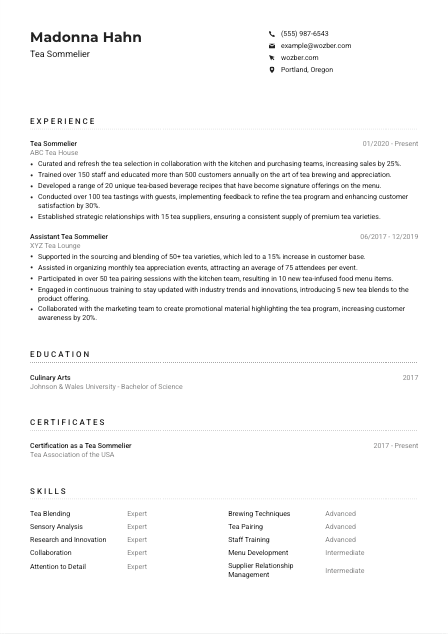
If the employer specifies a location requirement, show that clearly in your header. In the example, listing Portland, Oregon immediately supports a stated hiring preference. If you are relocating, you can signal that in a simple, honest way rather than leaving the employer guessing about availability.
Include LinkedIn or a professional website only if it adds value. For a Tea Sommelier, that might mean a profile that supports your experience with tea programs, events, beverage development, supplier relationships, or hospitality training. Make sure the details and dates match your CV exactly.
Your personal details should confirm that you are accessible, professionally presented, and realistically available for the role. Keep this section clean so the hiring team can move straight to your tea expertise.




This section carries the most weight for a Tea Sommelier. Hiring managers are looking for proof that you can influence tea selection, guest education, beverage development, and commercial results, not just that you have worked around tea.
Read the posting for the work themes that matter most, then build your bullets around them. Here, the priorities include sourcing, blending, presentation, food pairing, staff training, customer education, and ongoing refinement of the tea program. Those themes should shape which accomplishments you feature and how you phrase them.
Start with your current or most recent role and work backward. For each position, include your title, employer, and dates. That format helps the reader follow your progression from support work into ownership of tea selection, menu contribution, or guest-facing education.
Do not stop at listing responsibilities such as "curated tea selection" or "conducted tastings." Show what changed because of your work. The example does this well by tying curation to a 25% sales increase and tastings to stronger customer satisfaction. Those results make your tea knowledge feel operational, not theoretical.
Metrics are especially useful in hospitality and specialty beverage roles when they reflect real scope. Include figures such as number of teas sourced or blended, staff trained, guest tastings hosted, beverage recipes launched, supplier relationships maintained, menu items influenced, or sales and satisfaction improvements. Numbers like "trained over 150 staff" or "developed 20 tea-based beverages" give scale to work that could otherwise sound generic.
Prioritise achievements that show sensory judgment, menu contribution, collaboration with kitchen or purchasing teams, and guest education. If you have broader hospitality experience, keep only the parts that strengthen your case for tea leadership. The target role is looking for someone who can shape a tea experience, not a general service CV with tea mentioned occasionally.
After this section, the reader should be able to picture you managing a tea list, teaching staff, building pairings, and improving the program over time. Lead with work that shows both craft knowledge and business impact.
Education matters here because the role asks for a bachelor's degree in Culinary Arts, Hospitality, or a related field. Keep the section concise, but make sure it clearly supports your path into tea, food service, or beverage leadership.
List the degree that best matches the employer's requirement first. A bachelor's in Culinary Arts, Hospitality, Food Studies, or a related discipline should be easy to spot. In the example, a Bachelor of Science in Culinary Arts aligns directly with the posting.
Include degree, field of study, school name, and graduation year. That is usually enough. A simple structure keeps the section readable and makes it easier for both ATS software and hiring teams to confirm that you meet the baseline academic requirement.
If the posting asks for a bachelor's degree, do not bury that information. Present it in a way that leaves no doubt. When your degree is in a related field rather than an exact match, the field name should still connect logically to tea service, culinary work, hospitality operations, or sensory product expertise.
If you are early in your career or your degree title is broad, a short mention of coursework can help. Topics such as beverage studies, culinary theory, food pairing, hospitality management, sensory evaluation, or product sourcing can reinforce your preparation for tea program work.
Honors, scholarships, student leadership, or competition work can be worth adding if they connect to hospitality, culinary execution, or beverage service. Keep them brief and relevant. Once your professional experience is strong, these details should stay secondary to your tea accomplishments.
This section should make your academic foundation easy to verify and relevant to the role. Keep it focused on preparation that supports tea knowledge, service standards, and menu collaboration.
For a Tea Sommelier, certification is not a minor extra. It is a direct signal that your tasting framework, brewing knowledge, and tea education have been developed through formal study as well as experience.
Put your Tea Sommelier certification first and name the issuing body clearly. The posting explicitly asks for certification from a recognized institution, so this credential should be easy to find. In the example, the certification is listed prominently with the issuer, which helps confirm professional standing right away.
Only include certificates that strengthen your case for tea sourcing, service, hospitality, sensory evaluation, or beverage development. A shorter list of closely related credentials is more convincing than a long section filled with general training that does not support the role.
Add the year earned and, where relevant, an active date range. That helps show whether the training is current, especially in a field where product knowledge, preparation standards, and beverage trends continue to evolve.
If you have added advanced study in tea regions, tasting methodology, food pairing, or hospitality beverage programs, include it when relevant. Continued learning matters in a role that involves updating offerings, researching trends, and guiding guests with authority.
Your certifications should confirm that your tea knowledge is formal, current, and professionally recognized. For this role, that specialist training carries real weight.
A Tea Sommelier skill section should read like the working toolkit of someone who can evaluate tea, present it well, and improve a guest offering. Keep the list specific to the craft and the business setting where that craft is applied.
Start with the language the employer already uses. Here that includes tea sourcing, blending, brewing techniques, tea pairing, sensory analysis, presentation, staff education, and research into trends and innovations. Mirroring those terms helps both ATS matching and human review, provided the skills reflect real experience.
List hard skills such as Tea Blending, Brewing Techniques, Sensory Analysis, Tea Pairing, Menu Development, and Supplier Relationship Management alongside practical strengths like Staff Training or Cross-Functional Collaboration. In the example, that mix works well because it shows both product mastery and the ability to operate within a team setting.
Order the section so the most relevant capabilities appear first. For a role centered on curating teas and educating others, sensory analysis, blending, brewing, pairing, and training should generally appear before broader soft skills. Keep the list tight enough that every item supports the target job.
By the end of this section, the employer should see a specialist who understands tea deeply and can apply that knowledge in service, training, and menu development. Relevance matters more than volume.
Language skills matter differently depending on the tea role. In guest-facing and sourcing-oriented positions, they can support service quality, staff communication, supplier relationships, and access to broader tea culture.
If the posting states that English fluency is critical, list English at the top with an accurate proficiency level. That requirement should be unmistakable, especially in a role that involves customer education, staff training, and presentation.
Use familiar terms such as Native, Fluent, Advanced, or Intermediate. Avoid vague descriptions. A Tea Sommelier may need to explain brewing methods, tasting notes, and food pairings with precision, so language labels should be just as clear.
Extra languages are worth listing when they can support guest interaction, supplier communication, or cultural fluency around tea. In the example, Mandarin is a strong addition because it can complement sourcing conversations and broader tea knowledge, though it is not a universal requirement.
Do not overstate proficiency. If you can hold supplier conversations or assist guests comfortably, say so with an appropriate level. If your ability is more limited, label it accurately. Credibility matters, especially in a role built on expert guidance.
Where space allows, think about the practical value of each language. For Tea Sommeliers, that may mean discussing origin, production, and preparation with greater nuance, or serving an international guest base more confidently. Keep the section brief, but make it purposeful.
This section should reinforce your ability to communicate clearly in service settings and, when applicable, operate comfortably across the global tea landscape. Put the required language first and keep the rest credible.
The summary should quickly establish what kind of Tea Sommelier you are. Focus on your level of experience, the parts of the tea program you have owned, and the outcomes you are known for delivering.
Before writing, identify the two or three themes the employer cares about most. In this case, that includes tea sourcing and blending, brewing and pairing knowledge, customer and staff education, and ongoing refinement of the tea program. Your summary should bring those threads together in a few lines.
Start with a direct statement that covers your title and experience level, such as "Tea Sommelier with 4+ years of experience in tea curation, brewing, and guest education." That immediately tells the reader the level at which you operate.
Use one or two strong details that show how you work. The example summary succeeds because it mentions tea selection, staff training, beverage development, and refinement through customer feedback. If you have numbers such as sales growth, training volume, or menu launches, include one where it fits naturally.
Aim for 3 to 5 sentences with no filler. Avoid generic claims about passion or excellence unless you tie them to actual tea work, such as sensory analysis, pairings, or program development. A concise summary with real substance sets up the rest of the CV much more effectively.
Your summary should give the hiring team an immediate sense of your tea expertise, service range, and program impact. If it is doing its job, the rest of the CV simply adds detail to that picture.
A Tea Sommelier CV should make your product knowledge feel operational. Hiring teams need to see that you can curate a tea list, guide guests and staff, develop pairings, and adapt the program based on tasting feedback, service needs, and business results.
Use Wozber's free CV builder to shape that experience into an ATS-friendly CV template with strong ATS optimisation. Wozber's ATS CV scanner and AI CV builder can help you align your wording with the posting, surface missing requirements, and present your tea background in a clean ATS-friendly CV format. The final read should make one thing clear: you can lead a thoughtful, guest-ready tea program.




