



Use Wozber and land your dream job
Create CV
No registration required
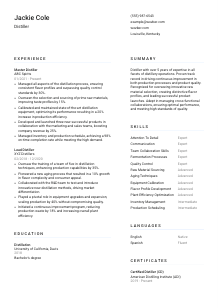
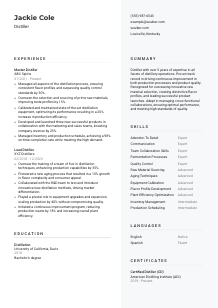
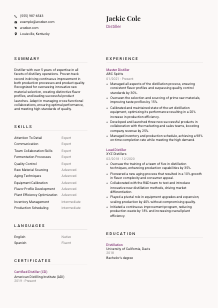
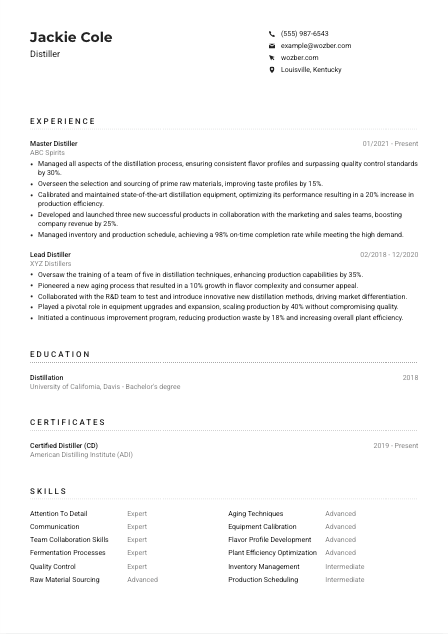
Mastering spirits, but your CV doesn't have that smooth finish? Check out this Distiller CV example, made with Wozber free CV builder. It shows how to blend your expertise with job requirements, ensuring your career story goes down as smoothly as your finest batches!
Distiller CVs are strongest when they show control over process, consistency, and product quality. Hiring teams want to see how you manage the chain from raw material selection and fermentation through distillation, aging, equipment performance, and final flavor outcomes. If your CV stays vague, it becomes hard to tell whether you have run production, improved yield, protected quality standards, or helped bring new products to market.
A tailored CV also helps separate hands-on distillery operators from candidates with only adjacent manufacturing or beverage experience. Using Wozber's free CV builder to align your wording with the posting and keep an ATS-compliant CV structure makes it easier to surface the right details first, such as batch quality, equipment calibration, inventory planning, and collaboration with sales or marketing on launches. That is the kind of context that makes your production judgment easier to trust.
The header section does quiet but important work on a Distiller CV. It should confirm who you are, what role you are targeting, and whether you meet practical filters before anyone reads your production history.
Your name should sit at the top in a clean, easy-to-read format. Keep the styling simple and professional. Distillery hiring is practical, and an ornate header adds nothing to your case when the real value is in your production record, quality control work, and technical knowledge.
If you are applying for a Distiller role and that reflects your background, place "Distiller" directly under your name. This immediately aligns your CV with the opening and helps when the employer is sorting candidates across related titles such as Lead Distiller, Production Supervisor, or Master Distiller.
List a reliable phone number and a professional email address. Accuracy matters here. If a team wants to speak with you about fermentation oversight, production scheduling, or equipment maintenance, a typo in your contact details can cost you the conversation before your experience is even discussed.
When a posting names a location requirement, address it directly in your contact section. For the example role, listing "Louisville, Kentucky" helps remove doubt around local eligibility and availability. For other openings, only include location detail to the extent that it supports the application.
A LinkedIn profile or professional website can help if it supports your CV with consistent career history, product work, certifications, or industry involvement. Keep it polished. If it includes distillery achievements, technical training, or product launch work, it should reinforce the same picture your CV presents.
Keep the personal details section concise and useful. For a Distiller, it should quickly establish identity, role focus, and any practical requirement such as location, without distracting from the production and quality experience that follows.




This is the section that carries most of the hiring weight for a Distiller. Titles alone do not tell enough. Your bullets need to show how you handled production, protected flavor consistency, maintained equipment, improved efficiency, and worked across teams when product plans changed.
Before rewriting your experience, mark the responsibilities that define the opening. For a Distiller, that often includes raw material selection, fermentation oversight, flavor consistency, equipment calibration, inventory planning, production schedules, and support for new product launches. Those themes should show up clearly in your bullet points, not remain buried in generic manufacturing language.
Start with your most recent role and work backward. For each position, include job title, employer, and dates. That structure helps the reader quickly understand your level of responsibility, whether you moved from hands-on production to broader plant oversight, and how recently you worked with the processes the role depends on.
Focus each bullet on work that matters in day-to-day operations. Good examples include maintaining consistent flavor profiles, improving raw material quality, reducing waste, increasing throughput, supporting aging improvements, or coordinating production to meet demand. In the sample CV, bullets like improving taste profiles through better sourcing and managing product launches with marketing are effective because they tie technical work to commercial results.
Numbers make distillery work easier to understand. Use metrics tied to production efficiency, quality improvement, on-time schedule performance, waste reduction, product launches, or revenue impact when that connection is credible. The sample CV does this well with figures such as a 20% increase in production efficiency and a 98% on-time completion rate.
Keep the section centered on distillery operations and adjacent work that clearly translates. If a past task does not help prove your ability to run batches, maintain standards, manage equipment, or collaborate on product development, trim it. Space is better used on achievements that show judgment, consistency, and production leadership.
Your experience section should leave no doubt that you can run distillation operations with discipline. When the bullets show process control, measurable quality outcomes, and reliable production execution, your background becomes much easier to place in a working distillery.
Formal education matters more in distilling than in many production roles because it signals grounding in fermentation science, process control, raw materials, and related technical principles. Present it clearly, especially when the posting asks for a bachelor's degree in distillation, brewing, or a related field.
Put your most relevant degree first. If you hold a bachelor's degree in Distillation, Brewing, Food Science, or a closely related area, make that easy to spot. In the example, a Bachelor's degree in Distillation directly supports the employer's stated educational requirement.
Use a simple format with school name, degree, field of study, and graduation year or date. Distillery hiring teams do not need decorative wording here. They need to see the credential quickly and move on to how your education supports production work.
If your degree title closely matches the role, keep that wording visible instead of shortening it too much. A specific field such as Distillation or Brewing immediately reinforces your technical foundation in fermentation, process development, and quality control.
Most experienced Distillers do not need a course list. Include it only if you are earlier in your career or if your coursework helps connect your education to the role, such as fermentation science, sensory analysis, chemistry, microbiology, or production systems.
Honors, projects, or research can help when they relate to spirit production, raw material analysis, aging studies, or process improvement. If you already have several years of distillery experience, keep these details brief so the section stays proportional.
Education should confirm that your understanding of distillation is grounded in more than trial and error. Keep it clean, relevant, and clearly tied to the technical expectations of the role.
Certifications are especially useful in distilling because they add formal recognition to practical production experience. They are not always mandatory, but when a posting prefers a distillation credential, this section can strengthen your standing quickly.
Read the requirements closely and feature credentials that match them. If the employer prefers certification in distillation or a Master Distiller credential, list that near the top. The example CV does this well by including a Certified Distiller credential from the American Distilling Institute.
Only include certificates that strengthen your case for production, quality, safety, or technical expertise. Distillation, sensory evaluation, food safety, process operations, or equipment-related training may all be relevant depending on the role. Leave out credentials that do not support your work in a distillery environment.
Include the issue date, renewal period, or active status when it helps show that your training is current. This is particularly useful for certifications tied to ongoing professional standards or industry-recognized bodies.
Distilling methods, compliance expectations, and equipment capabilities keep evolving. Updating this section as you complete new training shows that you stay engaged with the craft and with the operational side of production, not just the finished product.
Used well, certifications strengthen the technical side of your CV and support your credibility in a quality-driven production setting. Choose the ones that speak directly to distillation practice and keep them current.
A Distiller's skills section should read like a realistic operating profile, not a generic list. The most useful mix combines process knowledge, equipment capability, quality discipline, and the communication needed to work with production teams and commercial partners.
Start with the language the employer uses. For this role, that includes raw material selection, fermentation, aging, quality control, communication, and team collaboration. These are not filler keywords. They describe how the work is actually done and what the employer expects you to handle consistently.
List the capabilities most central to distillery operations first. Technical skills might include fermentation processes, equipment calibration, flavor profile development, inventory management, production scheduling, and quality control. Soft skills matter too, especially when you need to coordinate with operators, suppliers, or sales and marketing teams around product plans.
Resist the urge to include every skill you have used across your career. A shorter list with clear relevance is more effective. The sample CV works because it stays close to the role's real demands, pairing technical areas like aging techniques and raw material sourcing with communication and collaboration skills.
Your skills section should make it easy to see how you contribute in a working distillery. When the mix reflects process knowledge, equipment handling, quality standards, and collaboration, the section supports the rest of your CV instead of repeating it.
Language skills are usually a supporting detail on a Distiller CV, but they still matter when the role calls for clear communication. Distillery work depends on precise instructions, quality documentation, coordination across shifts, and accurate discussions with suppliers or commercial teams.
Some openings make this explicit. Here, strong English communication is essential, so your CV should state your English proficiency clearly rather than leaving it implied.
List English at the top if it is required for the role. Use an honest proficiency level such as Native or Fluent. That helps confirm you can handle production communication, documentation, and cross-team collaboration without ambiguity.
If you speak other languages, include them after the required one. Extra language capability can be useful when working with international suppliers, equipment vendors, visitors, or broader brand activity, though it should remain a secondary point unless the role specifically calls for it.
Use clear labels such as Native, Fluent, Intermediate, or Basic. Inflated language ratings can create problems quickly, especially in environments where technical instructions, safety procedures, or supplier communication need precision.
If another language has practical value in your work, let that value be implied by the rest of your CV or supporting materials. For example, supplier coordination or international market collaboration can make additional languages more relevant, but do not overstate their importance if the role is primarily local production.
For most Distiller roles, languages are a supporting qualification rather than the centerpiece. Present them clearly, lead with the required language, and let the section confirm that you can communicate accurately in a production environment.
The summary should give a fast, concrete picture of the kind of Distiller you are. A hiring manager should come away knowing your level of experience, the part of the operation you have managed, and the kinds of results you tend to deliver.
Start with a direct statement such as Distiller with 5+ years of experience in distillery operations. That immediately sets the frame and works well when the role asks for a minimum number of years in production or related work.
Use the next line or two to highlight the operational areas that match the job. For this kind of role, that may include raw material sourcing, fermentation, aging, flavor consistency, equipment performance, inventory control, and product development support. The sample summary does this effectively by combining process expertise with quality improvement and cross-functional collaboration.
Aim for three to five lines. Avoid broad claims like "results-driven professional" when you can say exactly what you improve, such as production efficiency, flavor profile consistency, or successful launch support. Specific language gives the summary far more credibility.
Close with a point that helps define your approach. That could be continuous improvement in plant operations, strong sensory judgment, success developing new products, or the ability to balance craft standards with production demand. Pick one distinction that fits the evidence in your experience section.
A good summary gives the reader a reliable first read on your production background before they reach the detail below. For a Distiller, it should quickly connect experience, technical scope, and the quality standards you know how to maintain.
A Distiller CV should make one thing clear fast: you know how to run a controlled process that delivers quality, consistency, and production reliability. When your sections align around real operating responsibilities such as fermentation, distillation, equipment care, inventory planning, and product development support, the application reads as grounded and credible.
Use Wozber's free CV builder to organise that experience into an ATS-friendly CV format, align your wording with the posting, and strengthen ATS optimisation without losing the technical detail that matters in distillery hiring. The finished CV should make it easy to judge whether you can step into production and protect the standard of the spirit.