



Use Wozber and land your dream job
Create CV
No registration required
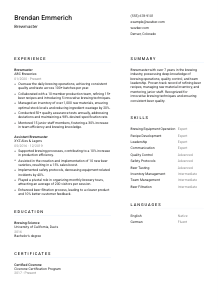
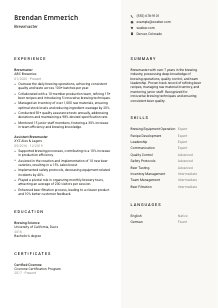
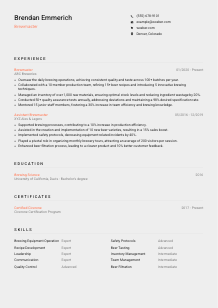
Brewing up hoppy creations, but your CV is flat? Tap into success with this Brewmaster CV example, created with Wozber free CV builder. Learn how to bring out your brewing experience and leadership strengths to match job needs, crafting a career as robust and satisfying as your best ale.
Brewing leadership is judged in the glass and on the production floor. A Brewmaster CV needs to show that you can keep batches consistent, protect quality standards, manage equipment and ingredients responsibly, and guide a team through a demanding brewing schedule. Hiring teams want to see how you handle the realities of production brewing, from recipe refinement and sensory standards to safety, sanitation, and process discipline.
The first screening pass often separates creative beer makers from operational brewing leaders. When your CV mirrors the language of the role, an ATS-compliant CV built with Wozber's free CV builder makes it easier to surface experience in batch consistency, QA testing, inventory control, and staff oversight, so the brewery can quickly see whether you can run a reliable brewhouse.
For a Brewmaster, the header needs to communicate professional readiness without clutter. Keep it straightforward so the brewery can immediately see who you are, how to reach you, and whether you meet practical requirements such as location or relocation.
Place your name at the top in a clear, readable font. Brewmaster hiring often moves quickly when a brewery needs production stability, so your header should be easy to scan on a phone, in a PDF, or after ATS parsing.
Put "Brewmaster" directly under your name if that is the role you are pursuing. This helps frame the rest of the CV around production oversight, recipe development, quality control, and team leadership instead of a broader brewing profile.
Include a reliable phone number and a professional email address. Add a website or LinkedIn profile only if it supports your candidacy, such as a portfolio of brewery projects, product launches, awards, or public-facing brewing work.
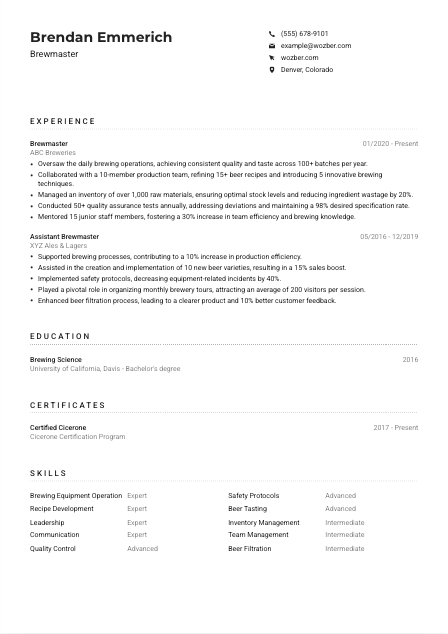
If the brewery specifies a location requirement, respond to it directly in this section. Here, Denver, Colorado is stated as a practical condition of hire, so listing Denver or noting willingness to relocate removes an avoidable screening barrier early.
A link is useful when it adds proof of brewing credibility, such as press coverage, competition results, brewing education, or a professional profile with consistent career history. Skip personal pages that do not add anything about brewhouse leadership, product quality, or industry reputation.
Your personal details should answer the basic operational questions fast: who you are, how to contact you, and whether you meet practical conditions for the role.




This is the section brewery leaders read most closely. They need to see whether you have managed real production volume, maintained quality across repeated batches, worked with brewing equipment safely, and led people as well as process.
Start by identifying the work the brewery most needs covered. For this role, that means daily brewing operations, recipe collaboration, inventory management, quality assurance, and mentoring junior staff. Your experience bullets should map directly to those areas so the reader can connect your background to brewhouse needs without guessing.
Show your most recent brewing leadership first, with job title, brewery name, and dates. For Brewmaster and Assistant Brewmaster roles, make the scope visible quickly by naming the scale of production, team size, systems overseen, or process ownership tied to each position.
A Brewmaster is hired to protect consistency and improve production, not simply to "oversee brewing operations." Use bullets that show results. The example does this well by pairing responsibilities with outcomes like consistent quality across 100+ batches per year, recipe refinement with a 10-member production team, and a 98% specification rate after QA testing.
Metrics are especially useful in brewing because they reflect operating control. Include batch volume or frequency, waste reduction, efficiency gains, incident reduction, specification compliance, number of recipes developed, staff trained, or ingredient inventory managed. Numbers like 20% less ingredient waste or 40% fewer equipment-related incidents tell a brewery far more than broad claims about being effective.
Prioritise experience that supports a Brewmaster decision. Production brewing, cellar operations, filtration improvements, quality programs, safety implementation, sensory testing, and team development all belong. If you include side projects or public-facing work such as brewery tours, make sure they support the story rather than displace core evidence of brewhouse management.
By the end of this section, a brewery should be able to picture you managing batches, maintaining standards, solving production issues, and leading people on the floor.
Formal brewing education matters because it signals technical grounding in fermentation, process control, raw materials, and production science. For a Brewmaster role, education usually supports your practical track record rather than replacing it.
When the posting asks for a bachelor's degree in Brewing Science, Fermentation Science, or a related field, make that qualification easy to spot. In the example, a Bachelor's degree in Brewing Science directly answers the requirement and should sit high enough in the section to be found quickly.
List degree, field of study, school, and graduation year in a simple structure. That is all most breweries need for an experienced Brewmaster. Clear formatting also helps ATS systems read the credential correctly.
If your degree is not named exactly as in the posting, present the connection clearly. Fermentation Science, Food Science, Microbiology, or Chemical Engineering can all be relevant when your work history shows direct brewing application. Make the relationship obvious instead of assuming the reviewer will infer it.
Early-career brewers can benefit from naming coursework in brewing operations, yeast management, sensory analysis, quality systems, or process engineering. For senior applicants with 5+ years in production, this detail is usually optional unless it supports a specialised brewery environment or a gap in direct experience.
Academic honors, brewing competition work, or notable research can help if they reinforce technical discipline and commitment to the craft. Keep them brief. Once your production experience is established, the education section should stay focused and efficient.
Your education should confirm that your brewing knowledge rests on solid technical training, then give the rest of the page back to production results and leadership.
Certifications can strengthen a Brewmaster application when they reflect real industry knowledge, tasting ability, or ongoing professional development. They are especially useful when a posting names a preferred credential or when you want to reinforce your technical standing.
Put brewing-related credentials first, especially any named in the posting. Here, Certified Cicerone is preferred, so it deserves clear placement. Relevant technical or safety certifications can also add value if they support production, quality, or sensory standards.
List certifications that connect to how Brewmasters are actually evaluated: beer knowledge, sensory calibration, quality control, sanitation, safety, or leadership within brewery operations. A short, relevant list is stronger than a long list of marginal credentials.
Certification dates help the brewery understand whether the credential is current and maintained. The example's "2017 - Present" format works because it shows the certification remains active, which matters more than simply naming it.
If you are moving from Assistant Brewmaster to Brewmaster, added certifications can reinforce readiness for broader ownership of product quality, training, and process control. Pursue them with purpose, especially if they close a gap that appears in target job descriptions.
Use certifications to reinforce brewing credibility, not to pad the page. The right ones show continued investment in quality, product knowledge, and operational discipline.
A Brewmaster skills section should reflect how beer is actually made, controlled, and improved in a production setting. Keep the list focused on capabilities that support brewing performance, product consistency, and team execution.
Read the posting for both named and implied skills. In this case, brewing equipment knowledge, safety protocols, quality control, leadership, communication, inventory management, and recipe development are central. Those are not filler keywords. They describe the day-to-day work of keeping a brewery running well.
Only include skills you can support elsewhere in the CV. If you list brewing equipment operation, quality control, or team management, your experience bullets should show batch oversight, QA routines, process improvements, or staff mentoring. The example does this effectively by aligning skills like Recipe Development and Leadership with specific production outcomes.
Group or order skills with technical and operational strengths near the top, such as brewing equipment operation, quality control, recipe development, safety protocols, beer tasting, and inventory management. Communication and leadership belong here too, especially for a role that supervises staff, but they carry more weight when surrounded by concrete brewing capabilities.
Your skills section should read like the toolkit of someone who can manage the brewhouse, protect product standards, and lead a production team without supervision.
Language ability matters when a role involves shift leadership, cross-functional communication, supplier coordination, training, or public-facing brewery work. For a Brewmaster, list languages only when they add something real to operations or meet a stated requirement.
If the job requires English proficiency, place English at the top with an honest level. That requirement matters because Brewmasters communicate quality issues, safety procedures, production adjustments, and staff instruction with little room for ambiguity.
Additional languages can help in supplier communication, multinational teams, export business, or customer-facing events. They are secondary to brewing competence, but they can strengthen your profile when they align with the brewery's environment.
Describe your level accurately with terms such as Native, Fluent, Advanced, or Intermediate. Overstating language ability creates risk in a role where clear instructions on sanitation, process deviations, and equipment handling matter.
If your work includes ingredient sourcing, vendor relationships, technical training, or international collaboration, language skills can be worth more than a passing mention. If not, keep this section concise and factual.
For most Brewmaster roles, languages will not outweigh brewing operations, QA discipline, or leadership. Include them when they add range, but do not let them distract from the production and quality story at the core of your CV.
List language skills when they clarify a requirement or add operational range, then let your brewing experience remain the main point of the application.
A Brewmaster summary should quickly establish your level, your production environment, and the kind of results you are trusted to deliver. This is where you frame your experience before the reader reaches the detailed bullets.
Start with the hiring need, not a generic self-description. If the role centers on daily brewing operations, recipe refinement, quality assurance, inventory control, and mentoring staff, those themes should guide what you include in the opening lines.
State that you are a Brewmaster and give your years in production brewing. The example's "over 7 years in the brewing industry" works because it immediately establishes seniority beyond the minimum 5 years requested.
Choose strengths that matter in production settings, such as maintaining consistent batch quality, improving recipes, managing raw materials, leading teams, or running quality control programs. Briefly anchor them in outcomes when possible. That keeps the summary grounded in brewery performance rather than broad personality language.
Aim for a short paragraph that reads cleanly in six to eight seconds. Avoid repeating every skill from the CV. A tight summary should give the brewery a clear reason to keep reading your experience section, where the operational detail and metrics do the heavier lifting.
The opening paragraph should tell a brewery, quickly and credibly, that you have the production experience, quality mindset, and leadership range to take charge of the beer and the team behind it.
A Brewmaster CV works when it connects brewing craft to operational control. Show how you maintain consistency, improve recipes, manage ingredients and equipment, protect quality standards, and lead people in a live production environment.
Use Wozber to shape that experience into an ATS-compliant CV with clear structure and job-aligned language. Wozber's ATS CV scanner and ATS-friendly CV format can help you tighten phrasing, surface missing requirements, and present your background in a way that is easy for both software and brewery leadership to review.
When the CV is finished, the brewery should be able to see one thing without hesitation: you can run the brewhouse with quality, discipline, and sound judgment.




