



Use Wozber and land your dream job
Create CV
No registration required
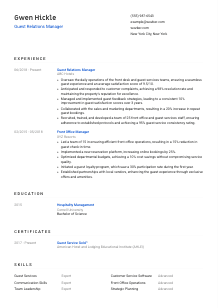
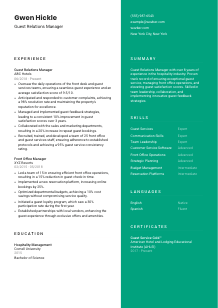
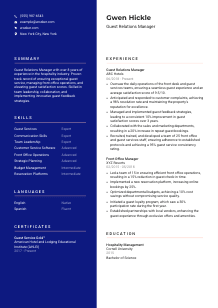
Rolling out the red carpet, but your CV isn't getting the VIP treatment? Step into this Guest Relations Manager CV example, created with Wozber free CV builder. It shows how to present your hospitality skills with style, making sure your career path is just as stellar as your welcoming smile!
Guest Relations Managers sit at the point where service standards meet operational pressure. The job is not only about being welcoming. It is about keeping front desk flow steady, resolving complaints before they escalate, coaching service teams in real time, and protecting guest satisfaction scores that affect reputation, repeat bookings, and revenue. Your CV needs to show that you can run that environment, not just that you enjoy hospitality.
When your CV is tailored well, the hiring team can quickly separate guest-facing leadership from general hotel operations experience. Wozber's free CV builder helps you shape an ATS-compliant CV around the language of the posting, so strengths like front office supervision, complaint resolution, team development, and property-level service results are easy to read in both an ATS scan and a hiring review.
For a Guest Relations Manager, the header needs to do one practical job fast. It should identify you as a hospitality leader who is reachable, professionally presented, and available where the property needs coverage. Keep it clean and easy to scan, with details that remove basic questions before the reader reaches your experience.
Use your full name exactly as you use it in professional settings and keep it visually prominent. In hospitality leadership, polished presentation matters, and the top of the page should already reflect the organised, guest-facing standard expected from someone who oversees front desk and guest services operations.
Add "Guest Relations Manager" beneath your name when that is the role you are pursuing. This creates immediate alignment with the posting and helps position your background around guest experience, service recovery, front office leadership, and team oversight from the first line.
List a phone number you answer reliably and a professional email address, ideally based on your name. This role often moves quickly from application to interview, and employers need to know they can reach you without friction when scheduling conversations about service leadership, shift coverage, or property operations.
If the employer specifies a location requirement, include your city and state in the header. In this example, New York City, New York is specifically requested, so showing that upfront removes a practical barrier. For other openings, handle location according to the employer's stated needs rather than assuming every Guest Relations Manager role requires the same geography.
Include LinkedIn or a professional website only if it reinforces your hospitality background with consistent titles, career progression, certifications, or measurable guest service results. If a profile is sparse or outdated, leave it off until it reflects the same standard as the CV.
This section should confirm who you are, how to reach you, and whether you meet any practical hiring filters such as location. For a guest relations leadership role, that clean first impression matters.




This is the section that carries the most weight for a Guest Relations Manager. Hotels and resorts want to see whether you have led front office teams, improved the guest experience, handled service recovery well, and worked across departments to keep operations smooth. Focus on outcomes tied to guest satisfaction, complaint resolution, team performance, and property results.
Pull out the responsibilities that shape the day-to-day work. For this role, that includes overseeing front desk and guest services operations, responding to guest complaints, improving satisfaction scores, partnering with department heads, and training staff. Those priorities should directly influence which accomplishments you highlight and which language you use.
List your most recent position first, then work backward. For each job, include title, employer, and dates so the reader can quickly track your progression from front office execution to broader service leadership. That kind of career path is especially relevant in hospitality, where promotion often reflects stronger command of staff management and guest operations.
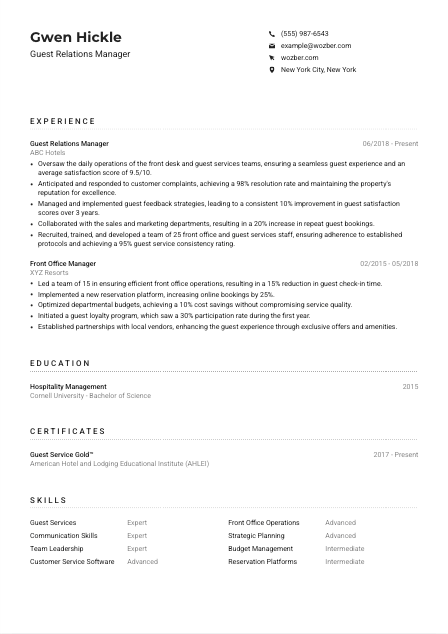
Guest relations work is easiest to judge when results are concrete. Replace broad duty statements with bullets that show what improved under your watch. The example CV does this well with details like a 98% complaint resolution rate and a 10% improvement in guest satisfaction scores over three years. Metrics like these show service recovery skill, follow-through, and operational consistency.
Quantify outcomes with guest satisfaction scores, resolution rates, check-in time, repeat booking increases, training scope, loyalty participation, or service consistency ratings. In this field, those figures tell a much clearer story than generic claims about delivering excellent service. Even one or two well-chosen numbers per role can show the scale of your impact.
Choose roles and bullets that support your candidacy for hospitality leadership. Experience involving front desk supervision, guest escalation handling, reservation workflows, staff coaching, and cross-department coordination should stay. Leave out achievements that do not strengthen your case for managing the guest journey at the property level.
A hiring team should come away knowing how many people you led, what service issues you handled, and what results improved because of your leadership. That is the standard this section needs to meet.
Education matters here because many Guest Relations Manager postings ask for a bachelor's degree in hospitality, business, or a related field. Keep this section straightforward and make it easy to confirm that you meet the baseline requirement, especially if your degree directly supports hotel operations or guest service management.
If the posting asks for a bachelor's degree in Hospitality Management, Business Administration, or a related field, make sure that credential is easy to find. In the example, a Bachelor of Science in Hospitality Management aligns directly with the employer's request and strengthens the match immediately.
Include degree, field of study, school name, and graduation year or date. That is usually enough for an experienced hospitality professional. A tidy format helps the reader confirm your academic background without interrupting the stronger story being told in your experience section.
If your coursework or degree focus connects closely to hotel operations, service management, or business administration, name it clearly rather than leaving it vague. A precise field can reinforce your understanding of guest service standards, operations, and leadership in a way a generic degree label cannot.
Early-career candidates may benefit from including coursework in hospitality operations, customer experience, revenue management, or organizational leadership. If you already have several years of front office and guest services experience, those details are usually less important than your service outcomes and management record.
Honors, hospitality competitions, leadership activities, or substantial projects can be useful if they connect to service management or operational discipline. Keep them selective. For a manager-level CV, academic extras should support your professional story rather than compete with it.
Your education section should quickly answer one question: do you meet the degree requirement for the role. When the answer is clear, the reader can return to the experience and results that matter most.
Certifications carry extra weight in hospitality when they speak directly to service quality, guest interaction, or operational standards. For a Guest Relations Manager, relevant credentials can reinforce your commitment to structured guest care, training, and professional development, especially when the employer names a preferred certification in the posting.
Some roles treat certifications as optional, but they still influence who stands out. Here, Guest Service Gold from AHLEI is listed as preferred, so including it can strengthen your application right away. When a posting names a hospitality credential, mirror that terminology if you hold it.
Choose certificates that connect to service excellence, front office operations, hotel management, complaint handling, or leadership development. A short, relevant list works better than a long collection of unrelated courses because it keeps attention on qualifications that matter to guest-facing management.
Include the issue date and, if applicable, renewal or active period. That helps employers understand whether your training is current. In the example, listing the Guest Service Gold certification with dates gives useful context without adding clutter.
Hospitality standards evolve with guest expectations, technology, and brand service models. Ongoing training in guest experience, conflict resolution, service recovery, or hotel operations can strengthen your CV over time, especially if you are moving from front office management into a broader guest relations leadership role.
Relevant certificates will not replace experience, but they can reinforce the service standards, training mindset, and hospitality focus employers want to see in a Guest Relations Manager.
A Guest Relations Manager needs a mix of operational, interpersonal, and leadership skills. The skills section should reflect how the role actually works: resolving issues quickly, supervising teams, using property systems accurately, and maintaining service standards across the guest journey. Keep the list targeted to what the hotel can use immediately.
Look for both direct requirements and the abilities implied by the responsibilities. In this case, the posting points clearly to customer service software, property management systems, reservation platforms, communication, team leadership, and guest satisfaction improvement. Those are the starting points for your list.
Hospitality hiring teams want to see both system competence and people management. Include tools such as property management systems, reservation platforms, or customer service software alongside skills like complaint resolution, staff training, cross-department coordination, and verbal communication. The example CV handles this balance well by pairing software knowledge with team leadership and guest services expertise.
Do not overload this section with every capability you have developed across your career. Prioritise the skills that support front office execution, service recovery, guest communication, and supervisory work. A shorter, more relevant list is easier for both an ATS and a hiring manager to connect to the actual demands of the job.
For this role, that usually means a clear mix of guest service tools, communication strength, leadership ability, and front office knowledge. If the list feels generic, tighten it until it reflects real hotel operations.
Language skills matter in guest relations because this work depends on clarity, tone, and trust in real-time interactions. English proficiency is essential for most hotel leadership roles, and additional languages can be valuable when properties serve international travelers or multilingual local markets. Present them clearly and honestly.
If the posting states that you must articulate well in English, list English prominently with an accurate proficiency level. For a Guest Relations Manager, strong spoken and written English supports complaint handling, guest correspondence, staff coaching, and coordination with other department heads.
If you speak other languages well, include them after English. Multilingual ability can help with check-in conversations, service recovery, VIP interactions, and personalized guest support. In some properties, that can be a meaningful differentiator, even when it is not listed as a formal requirement.
Terms such as Native, Fluent, Intermediate, and Basic are easy to understand and work well on CVs. Avoid overstating your ability. In guest relations, language claims are often tested quickly in interviews or on the job.
A luxury hotel, resort, or international brand may place more practical value on multilingual communication than a smaller local property. Highlight languages that would help you serve the likely guest base, but keep the section grounded in honest professional use rather than aspiration.
Only list languages you can actually use in guest-facing situations. If you can handle directions, requests, and problem resolution in another language, that supports the role. If not, leave it off. The value here comes from smoother guest interactions, not from filling space on the page.
For a Guest Relations Manager, language skills matter when they help you resolve issues clearly, welcome guests confidently, and support service across a diverse customer base.
The summary should give a hiring manager a fast read on the kind of hospitality leader you are. In a few lines, show your experience level, your area of strength, and the kind of guest service results you deliver. Keep it specific enough to sound credible and broad enough to fit the role you are targeting.
Start by identifying yourself in terms the employer will recognize, such as years in hospitality, front office leadership, guest relations, or service management. The example summary does this effectively by establishing more than 8 years in the hospitality industry and centering guest service and front office operations.
Choose strengths that reflect the job's priorities, such as leading guest services teams, improving satisfaction scores, resolving complaints, or coordinating with other departments. This keeps the summary anchored in the real work of the role rather than sounding like a generic hospitality profile.
Aim for a short paragraph that can be scanned in seconds. Brief references to service outcomes, operational leadership, or team development will land better than broad personality statements. In this profession, a summary earns attention when it points toward measurable service performance.
A final sentence can highlight your style as a leader, such as building service standards, coaching teams, or creating memorable guest experiences at scale. Keep it professional. Hospitality employers respond better to grounded leadership language than to generic enthusiasm.
By the time someone finishes your summary, they should already understand your level, your hospitality focus, and the service results you are known for. That sets up the rest of the CV well.
A Guest Relations Manager CV works when it connects service leadership to hotel results. If your contact details are practical, your experience shows front office impact, your education and certifications match the posting, and your skills reflect real guest-facing operations, the hiring team can quickly see your value.
Wozber's free CV builder can help you organise that story into an ATS-friendly CV format, refine role-specific wording with AI support, and strengthen ATS optimisation around the terms hospitality employers actually use. The final version should make one thing easy to judge: whether you can lead teams and deliver the level of guest experience the property promises.