



Use Wozber and land your dream job
Create CV
No registration required
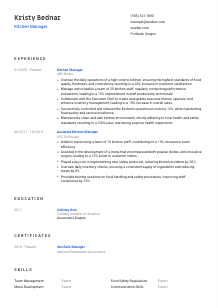
Commanding culinary chaos, but your CV is blending into the background? Check out this Kitchen Manager CV example, made with Wozber free CV builder. Learn how to season your leadership skills and kitchen knowledge to match the job's recipe requirements, making sure your career stays as sizzling as your sautés!
Kitchen managers are trusted with the part of the restaurant that breaks first when standards slip. Food quality, ticket flow, prep discipline, labour coverage, cost control, and sanitation all show up in the same shift, often at once. Your CV needs to make that operating control visible, not just your ability to cook or supervise.
When the CV is tailored well, hiring teams can quickly see whether you have run a kitchen at the pace, team size, and quality level they need. Wozber's free CV builder helps you shape that story into an ATS-compliant CV by matching your wording to the posting and keeping the layout clean, so your background in staffing, food safety, and daily kitchen execution is easier to recognize.
In restaurant hiring, the header is practical. Managers need to know who you are, how to reach you, and whether basic requirements such as location and communication can be confirmed without digging.
Set your name at the top in a clear, readable font so it anchors the page immediately. Kitchen hiring moves quickly, especially for operational leadership roles, so your CV should open with clean identification rather than decorative formatting.
Place "Kitchen Manager" directly under your name when that is the role you are pursuing. This keeps your positioning clear, especially if your recent title was something adjacent such as Assistant Kitchen Manager, Sous Chef, or Back-of-House Manager.
List a working phone number and a professional email address with no errors. For a role that depends on shift coordination, team communication, and fast hiring follow-up, missing or sloppy contact information creates unnecessary doubt.
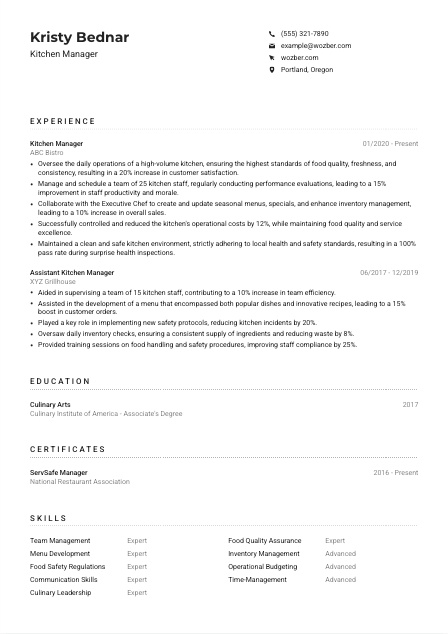
If the employer specifies a city or relocation requirement, include your current location or note that you are open to relocating. In this example, Portland, Oregon appears in the posting, so showing Portland in the CV header immediately removes a potential screening question.
Include LinkedIn or a professional website if it reinforces your background in restaurant operations, culinary leadership, or hospitality management. Skip social links that do not add hiring value. If you include a profile, make sure titles, dates, and certifications match the CV.
Your personal details should answer the practical basics in seconds: identity, contact, and any stated location requirement. Wozber's ATS optimisation helps keep that information structured and easy to parse.




This section carries the most weight for a kitchen manager. Hiring teams look for proof that you have handled production pressure, led a back-of-house team, maintained food standards, and kept costs and compliance under control during real service.
Read the job description closely and mark the responsibilities that define daily performance. For kitchen manager roles, that usually includes food quality and consistency, staff scheduling, training, sanitation, inventory, and expense control. Use those same ideas in your bullet points when they reflect your actual work.
List your positions in reverse chronological order with job title, employer, and dates. That structure helps employers quickly trace your progression from line leadership or assistant management into full kitchen oversight.
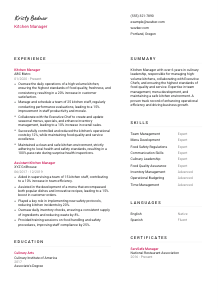
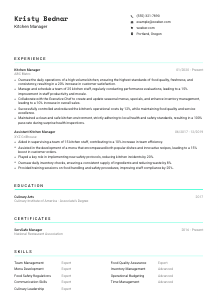
Write bullets that connect what you managed to what improved. Instead of stopping at "scheduled staff" or "oversaw kitchen operations," show the result. The sample CV does this well with lines such as managing 25 kitchen staff and improving productivity and morale by 15 percent.
Quantify performance with metrics that fit restaurant operations: customer satisfaction, labour efficiency, food cost reduction, sales lift from menu updates, waste reduction, inspection results, or team size. A bullet like reducing operational costs by 12 percent while maintaining quality is much stronger than a broad claim about efficiency.
Prioritise roles that show supervision, kitchen systems, menu collaboration, cost awareness, and health-code discipline. Older or unrelated jobs can be shortened or removed unless they add clear value. For this kind of opening, experience that shows control of service standards and back-of-house execution matters most.
Your experience should show that you can run service, lead staff, and protect quality at the same time. Wozber's ATS CV scanner can help you align your bullet points with the exact language used for staffing, safety, and kitchen operations in the posting.
Education is usually secondary to hands-on kitchen leadership, but it still adds useful context. Formal culinary training can support your credibility, especially when the role includes menu collaboration, food quality oversight, or staff development.
List the education that best supports your kitchen background, such as Culinary Arts, Hospitality Management, or Restaurant Management. Even when the posting does not require a degree, related education shows training in technique, kitchen systems, and professional standards.
Include the degree or diploma, school name, field of study, and graduation year or date. Keep the format straightforward so employers can scan it quickly between your experience and certifications.
If your program was directly tied to cooking, food production, or hospitality operations, state that clearly. In the example, an Associate's Degree in Culinary Arts supports the candidate's path into kitchen leadership without taking attention away from experience.
Food safety coursework, supervisory training, cost control classes, or hospitality operations programs can add value here or in certifications, depending on how your CV is structured. Include them when they support responsibilities named in the job posting.
If you are earlier in your career, academic honors, student leadership, externships, or kitchen projects can help show readiness. If you already have several years of management experience, keep this section brief and let your results in service operations lead.
For kitchen manager hiring, education should support the story your experience already tells. An ATS-friendly structure keeps those details visible without letting them crowd out your operational record.
Certifications matter more in kitchen leadership than in many other restaurant roles because they speak directly to compliance, food handling, and supervisory responsibility. When a posting mentions sanitation knowledge or a preferred credential, this section becomes more important.
Start with credentials tied to food safety, sanitation, and kitchen oversight. Here, the posting specifically prefers ServSafe Manager, so that certification should be easy to find if you have it.
Place the strongest role-related credentials first. For most kitchen manager CVs, ServSafe Manager, local food protection certificates, allergen training, or supervisory hospitality credentials will matter more than broad general-interest courses.
If a certification must be renewed or is tied to current compliance standards, include the date or active period. The example CV lists ServSafe Manager with an ongoing validity range, which helps reassure employers that the knowledge is current.
Renewing and adding relevant certifications shows that you stay current with sanitation rules, safe handling procedures, and operational best practices. That matters in kitchens where managers are responsible for both team behaviour and inspection readiness.
The right certification section reinforces that you can manage a kitchen safely as well as efficiently. Wozber's free CV builder and ATS CV scanner help keep those credentials visible in the parts of the CV where employers and ATS filters expect to find them.
A kitchen manager skill list should read like the real demands of back-of-house leadership. That means balancing people management, food execution, safety knowledge, inventory discipline, and day-to-day operational control.
Identify the capabilities the employer names directly and the ones implied by the work. In this posting, that includes large-team management, food quality control, sanitation knowledge, time management, communication, budgeting, and inventory coordination.
Choose skills that also appear in your bullet points or certifications. If you list team management, menu development, or food safety regulations, your experience should show where you used them and what results followed.
Do not overload this section with every kitchen or hospitality skill you have ever used. A tighter list is stronger. The sample CV keeps the focus on kitchen management, food quality assurance, inventory management, operational budgeting, and communication, which aligns well with the job requirements.
Every skill should point back to work a kitchen manager actually owns during service, prep, staffing, or compliance. Wozber's ATS-friendly CV format helps present those terms clearly without turning the section into a keyword dump.
Language ability can matter in restaurant operations because kitchen managers give instructions quickly, document issues clearly, and coordinate with chefs, staff, vendors, and front-of-house teams. Include languages when they support communication on the job.
If a role specifies language ability, include it clearly. This posting requires proficiency in spoken and written English, so English should appear with an accurate proficiency level.
Put the language you use most confidently in professional settings at the top. For many kitchen manager applications, that will be English, especially when the role includes staff communication, written schedules, ordering, and compliance documentation.
Extra languages can be useful in diverse kitchen teams, multi-unit operations, or restaurants serving varied communities. Spanish, for example, can be valuable in many back-of-house environments when it reflects your real communication ability.
Choose straightforward terms such as Native, Fluent, Intermediate, or Basic. Avoid vague descriptions. Managers need to be understood quickly during service, training, and safety instruction, so clarity here matters.
Only list languages you can actually use in a workplace setting. For a kitchen manager, that may include giving prep directions, coaching staff, reading procedures, or handling written communication. Accuracy is better than an inflated list.
If language skills help you lead teams and communicate clearly in a fast kitchen, they belong on the CV. Presented cleanly in an ATS-friendly format, they add practical value rather than filler.
The summary should give a hiring manager a fast read on the kind of kitchen you have led, the scope of your responsibility, and the standards you maintain. Keep it concrete enough to set up the rest of the CV.
Before writing, identify the two or three themes the posting emphasizes most. For kitchen manager jobs, that is often food quality, team leadership, sanitation, and cost control. Your summary should reflect those priorities directly.
Start with a concise line that positions you clearly, such as a Kitchen Manager with 6+ years in culinary leadership or high-volume back-of-house operations. That gives immediate context for the rest of the summary.
Mention capabilities that match the role and are backed up elsewhere in the CV. The example summary works because it combines high-volume kitchen management, collaboration with an Executive Chef, food quality standards, and operational improvement in one compact paragraph.
Aim for 3 to 5 sentences or a tight paragraph. The summary should introduce your leadership profile, not repeat your whole work history. Save detailed metrics for the experience section, where they carry more weight.
A well-written summary should make it clear that you can lead a kitchen, protect standards, and support the business side of service. Wozber's free CV builder can help shape that opening into ATS-compliant language that matches the role without sounding generic.
A kitchen manager CV works when it shows more than passion for food. It should show that you can lead a team through service, keep quality consistent, stay on top of sanitation, and manage cost pressure without losing control of the line.
Use Wozber to build a CV that is tailored, ATS-friendly, and grounded in the language employers use for kitchen operations. When your sections line up clearly around staffing, standards, safety, and results, hiring teams can quickly see that you are ready to run the kitchen they need.