




Use Wozber and land your dream job
Create CV
No registration required
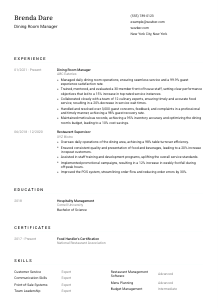
Orchestrating fine dining, but your CV feels half-baked? Feast your eyes on this Dining Room Manager CV example, created with Wozber free CV builder. Learn how to match your service savoir-faire with job needs, crafting a career journey as refined as your most elegant table settings!
Dining room management is judged in live service, where pacing, staff direction, guest recovery, and coordination with the kitchen all happen at once. A CV for this role needs to show that you can keep front-of-house operations steady under pressure, lift service standards, and protect the guest experience when things go off script.
When that experience is tailored well, hiring teams can quickly separate someone who has simply worked in restaurants from someone who has run service, coached a floor team, and managed operational details such as POS flow, inventory records, and budget performance. Wozber's free CV builder helps you shape that story into an ATS-compliant CV, so the operational scope behind your service results is easier to read and easier to shortlist.
For a Dining Room Manager, the header should feel clean, credible, and operationally ready. Keep it focused on the details a restaurant group or venue needs first: who you are, what role you do, and how quickly they can contact you.
Use your full name in a clear, readable format at the top of the page. This is a hospitality leadership role, so skip decorative styling and make your name easy to scan on both screen and print.
Place "Dining Room Manager" directly below your name if that is the role you are targeting. This immediately frames your background around front-of-house leadership rather than broader restaurant work, and it helps align your CV with the language used in the posting.
List a reliable phone number and a professional email address. In restaurant hiring, interview requests and shift-sensitive follow-up can move quickly, so accuracy matters. If your email still looks informal, replace it with a simple format based on your name.
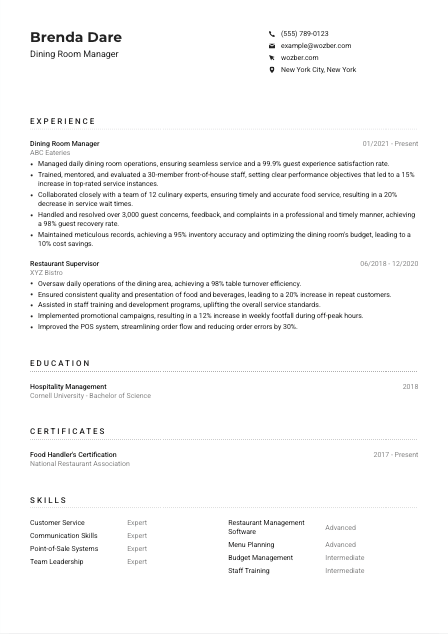
If the employer specifies a city, include it in your personal details. Here, listing New York City, New York directly answers a stated requirement and removes doubt about local availability. For other applications, only include location when it supports the role or hiring logistics.
A LinkedIn profile can help if it reinforces your restaurant leadership background, service metrics, and career progression. Make sure the job titles, dates, and headline match your CV so there is no confusion when an employer checks both.
This section does not need personality flourishes. It needs accurate contact information, a role-aligned title, and any location detail that directly affects availability for the dining room leadership job you want.




This is where hiring managers look for proof that you can lead the floor, manage guest expectations, and keep service moving smoothly during busy periods. The strongest Dining Room Manager experience sections show team scope, service outcomes, operational control, and how you worked with the kitchen and staff on the floor.
Before rewriting bullets, identify what the employer actually needs managed day to day. In this case, the posting emphasizes guest experience, front-of-house supervision, staff training, communication with guests and staff, food safety awareness, POS and restaurant software use, and budget or inventory oversight. Those priorities should shape which accomplishments you keep and which you cut.
List your jobs in reverse chronological order and make the move into management easy to follow. A path from Restaurant Supervisor to Dining Room Manager, like in the example CV, works well because it shows increasing responsibility for service execution, staff oversight, and operational performance.
Each bullet should show what you managed, how you improved service, or what operational issue you handled. Good Dining Room Manager bullets often cover team training, table flow, complaint resolution, kitchen coordination, POS accuracy, inventory control, or labour and cost performance. The example does this well by pairing duties with results such as a 99.9% guest satisfaction rate and a 20% drop in service wait times.
Quantified results make hospitality management experience much more credible. Use metrics such as guest satisfaction scores, wait time reduction, guest recovery rate, order accuracy, repeat customer growth, table turnover, staff size, inventory accuracy, or cost savings. The sample's 30-member front-of-house team and 10% budget savings are strong examples because they show both people leadership and financial control.
Prioritise accomplishments that support the target role. A Dining Room Manager CV should lean toward service leadership, staff coaching, cross-functional coordination, and guest issue resolution. Leave out unrelated achievements unless they clearly improved restaurant operations or customer experience.
Your experience section should make it easy to picture you running a dining room. If a hiring manager can quickly see service standards, staff leadership, guest outcomes, and operational control, this section is doing its job.
Education usually plays a supporting role for Dining Room Manager candidates, but it still adds context. It can reinforce your grounding in hospitality, service operations, and restaurant management, especially when paired with practical experience on the floor.
Start with your highest or most relevant education, especially if it connects to hospitality, business, or restaurant operations. A degree in Hospitality Management, like the example's Bachelor of Science from Cornell University, adds useful context for employers reviewing leadership potential in guest-facing operations.
List the school, degree, field of study, and graduation year or date in a simple structure. Dining employers do not need a long academic narrative here. They need to see the credential quickly and move back to your operating experience.
If the job posting does not require a degree, your education can still strengthen the application by showing formal exposure to service standards, hospitality operations, guest relations, or management fundamentals. That matters most when it complements hands-on restaurant leadership rather than trying to replace it.
Keep certifications such as a Food Handler's Certification in the certificates section unless your CV format combines them intentionally. That separation helps the reader distinguish academic background from compliance or operational credentials tied to food safety and restaurant management.
Include additional courses, workshops, or training if they strengthen your case for the specific opening. Topics such as food safety, beverage service, hospitality operations, customer experience, or team leadership can add value, but only if they stay concise and clearly support the role.
This section should confirm your educational foundation without competing with your work history. Keep it clean and relevant, and let it support the larger story of restaurant leadership and service management.
Certifications matter more in dining leadership when they connect directly to compliance, safety, or recognized management standards. They can help confirm that you understand sanitation requirements, staff accountability, and the operational side of guest service.
Review the job description for any credential that is preferred or explicitly mentioned. Here, a Food Handler's Certification is directly relevant because the role calls for in-depth knowledge of food safety and sanitation regulations.
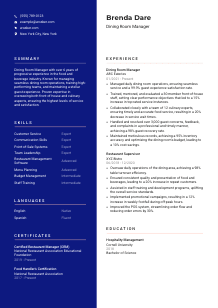
Prioritise certificates that strengthen your fit for front-of-house leadership, food safety oversight, or restaurant operations. In the example, both the Food Handler's Certification and Certified Restaurant Manager credential reinforce practical knowledge that matters in daily dining room management.
If a certificate is current, renewable, or still active, show that clearly. Current dates help employers see that your food safety knowledge or management training is up to date, which matters in regulated service environments.
As you move into larger teams, higher-volume service, or broader financial oversight, update your certifications accordingly. Additional training in food safety, alcohol service, supervisory management, or hospitality operations can strengthen future applications.
For a Dining Room Manager, certificates work best when they support real operating responsibilities. Keep the list focused on credentials that strengthen your authority in service, sanitation, and restaurant leadership.
Hiring teams usually scan the skills section to confirm the practical mix behind your experience. For this role, that means service leadership, guest communication, restaurant systems, and the operational judgment needed to keep the floor running well.
Start with the terms used in the posting and compare them against your actual background. Here, that includes team leadership, customer service, communication, restaurant management software, point-of-sale systems, and food safety knowledge. Using the employer's language helps both human reviewers and ATS screening connect your CV to the role more accurately.
List the capabilities most central to dining room management first. Customer service, team leadership, POS systems, staff training, conflict resolution, budget awareness, and coordination with kitchen staff usually belong near the top because they reflect what the manager handles during service and in pre-shift planning.
Choose skills that clearly support front-of-house leadership instead of filling the section with every hospitality term you know. The example CV stays on track by mixing people management skills with operational tools such as restaurant management software and point-of-sale systems. That balance tells a clearer story than a long generic list.
A useful skills section should confirm the practical strengths behind your experience. If the list reflects guest service, team oversight, restaurant systems, and day-to-day operational control, it will support the rest of your CV well.
In hospitality, language ability matters when it improves guest communication, staff coordination, and service consistency. For a Dining Room Manager, that usually starts with clear English and may extend to other languages that help in the local market or with a diverse guest base.
If the job description names a required language, list it clearly and use an honest proficiency level. Here, English is a critical requirement, so it should appear prominently. A label such as "Native" or "Fluent" quickly answers that part of the screening process.
After the required language, include any additional languages that improve communication with guests or staff. Spanish, for example, can be valuable in many dining environments because it supports smoother interactions across both front- and back-of-house teams.
Keep your levels easy to interpret with terms such as Native, Fluent, Intermediate, or Basic. Avoid vague descriptions. Hospitality employers need a realistic sense of how confidently you can speak with guests, handle service issues, or communicate during busy shifts.
Some restaurants and hospitality groups will value additional language skills more than others. If the operation serves an international clientele or relies on multilingual staff coordination, this section becomes more important. Tailor the order of languages to that reality when it applies.
Do not include languages just to make the CV look broader. List the ones you can actually use in guest interactions, service recovery, team communication, or training. In a dining room, practical communication matters more than a long list.
This section should help an employer understand how you communicate on the floor. Clear language levels, especially for English, can strengthen your application when guest interaction and team coordination are central to the role.
The summary sits at the top of the CV and should quickly establish your level, your operating strengths, and the kind of dining environment you are prepared to manage. For a Dining Room Manager, that usually means combining guest experience, team leadership, and front-of-house execution in a few focused lines.
Review the role and identify the two or three themes that should anchor your opening lines. Here, those are dining room operations, team leadership, guest satisfaction, and operational tools such as POS or restaurant management systems. That keeps the summary aligned with what the employer needs first.
Start with a direct line that states your role and experience level. The example summary does this effectively with "Dining Room Manager with over 6 years of progressive experience in the food and beverage industry." This gives hiring managers immediate context about your seniority.
Use the next sentence or two to describe the parts of the job you handle well, such as running smooth service, training front-of-house staff, resolving guest concerns, and coordinating with the culinary team. Focus on operating strengths, not personality traits.
Aim for 3 to 5 lines with language that reflects your actual track record. If you mention performance, tie it to outcomes that matter in restaurants, such as guest satisfaction, service flow, staff development, or cost control. Short, concrete summaries are easier to trust and easier to scan.
A well-written summary should tell the reader, within seconds, what level of dining room you can manage and what kind of service leadership you bring. Keep it tight, specific, and clearly connected to the role you are targeting.
Once each section reflects the realities of dining room management, your CV should show more than restaurant experience. It should show floor leadership, guest recovery judgment, team development, and operational control in a format that is easy to review.
Wozber's free CV builder can help you turn that experience into an ATS-friendly CV template with strong ATS optimisation, whether you are refining service metrics, matching the employer's language, or checking alignment with an ATS CV scanner. The end result should make one thing clear fast: you are ready to lead the dining room from the first shift.




