



Use Wozber and land your dream job
Create CV
No registration required
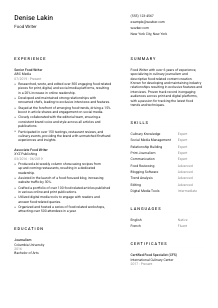
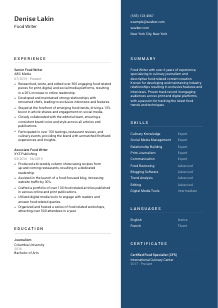
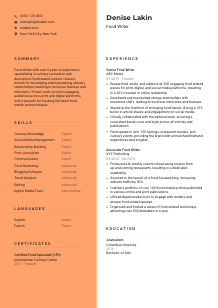
Serving up delicious reads, but your CV lacks flavor? Sample this Food Writer CV example, created with Wozber free CV builder. It shows how to blend your literary palate with editorial expectations, making your career as delectable as the dishes you describe!
Food writing gets judged on two fronts at once. Editors want prose that can make a dish, chef, or dining trend vivid on the page, and they also want reporting discipline behind it. A Food Writer CV needs to show both. It should quickly make clear that you can turn tastings, interviews, restaurant visits, and trend research into publishable work across print, digital, and social channels.
When that balance is missing, food journalists often get sorted into the wrong pile, strong writer but weak reporter, or deep food knowledge but limited platform range. Tailoring your CV with Wozber's free CV builder helps you align your language with the posting and present it in an ATS-friendly CV format, so hiring teams can see your editorial voice, sourcing ability, and multi-platform publishing experience without digging for them.
Food writing is a public-facing field. Your byline, contact details, and portfolio links should immediately support your credibility and make it easy for an editor to find your work, reach you quickly, and place you in the right market.
Use your full name as it appears on published work, newsletter posts, or contributor pages. Consistency matters in media hiring. If an editor searches your clips or social profiles, they should find the same byline without confusion.
Place "Food Writer" directly beneath your name if that is the role you are pursuing. This helps frame your background immediately, especially if your previous titles include variations such as editorial writer, columnist, or content producer. Keep the title aligned with the job posting rather than inventing a more creative label.
List a reliable phone number and a professional email address. Media hiring often moves quickly when an editor wants clips, availability, or freelance rates, so this section should be clean and easy to scan. Avoid casual email handles and make sure your voicemail and inbox are active.
If the role requires a specific market, reflect that clearly. Here, listing "New York City, New York" directly supports the posting's location requirement and also suggests familiarity with a local restaurant scene, events calendar, and source network. For other jobs, include location only when it helps answer a stated requirement.
A Food Writer CV is stronger when it links to published clips, a personal site, a digital portfolio, or a professional profile with recent work. Choose links that show variety, reviews, trend pieces, chef interviews, service journalism, or social storytelling. If you maintain a blog or newsletter, make sure the tone and quality match the level of publication you are targeting.
These details do more than identify you. They should confirm your byline, your market, and where an editor can quickly review the work behind your CV.




For Food Writers, experience is not just a timeline of jobs. It is proof that you can report, write, edit, and publish food coverage that connects with readers and meets editorial standards across different formats.
Read the job description the way you would read an editorial brief. Mark the recurring themes. In this case, those include writing for print, digital, and social media, maintaining chef and restaurateur relationships, following food trends, and attending tastings and events. Those priorities should shape which bullets you lead with and what language you mirror.
Start with your most recent position and include job title, publication or employer, and dates. For media roles, the employer name often carries weight, so keep the structure clean. If you worked freelance, on contract, or contributed to multiple outlets, present that work in a way that still shows continuity and platform range.
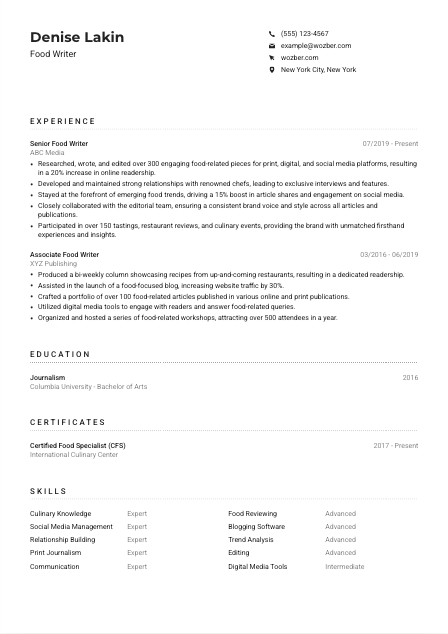
Your bullets should answer practical questions an editor will have. How much did you publish. What kinds of food stories did you cover. Which formats did you handle. The sample does this well with "Researched, wrote, and edited over 300 engaging food-related pieces for print, digital, and social media platforms," which quickly communicates volume, subject focus, and channel breadth.
Food writing impact is often measured through readership growth, engagement, social shares, recurring columns, traffic, newsletter performance, or exclusive access. Include those numbers where you have them. A result such as a 20% increase in online readership or a 30% lift in website traffic gives hiring teams a clearer sense of how your work performed beyond simply being published.
Prioritise work that shows culinary knowledge, source development, reporting credibility, and editorial judgment. Restaurant visits, interview access, review writing, trend coverage, and collaboration with editors all belong here. Less relevant hospitality experience can stay brief unless it directly sharpened your food reporting or subject-matter expertise.
By the end of this section, an editor should be able to see your publication history, your command of food coverage, and the audience results your writing has already produced.
Education carries weight in food media when it supports reporting craft, editorial standards, or subject expertise. Keep this section straightforward and let it reinforce the foundation behind your writing.
If the role asks for a bachelor's degree in Journalism, English, or a related field, make that easy to find. In the example, a Bachelor of Arts in Journalism aligns directly with the requirement and supports the candidate's editorial training.
Include degree, school, field of study, and graduation year or date. This section should read quickly. Editors and recruiters are usually checking for alignment and credibility here, not looking for a long narrative.
If your studies included magazine writing, reporting, criticism, digital publishing, or food studies, include that detail when it helps explain your path into food journalism. Use it selectively. One targeted detail is more useful than a long list of classes.
Early-career writers can benefit from including journalism labs, editorial internships, culinary workshops, or media fellowships that connect directly to food coverage. Once your publication history is established, those details matter less unless they are especially notable.
Honors, student publication roles, or writing awards can be useful if they relate to reporting, criticism, or publishing. Keep them relevant. The section should support your editorial development, not turn into a full campus biography.
This section should confirm that your writing background has formal grounding, especially when the employer has asked for journalism or English training.
Certificates are rarely the deciding factor for a Food Writer, but the right ones can add useful depth. They work best when they strengthen your subject knowledge or digital publishing profile.
Start with certificates that support food expertise, media skills, or adjacent editorial knowledge. This role does not require certification, so every item here should earn its space. A credential such as Certified Food Specialist can reinforce culinary knowledge without distracting from your writing portfolio.
Choose certificates that connect to restaurant criticism, food studies, nutrition reporting, digital publishing, SEO writing, multimedia storytelling, or audience development if those areas are part of your target roles. Relevance matters more than quantity.
Listing dates helps show whether a credential is current, recently earned, or part of longer-term professional development. That matters more when the certificate reflects an evolving area such as digital media tools or content strategy.
Food media changes with new platforms, audience habits, and culinary conversations. Short programs in newsletter strategy, video scripting, social storytelling, or food systems reporting can deepen your range and give you stronger material for future CV updates.
Use this section to add focused credibility, especially when a credential sharpens your culinary authority or expands the formats you can write for.
Editors look here for a quick snapshot of how you work. For a Food Writer, that means a blend of reporting ability, food knowledge, audience awareness, and platform fluency.
Start with the capabilities the posting spells out. Here, that includes strong culinary knowledge, descriptive and engaging writing, digital media proficiency, blogging tools, social media, relationship building, and editorial collaboration. Those should anchor the section before you add anything broader.
A useful Food Writer skills section mixes subject expertise with practical publishing tools. Include items such as food reviewing, editing, trend analysis, interviewing, social media management, CMS or blogging software, and audience engagement if they reflect your actual work. That balance shows you can both create strong copy and publish it effectively.
Place the most role-relevant skills near the top. In the example, culinary knowledge, relationship building, print journalism, food reviewing, blogging software, and trend analysis all support the job's priorities. Keep the list tight enough that every skill points back to food coverage, editorial production, or digital reach.
An editor should be able to scan this section and quickly understand your command of food journalism, your familiarity with digital publishing, and the tools or strengths you would bring to the desk.
Language skills are optional for many Food Writer jobs, but they can add real value when your reporting touches international cuisines, global restaurant scenes, or interviews with chefs and producers from different backgrounds.
Most food writing roles do not require additional languages, so treat this section as a strategic extra. If your work covers French technique, regional Italian foodways, or immigrant-owned restaurants, language ability can strengthen your reporting access and cultural fluency.
List English clearly, then add any other language that meaningfully supports your coverage or audience. In the example, fluent French could be relevant for culinary terminology, chef interviews, or international food writing. Lead with the language that best supports your editorial niche.
Add other languages when they help you research sources, review menus, attend events, or communicate with interview subjects. Leave out languages you cannot comfortably use in a reporting context.
Choose straightforward labels such as Native, Fluent, Conversational, or Basic. Overstating proficiency can become obvious quickly if the role involves live interviews, event coverage, or source outreach.
When a second language has helped you cover specific cuisines, translate material, or broaden sourcing, it becomes more than a nice extra. It shows range in how you gather and interpret food stories across cultures.
Languages are most useful here when they expand your access, sharpen your culinary context, or support the kind of food reporting you want to do next.
The summary should read like the top of a contributor bio with sharper hiring focus. In a few lines, show your editorial identity, food beat expertise, and the kind of publishing results that make you worth a closer look.
Before writing the summary, isolate the job's most important needs. For this opening, that means food writing experience, culinary knowledge, descriptive writing, digital platform fluency, relationship building, and trend awareness. Those themes should shape the wording of your first few lines.
State who you are and how long you have been working in the field. A line such as "Food Writer with 6+ years of experience in culinary journalism" immediately establishes beat and seniority. Keep it specific enough to separate you from general lifestyle or content writers.
Choose the qualifications that matter most for the target role and support them with concrete outcomes or scope. The sample summary works because it mentions industry relationships, exclusive features, cross-platform audience engagement, and food trend coverage rather than relying on broad claims about passion or creativity.
Aim for a short paragraph that could survive an editor's quick skim. Every phrase should earn its place. Focus on beat expertise, platform range, and notable results, then leave the detail for the experience section.
A well-shaped summary should make it immediately clear that you can report on food with authority, write for the right audience, and contribute from day one across the publication's chosen platforms.
With each section aligned to the role, your CV should now show more than an interest in food. It should present a clear record of reporting, publishing, sourcing, and audience engagement that matches how Food Writer roles are actually staffed.
Use Wozber's free CV builder to organise that experience into an ATS-compliant CV, then refine it with the ATS CV scanner and AI-powered tailoring features so the language of your clips, coverage areas, and platform strengths lines up with the posting. The final result should make your editorial range and culinary authority easy to recognize.