



Use Wozber and land your dream job
Create CV
No registration required
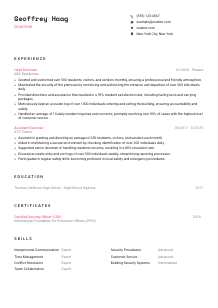
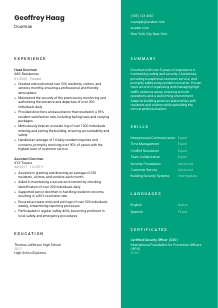
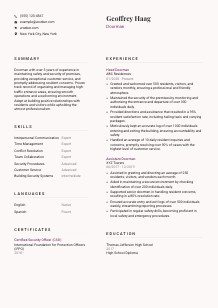
Guarding grand entrances, but your CV feels left out? Step into this Doorman CV example, created with Wozber free CV builder. Learn how to present your security and guest service skills to match job standards, ensuring your career opens doors to new opportunities as gracefully as you do!
A doorman is often the first person residents, guests, and vendors encounter, and the job blends hospitality with building security in every shift. Hiring teams want to see that balance on the page. Your CV should show that you can keep an entrance orderly, manage access with good judgment, handle resident requests calmly, and stay professional through constant foot traffic.
Screening for doorman roles usually narrows quickly around relevant service and entry-control experience. Wozber's free CV builder helps you shape that experience into an ATS-friendly CV format, so duties like visitor logging, resident assistance, and emergency procedure familiarity are easy to find and easy to connect to the opening. That makes it much clearer whether you can handle the lobby, the people flow, and the security expectations from day one.
In resident-facing building jobs, contact details are practical information, not filler. This section should identify you clearly, confirm that you're reachable for shift-based scheduling, and, when the posting asks for it, show local availability without making the top of the CV feel crowded.
Use your full name in a larger, clean font so it stands out immediately at the top of the page. For a doorman role, hiring teams often review many CVs from candidates with similar service backgrounds, so clear identification matters from the first line.
Place the target title directly under your name. If you are applying for a doorman opening, say "Doorman" rather than a broad label like "Customer Service Professional." It helps frame your experience around lobby operations, resident interaction, and access control instead of leaving the reader to interpret your direction.
Add a current phone number and a professional email address. Double-check both. Doorman hiring can move quickly, especially when buildings need coverage for rotating shifts, weekends, or holiday schedules, so missed calls and mistyped emails can cost you an interview.
If the employer asks for candidates based in a specific area, include your city and state. In the example, listing New York City, New York directly supports the stated local requirement. Use location this way only when it helps answer a real screening question.
A LinkedIn profile can help if it matches your CV and shows consistent job titles and dates. A personal website is usually unnecessary for doorman roles unless it supports related property, hospitality, or security work. Keep this section focused on information that helps an employer contact and place you.
At the top of the CV, clarity matters most. Give the employer your name, target role, contact details, and any required location information in a format that supports fast scheduling and straightforward review.




This section carries most of the hiring decision for a doorman CV. Buildings want to know whether you have handled resident traffic, visitor access, service requests, and routine security responsibilities in a real front-of-house setting. Your bullets should show both presence and judgment.
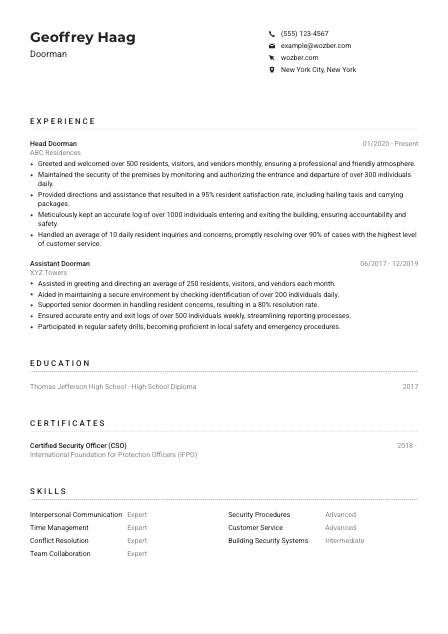
Start by pulling out the core duties from the job description and making sure your experience reflects them with real examples. For a doorman, that usually means greeting residents and visitors, authorizing entry, keeping logs, assisting with directions or packages, and responding to resident concerns. In the example CV, those duties appear in direct, concrete bullets instead of vague customer service language.
Use reverse-chronological order and include your job title, employer, and dates for each role. That format lets employers track your progression from support-level front desk or lobby work into more independent responsibility. Titles such as "Assistant Doorman" and "Head Doorman" immediately show scope and growth in a way generic labels do not.
Do not stop at listing routine tasks. Show how you handled the work and what standard you maintained. A bullet about assisting residents becomes stronger when it mentions quick response, professional service, or smooth building flow. The example bullet about hailing taxis, carrying packages, and supporting a 95% resident satisfaction rate works because it ties daily service to a measurable resident outcome.
Volume helps employers understand pace and trust. Count residents greeted, daily entries monitored, logs maintained, inquiries resolved, or satisfaction rates when you have them. In the sample, figures like 300 individuals monitored daily and more than 1000 entries logged make the scale of the work tangible. Use realistic numbers from your own shifts rather than inflated estimates.
Prioritise experience that proves you can manage the building entrance well. Front desk, concierge, hospitality, and security-adjacent work can all be relevant if you connect them to visitor handling, access procedures, incident awareness, and professional communication. Cut bullets that focus on unrelated back-office work unless they support the exact opening.
By the end of this section, the reader should understand how you operate at the door. Show traffic volume, resident interaction, access control, and day-to-day dependability clearly enough that your experience feels immediately usable in a live building environment.
Education is usually a straightforward section for doorman roles, but it still answers an important screening point. When a posting asks for a high school diploma or equivalent, make that information easy to find so the employer does not have to search for a basic qualification.
If the job calls for a high school diploma or equivalent, list it clearly. That is the baseline requirement in the provided opening, so the education section should confirm it without extra wording or explanation.
Include the school name, the credential earned, and the graduation year or date. For this kind of role, a clean entry is enough. The employer is usually checking that you meet the posted requirement, not looking for a long academic profile.
Write "High School Diploma" directly rather than leaving the degree field vague. Straightforward labeling helps during quick CV review and supports ATS matching when the job description includes exact education language.
If you completed coursework or school-based training connected to customer service, safety, hospitality, or emergency response, you can include it briefly. This is optional, but it can add context when your work history is still growing or when the role leans heavily on resident interaction and building procedures.
Honors, activities, or team-based responsibilities can stay if they show reliability, service orientation, or accountability. Keep them brief. For most experienced doormen, the education section should stay compact because the work experience section carries more hiring weight.
For a doorman application, education should remove doubt, not take up space. State the diploma clearly, format it cleanly, and let the rest of the CV focus on how you handle residents, visitors, and building operations.
Certifications are not always required for doorman jobs, but the right ones can strengthen your CV, especially when they connect to security awareness, emergency response, or professional service standards. Include them when they add real credibility to the work you claim elsewhere on the page.
Focus on credentials that relate to the mix of front-entry security and resident-facing service. A certificate such as Certified Security Officer supports the access-control side of the role and complements responsibilities like monitoring entrances and maintaining building safety.
Do not fill this section with unrelated short courses. Prioritise certificates in security, emergency preparedness, customer service, first aid, or similar areas that help in residential or mixed-use building settings. Relevance matters more than volume here.
Include the issue date and, if applicable, the active period. Employers want to know whether your training is current, especially for certificates tied to safety procedures or operational compliance.
If you are applying to residential towers, luxury properties, or buildings with stricter safety expectations, updated training can help. Emergency procedure refreshers, de-escalation training, or building security courses can strengthen your profile when they reflect the environment you want to work in.
A focused certificate section can support the two things doorman employers care about most: dependable service and sound judgment around building safety. Include only the credentials that make those qualities easier to believe.
A doorman skills section should read like the operating toolkit for the job. That means people skills, security awareness, and the practical abilities needed to manage a steady flow of residents, guests, deliveries, and day-to-day requests without losing composure or control.
Start with the language used in the job description. If the employer asks for interpersonal communication, approachable service, and familiarity with safety procedures, those should appear in your skills section when they reflect your real background. This keeps your CV aligned with both ATS terms and hiring priorities.
Lead with the skills that affect daily performance at the entrance. Interpersonal communication, customer service, conflict resolution, security procedures, time management, and teamwork all make sense for this profession. In the sample CV, that mix works because it reflects both resident service and building control.
Use a clean list and avoid overcrowding it with every ability you have ever used. If your format allows, group skills by service, security, and operations. That makes it easier for the reader to connect your strengths to common doorman tasks such as greeting visitors, checking access, managing logs, and handling resident concerns.
This section should quickly confirm that you can communicate well, stay alert, and handle a resident-facing security post with professionalism. If the skills list feels specific to actual building operations, it is doing its job.
Language skills can matter in doorman work because the role involves constant face-to-face interaction. In residential buildings, clear communication helps with directions, visitor screening, resident requests, and calm handling of small issues before they become larger ones.
If the job specifies English proficiency, list English prominently with an honest fluency level. That requirement appears directly in the provided posting, so it should be visible right away.
Additional languages can be useful in buildings with diverse residents, visitors, and vendor traffic. In the example, Spanish adds practical value because it supports smoother day-to-day interactions beyond the required English baseline.
Terms like Native, Fluent, Conversational, or Basic are easier to understand than vague descriptions. Be accurate. If a resident or manager switches languages during an interaction, your stated level should hold up in real use.
For doorman roles, extra language skills are most useful when they help with directions, package questions, entry communication, and resident comfort. Include them when they strengthen your ability to serve the people coming through the building, not just to add another line to the CV.
In large cities and busy residential properties, even conversational ability in another language can become useful over time. Ongoing language development can support smoother service and help you stand out for buildings with an international resident base or frequent visitor traffic.
For this role, language skills matter when they make communication smoother at the entrance, in the lobby, and during resident requests. Put required English first, then add any additional languages that strengthen service in a building setting.
The summary sits near the top of the CV, so it should quickly establish what kind of doorman you are. A hiring manager should come away knowing your years of experience, the setting you have worked in, and the balance you bring between resident service and building security.
Read the posting closely before writing this section. If the role emphasizes greeting residents, managing entry, responding to inquiries, and following safety procedures, your summary should reflect that mix. This keeps the opening lines of the CV aligned with the work you are applying to do.
Open with your title and experience level. A line such as "Doorman with 5+ years of experience" gives immediate context and works well because it tells the employer both your function and your tenure without extra buildup.
Use the next sentence or two to cover the areas that matter most in doorman hiring: resident service, entrance monitoring, visitor handling, and prompt response to concerns. The sample summary works because it ties safety, smooth operations, and professionalism together in language that matches the role.
Aim for a short paragraph of three to five lines. Include enough detail to establish your value, but avoid repeating every skill or duty listed elsewhere. The best summaries sound grounded in real lobby work, not generic customer service phrasing.
A well-written summary should make your experience feel immediately relevant to a residential building or front-entrance team. Keep it brief, role-specific, and focused on the qualities that matter most at the door: professionalism, awareness, and resident service.
A doorman CV works when it makes everyday performance visible: how you greet people, control access, keep accurate records, respond to resident needs, and stay composed across busy shifts. When those details are specific, your application reads like someone who can step into the lobby and handle the work.
Use Wozber's AI CV builder to tailor your wording, strengthen ATS optimisation, and organise your experience in an ATS-compliant CV that reflects the role clearly. The finished CV should make one thing easy to judge: whether you can represent the building well while keeping it secure.




