



Use Wozber and land your dream job
Create CV
No registration required
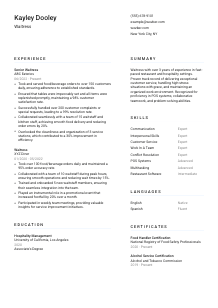
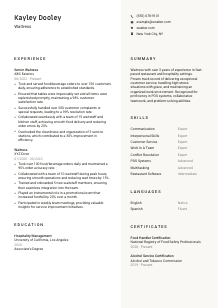
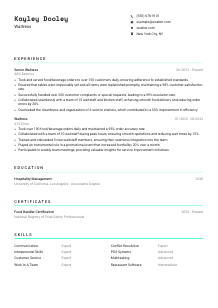
Juggling orders like a pro, but your CV isn't getting a seat at the interview table? Savor this Waitress CV example, made with Wozber free CV builder. Learn how to present your service skills smoothly to match the job recipe, ensuring your career is served up just right!
Restaurant service moves fast, and waitress CVs are often too vague about what that pace actually looked like. Hiring managers want to see whether you can keep orders accurate, stay composed during a rush, coordinate with the kitchen, and maintain a polished guest experience across every table you handle. Your CV should make those service habits visible, not leave them buried under generic customer service language.
A tailored CV changes what stands out first. When your wording matches the restaurant's needs, from POS use to complaint handling and floor teamwork, Wozber's free CV builder helps you shape an ATS-compliant CV that surfaces the experience most relevant to service flow and guest care. That gives the hiring team a quicker read on whether you can step into a high-volume dining room and perform from day one.
This section needs to do one job well. Give the employer clean, usable contact information and immediately remove any doubt about basic logistics for the role, especially title and location when those are stated in the posting.
Use your full name in a clear, readable format at the top of the page. Keep the styling simple and professional so the focus stays on your application, not on design choices. In restaurant hiring, managers often review CVs quickly between service periods, so clean presentation matters.
Place "Waitress" directly under your name if that is the title used in the job ad. This creates immediate alignment with the position and helps avoid confusion if your past employers used nearby titles such as Server or Dining Room Attendant. Match the posting when the responsibilities are the same.
Include a reliable phone number and a professional email address. These roles are often filled quickly, and interview requests may come by phone during active hiring periods. Make it easy for a manager to reach you without sorting through unnecessary details.
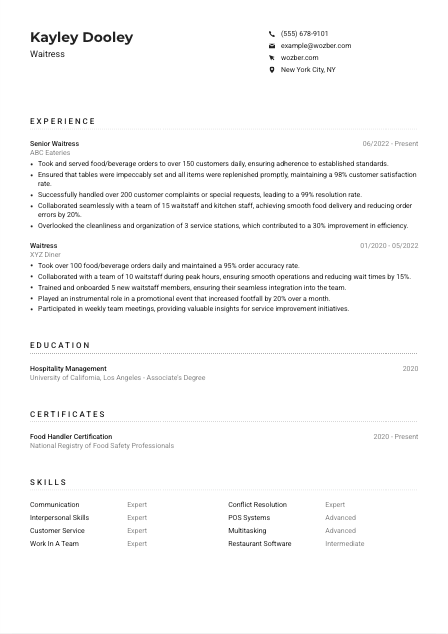
If the employer asks for someone based in or willing to relocate to a specific city, show that clearly in your personal details. In the example, listing "New York City, NY" works because the posting specifically calls for that location. Treat this as tailoring to the role, not as a rule for every waitress CV.
A LinkedIn profile can be useful if it is current and supports your CV with matching job dates, hospitality experience, or manager recommendations. If you include one, make sure it reflects the same service history, certifications, and job titles shown on your CV.
Your personal details should answer the practical hiring questions right away: who you are, what role you want, how to contact you, and whether you meet any location requirement in the posting. Keep it clean and accurate so the reader can move straight to your service experience.




For a waitress role, experience is where employers look for proof of pace, accuracy, guest handling, and teamwork. They are not only scanning for restaurant names. They want to see how many guests you served, how you handled busy shifts, and whether your work improved service quality or reduced mistakes.
Before editing your bullets, identify the recurring operational needs in the posting. Here, that includes taking and serving orders, handling guest concerns, working with kitchen staff, maintaining dining areas, and using POS systems. Once you know those priorities, rewrite your experience so those exact parts of your background are easy to find. The example does this well with bullets tied directly to order volume, service standards, and complaint resolution.
Start with your most recent restaurant or hospitality position and work backward. For each role, include your job title, employer name, and dates of employment. That structure lets hiring managers quickly see whether you have recent fast-paced floor experience, which matters more here than older unrelated work.
Do not stop at "took orders" or "served customers." Add the scale, pace, or outcome. A stronger bullet sounds like serving 100+ guests per shift, maintaining high order accuracy, resolving guest issues quickly, or supporting smoother ticket flow during peak periods. In the sample CV, "reduced order errors by 20%" and "maintained a 98% customer satisfaction rate" work because they show performance, not just responsibility.
Restaurant work gives you plenty of measurable material. Use counts of guests served, tables managed, order accuracy, satisfaction scores, wait-time improvements, upselling results, training contributions, or service-station efficiency. Even one or two concrete numbers per role can make your CV feel grounded in real shift performance.
Prioritise accomplishments that show guest service, teamwork during rushes, complaint handling, cleanliness, and smooth coordination with hosts, bartenders, runners, or kitchen staff. If you have extra space, include training new hires or helping with promotions only when those points support your value in service operations, as they do in the example.
After reading this section, a restaurant manager should be able to picture you on the floor: handling volume, keeping orders accurate, supporting the team, and staying steady when service gets busy. That is the standard your experience bullets need to meet.
Education usually plays a supporting role on a waitress CV, but it can still strengthen your application when it connects to hospitality, customer service, or food and beverage operations. Keep it straightforward and give extra visibility to training that relates to restaurant work.
Many waitress roles do not require a degree, so start by confirming whether the employer asks for one. If not, include your highest completed education and give more attention to hospitality-related study when you have it. In the example, an Associate's Degree in Hospitality Management adds useful context because it supports front-of-house service work.
List your degree, field of study, school name, and graduation year or date. Keep the entry easy to scan. Restaurant hiring rarely depends on academic detail, so clarity matters more than elaboration here.
If your coursework or degree directly connects to restaurant operations, guest service, or hospitality management, make that visible. It shows formal exposure to service standards, guest relations, and hospitality environments, which can help if you are competing against candidates with similar floor experience.
Short courses in food safety, guest relations, wine service, mixology, or hospitality operations can strengthen this section if you do not have many certifications or if the training is especially relevant to the restaurant's concept. Keep the focus on training that supports real front-of-house work.
Add honors, leadership, or event work only if they reinforce service-related strengths such as organisation, teamwork, or hospitality exposure. For example, helping run a student hospitality event is more relevant than listing unrelated campus activities.
Education should support your service profile, not compete with it. If it shows hospitality knowledge, customer-facing training, or a disciplined work history, it has done its job.
Certifications can carry real weight in food service because they connect directly to compliance and day-to-day operations. When a posting mentions food handling or alcohol service requirements, this section becomes much more than a formality.
Put food handler and alcohol service certifications first when the role mentions them. These credentials show that you understand regulated parts of restaurant work and may be able to start serving with less onboarding. The example CV handles this well by listing both clearly.
Do not crowd this section with every course you have ever taken. Prioritise certifications that support restaurant service, guest safety, compliance, and beverage handling. If a credential does not strengthen your ability to work a dining room, leave it out.
Include the issuer and date, and make it clear if the certification is current. Restaurants often need active credentials for scheduling and compliance, so this detail helps the employer gauge readiness without extra follow-up.
If you plan to move into higher-end service, bar service, or supervisory front-of-house roles, keep this section updated with relevant certifications. Ongoing training in responsible alcohol service or hospitality operations shows professional momentum in a field that values dependability and standards.
For waitress roles, the right certifications tell an employer you are prepared for the practical side of service, from safety rules to alcohol compliance. If the posting names them, make them easy to find.
A waitress skills section should read like the profile of someone who can keep service moving, communicate well with guests and coworkers, and handle restaurant systems without slowing the floor down. Choose skills that reflect how the job is actually done.
Start with the language used in the posting. Here, that includes communication, interpersonal skills, customer service, teamwork, handling high-stress situations, POS systems, and restaurant software. Mirror those terms when they match your actual background so both hiring managers and ATS screening can recognize the fit.
Combine soft skills with practical restaurant abilities. Strong options include conflict resolution, multitasking, order accuracy, menu knowledge, POS use, cash handling, table maintenance, and coordination with kitchen staff. The sample CV does this well by mixing customer service strengths with POS and restaurant software experience.
Do not list broad traits that you cannot support elsewhere in the CV. Focus on skills that show up in your work history, such as complaint handling, team coordination during peak hours, or maintaining fast service with low error rates. A shorter, sharper list is more convincing than a long inventory of vague strengths.
Every skill in this section should connect to restaurant performance. If a hiring manager can trace it to better guest service, smoother teamwork, cleaner execution, or stronger use of POS tools, it belongs here.
Language ability can be genuinely useful in restaurants, especially in cities and venues that serve a diverse customer base. This section should stay factual and should reflect how well you can actually communicate with guests and coworkers during service.
If the posting states that English is required, list English first with your proficiency level. That immediately answers a stated hiring need. In the example, "English - Native" works because it directly matches the requirement.
Extra languages can strengthen your CV when they are relevant to guest interaction, upselling, resolving questions, or supporting a multilingual team. In many restaurants, Spanish can be especially useful for guest service or communication during busy shifts, but only include languages you can comfortably use.
Use clear labels such as Native, Fluent, Intermediate, or Basic. Avoid overstating your ability. In restaurant work, language skill becomes obvious quickly when taking orders, answering menu questions, or handling special requests.
This section can quietly show that you are prepared to serve a broader mix of guests and communicate more smoothly in a busy environment. That is especially useful in high-traffic hospitality settings where clear communication affects speed, accuracy, and guest comfort.
Keep your language section honest and practical. The value here is simple: showing that you can communicate clearly with the people you serve and the team you work beside.
The summary sits at the top of the CV, so it should quickly establish your level, environment, and strongest service strengths. For waitress roles, that usually means experience in fast-paced settings, guest service quality, teamwork, and any operational strengths that matter to the opening.
Start with a direct line that states your title and relevant background, such as experience in fast-paced restaurants, diners, cafés, or hospitality venues. The sample summary works because it immediately tells the reader that the candidate has more than 3 years in high-volume service environments.
Use the next sentence to highlight two or three capabilities that match the role closely, such as customer service, handling pressure, POS proficiency, teamwork, or complaint resolution. Pick the strengths you can prove in your experience bullets so the summary feels consistent rather than inflated.
Aim for three to five lines with clear service language. Skip broad personality claims and focus on the combination of restaurant pace, guest care, and operational reliability. A hiring manager should be able to read the summary and immediately understand what kind of shift coverage you can provide.
A good summary gives the employer an immediate sense of your restaurant background and how you work under pressure. When it is tailored well, the rest of the CV reads as proof of that first impression.
Waitress CVs work best when they show the realities of service clearly: guest volume, order accuracy, teamwork with the kitchen, complaint handling, cleanliness, and confidence with POS tools. Keep each section focused on how you perform in a live dining environment, and tailor details like location or certifications when the posting specifically asks for them.
Wozber's free CV builder helps you organise that experience into an ATS-friendly CV format, and its ATS CV scanner can help you match your wording to the job description more precisely. The final result should make one thing easy to judge: whether you can step into a busy restaurant and deliver steady, professional service.




