



Use Wozber and land your dream job
Create CV
No registration required
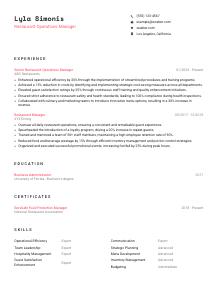
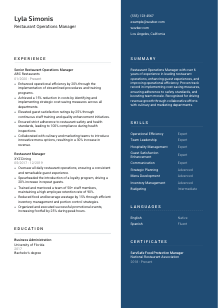
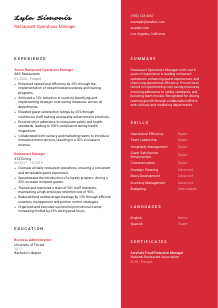
Tasting success from behind the scenes, but your CV doesn't sizzle? Sample this Restaurant Operations Manager CV example, created with Wozber free CV builder. Learn how to mix your managerial mastery with the specifics eateries want, giving your career all the flavor it deserves!
Restaurant operations management is judged in the middle of constant movement. Service has to stay smooth, labour has to stay controlled, food safety cannot slip, and guest experience has to hold up even when volume spikes. Your CV needs to show that you can run that environment, improve weak processes, and keep both people and numbers moving in the right direction.
Hiring teams sort quickly between managers who simply supervised shifts and operators who improved margins, trained teams well, and kept standards consistent across the floor and back of house. Wozber's free CV builder helps you tailor that story into an ATS-compliant CV, so terms like guest satisfaction, cost control, scheduling, and health compliance are easy to match to the posting and easy to connect to your actual operating results.
Restaurant leadership starts with trust and clarity. Your contact section should look polished, current, and aligned with the role before the hiring team gets to staffing results, P&L oversight, or guest satisfaction metrics.
Place your name prominently at the top using a clean, readable format. For management roles in hospitality, presentation matters. A hiring manager should be able to identify you immediately without hunting through the page.
Add the job title directly beneath your name when it matches the role you are pursuing. Using "Restaurant Operations Manager" tells the reader right away that your background is built around running service, teams, and operating performance rather than a narrower front-of-house or assistant role.
Include a reliable phone number and a professional email address. Check both carefully. In a role where precision affects scheduling, vendor coordination, and daily execution, even basic details should look dependable.
If the posting specifies a local requirement, list your city and state clearly. Here, Los Angeles, California matters because it removes uncertainty about relocation and local availability. For other roles, use location only when it supports the application.
Include LinkedIn or a professional website only if it reinforces your restaurant management background. Keep it consistent with your CV, especially around multi-unit exposure, training leadership, financial oversight, or compliance accomplishments.
This section should answer the basic hiring questions fast: who you are, what role you are targeting, and whether you are reachable and available. That keeps the focus on your operational track record.




For a Restaurant Operations Manager, experience is where the hiring decision usually starts. Employers want to see how you handled service standards, labour, training, cost control, compliance, and cross-functional coordination in a live restaurant environment.
Read the job description closely and mark the operating themes that repeat. In this case, efficiency, cost-saving measures, guest satisfaction, staff management, budgeting, and collaboration with culinary, marketing, and finance all deserve space in your bullets. Those are the outcomes your experience section should answer directly.
List roles in reverse chronological order with your title, employer, and dates. That format helps a hiring manager follow your progression from running a single location or shift team to owning broader operational responsibility.
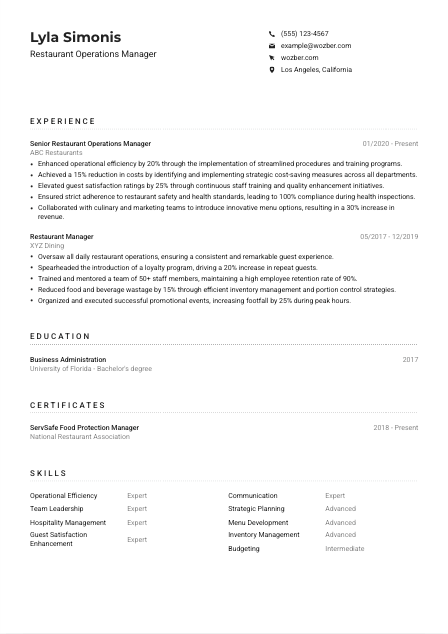
Focus each bullet on a result that matters in restaurant leadership. Good examples include reducing waste, improving table turn efficiency, lifting guest satisfaction scores, training staff to standard, or tightening SOP execution. The sample CV does this well by tying actions to outcomes such as stronger procedures, staff training, and revenue growth from cross-department work.
Numbers carry weight in restaurant operations because they show command of labour, costs, volume, and service outcomes. Use metrics such as percentage reductions in food waste, increases in repeat guests, health inspection scores, employee retention, or revenue growth. "Reduced costs by 15%" or "improved guest satisfaction ratings by 25%" says far more than a generic claim about leadership.
Prioritise experience that reinforces your ability to lead operations, not just participate in them. If an older role does not add anything about staffing, budgets, guest experience, compliance, or process improvement, trim it back. The section should build a clear case that you can oversee a full restaurant operation with measurable business impact.
Your experience section should show that you improved the restaurant, not that you were present while it operated. Strong bullets connect your decisions to profit, standards, team performance, and guest outcomes.
Education matters most when it confirms the business or hospitality foundation behind your operating decisions. For this role, the degree is less about academic detail and more about showing formal preparation in management, finance, or hospitality systems.
If the posting asks for a bachelor's degree in Business Administration, Hospitality Management, or a related field, make that easy to spot. A direct match helps immediately, especially for employers screening for baseline management qualifications.
List your degree, field of study, school, and graduation year. Keep the formatting straightforward so the reader can confirm the credential quickly and move on to your operating background.
Use the formal wording of your degree and major. In the example, "Bachelor's degree" in "Business Administration" aligns neatly with the posting. If your degree is in a related area, name it plainly rather than trying to stretch the wording.
Most experienced restaurant operators do not need a long course list. Add selected coursework only if it directly supports the role, such as hospitality operations, finance, food service management, organizational behaviour, or leadership development.
Honors, student leadership, and projects can help if you are earlier in your career. With 5+ years in operations, they should stay brief unless they connect directly to hospitality, business performance, or people leadership.
Keep this section concise and relevant. It should confirm that you meet the degree expectation and support the management side of your restaurant background without distracting from experience.
In restaurant operations, certifications are most valuable when they strengthen your credibility around food safety, compliance, and day-to-day accountability. They matter because they connect directly to inspection readiness, staff training, and risk control.
Check whether the employer names a preferred or required credential. Here, ServSafe Food Protection Manager is preferred, so anyone who holds it should feature it clearly. That gives immediate support to your compliance and food safety background.
Prioritise certifications tied to restaurant execution, sanitation, alcohol service where relevant, workplace safety, or management training. A certificate should earn its place by showing you can uphold standards that affect guests, staff, and regulatory compliance.
Add issue dates and renewal periods when the certification has an active status or expiration cycle. That matters for credentials like ServSafe because employers often want to know whether your training is current.
Restaurant operations change with regulation updates, safety practices, labour rules, and service models. Refreshing certifications or adding targeted training shows that you keep your operation current rather than relying on outdated practices.
Certifications should strengthen the parts of your CV tied to safety, compliance, and disciplined management. For this role, they work best when they back up the standards you claim to lead.
A Restaurant Operations Manager is hired for practical control of service, teams, costs, and standards. Your skills section should reflect that operating range, not read like a generic management checklist.
Start with the capabilities the posting emphasizes. Here, leadership, interpersonal communication, operational efficiency, guest satisfaction, budgeting, and knowledge of health standards all belong on the shortlist. Mirror the language where it truthfully reflects your experience.
Lead with the skills that shape restaurant results: staff training, scheduling, inventory control, cost management, SOP implementation, and service quality. In the sample CV, "Operational Efficiency," "Team Leadership," and "Guest Satisfaction Enhancement" are strong examples because they connect directly to the work being hired for.
Do not overload this section with every skill you have touched. A shorter list of relevant operational and leadership skills is more convincing than a broad catalogue. Choose the skills you would be ready to discuss through real examples such as labour optimisation, vendor coordination, or health inspection compliance.
Every skill listed should point back to restaurant performance. When the section is tailored well, it reinforces the same picture shown in your experience bullets: a manager who can lead people, control operations, and protect guest standards.
Language details matter in restaurant management when they affect training, policy communication, guest service, and document handling. This section is usually short, but it can still support the application when the posting mentions a language requirement directly.
If the role specifies English proficiency or the ability to read complex texts in English, list English clearly with an accurate proficiency level. That covers an explicit requirement tied to procedures, compliance documents, and operational communication.
Place the required or most useful language first. For this position, English belongs at the top. That keeps the section aligned with the posting and the realities of reading policies, reports, schedules, and financial materials.
Additional languages can be a real asset in restaurants, especially for team leadership and guest interaction in diverse markets. Spanish, for example, can support staff training and day-to-day communication, but it should remain an added strength rather than a substitute for the required English proficiency.
Use clear levels such as Native, Fluent, Conversational, or Basic. Honest labeling matters because language ability affects real tasks, from explaining procedures to resolving guest issues.
In some locations, extra language capability adds practical management value. A market like Los Angeles may reward Spanish or other commonly spoken languages because they can improve communication with both employees and guests, but that remains a context advantage rather than a universal requirement.
List languages that genuinely support communication, training, and service. For this role, clear English proficiency comes first, and additional languages can add practical value in the right market.
Your summary should quickly place you at the right level of restaurant leadership. In a few lines, it needs to show the scale of your experience and the kinds of operating results you have delivered.
Pull out the themes that matter most for the opening before drafting anything. For this one, that includes operational efficiency, profitability, guest experience, team leadership, and compliance. Your summary should echo those priorities in natural language.
Start with your title and years of relevant experience. A line such as "Restaurant Operations Manager with 6+ years of experience" gives the hiring team immediate context about your level and focus.
Choose strengths that match how restaurant operators are evaluated. Strong options include cost control, staff development, process improvement, safety compliance, and guest satisfaction growth. The sample summary works because it ties leadership experience to efficiency improvements, safety standards, and revenue-driving collaboration.
Aim for three to five lines and avoid generic personality language. Use the space for operating impact, such as improving margins, raising guest ratings, reducing waste, or strengthening team performance. That gives the reader a concise management profile before they reach the detailed bullets below.
When this section is written well, the rest of the CV reads with more clarity. The hiring team should reach your experience already expecting to see stronger operations, better guest results, and disciplined restaurant leadership.
A Restaurant Operations Manager CV works when it makes your operating judgment easy to see. The hiring team should quickly understand how you improve service standards, control costs, train teams, and keep the restaurant compliant and profitable.
Use Wozber's free CV builder to tighten structure, tailor wording, and create an ATS-friendly CV template that reflects the language of the job posting without sounding forced. Pair that with Wozber's ATS CV scanner if you want a sharper view of missing requirements, keyword alignment, and section-level match rate before you apply.
By the time you send it, your CV should show a manager who can run the floor, guide the team, and move the business forward.




