



Use Wozber and land your dream job
Create CV
No registration required
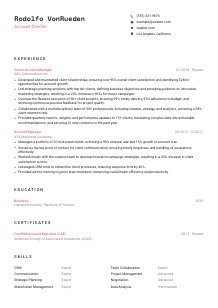
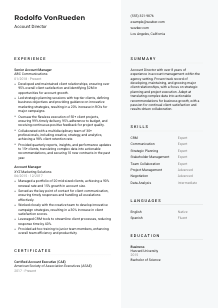
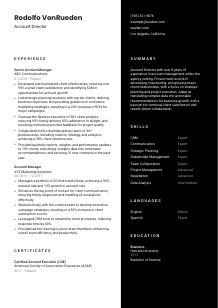
Charting account triumphs, but your CV feels off the balance sheet? Check out this Account Director CV example, created with Wozber free CV builder. It shows how to match your strategic leadership with job specifics, driving your career narrative to the top tier, just like your clients!
Account Director hiring tends to move quickly once a CV shows two things clearly: you can grow client business, and you can keep complex work moving across teams without losing trust. Titles alone do not prove that. Your CV needs to show the kind of account ownership you have handled, how you influenced strategy, and what happened to retention, revenue, budget control, or campaign performance under your lead.
When those points are tailored to the target role, hiring teams can tell faster whether your background leans toward true account leadership rather than support-level client service. Wozber's free CV builder helps you line up your wording with the job description in an ATS-friendly CV format, so strengths like account growth, strategic planning, and cross-functional delivery are easier to spot early.
For an Account Director, the header should read like clean client-facing communication. It needs to be easy to scan, professionally presented, and aligned with any practical requirement the employer has already stated.
Place your full name at the top in the most visible text on the page. This is basic formatting, but it matters in a role built on presentation and polish. If your CV looks cluttered before the reader reaches your experience, that undercuts the executive presence expected in senior client leadership.
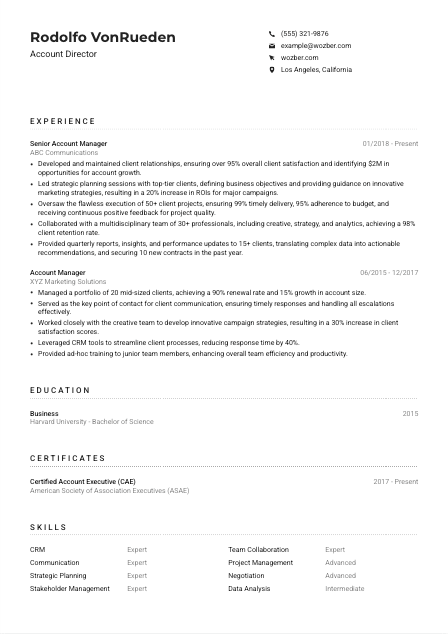
Add "Account Director" under your name when that is the role you are pursuing. It immediately frames your background in the right lane, especially if your recent title is Senior Account Manager, Group Account Supervisor, or another adjacent role. In the example CV, using "Account Director" helps connect prior agency-side work to the next-level scope the employer wants.
Include a reliable phone number and a professional email address. If a posting includes a location requirement, reflect that accurately in your city and state. Here, listing Los Angeles, California directly supports a stated requirement without forcing the hiring team to guess about relocation or local availability.
Add a LinkedIn profile or relevant professional website if it strengthens your candidacy. For Account Directors, this can reinforce client portfolio depth, leadership progression, industry focus, or speaking and thought leadership in marketing and account management. Check that every link works and that the profile matches the CV's dates, titles, and achievements.
Skip personal data that has no bearing on client leadership, communication, or availability. Hiring teams need fast confirmation of who you are, how to reach you, and whether you meet practical criteria. Everything else should earn space through relevance.
Your personal details should make the CV feel immediate and professional from the first glance. For an Account Director application, that means clear identity, clean contact information, and any location detail the employer has asked to see.




This section carries the most weight for Account Director hiring. Employers want to see how you managed client relationships, expanded accounts, guided strategy, and kept creative, strategy, and analytics teams aligned around deadlines, budgets, and results.
Read the posting closely and mark the work that defines the role. In this case, the recurring themes are long-term client relationship management, strategic planning, project oversight, cross-functional collaboration, reporting, and account growth. Those themes should shape which bullets you keep and how you phrase them, especially if your background spans agency, brand, or hybrid environments.
Use reverse chronological order so hiring teams see your latest account scope first. For a senior client-services role, recent work usually gives the clearest picture of portfolio size, team coordination, presentation exposure, and business impact. If your current role includes executive client contact or ownership of renewals, upsells, or campaign planning, make that visible near the top of the section.
Account Director CVs improve fast when generic task language is replaced with concrete client and business results. Instead of saying you "managed accounts" or "worked with internal teams," show what changed because of your leadership. The sample CV does this well with bullets tied to 95% client satisfaction, $2M in growth opportunities, 98% retention, and improved campaign ROI.
Metrics are especially persuasive in account leadership because they connect relationship management to commercial outcomes. Use numbers that make sense for your work: renewal rate, retention, revenue growth, client portfolio size, budget adherence, delivery rate, campaign ROI, contract expansion, response time, or number of active accounts. The strongest bullets combine scope and result, such as project volume plus on-time delivery or reporting cadence plus new business secured.
Every bullet should support your case for leading client business at a high level. Prioritise experience that shows ownership, judgment, and influence across stakeholders. If an older role is useful, keep the bullets focused on transferable signals like client communication, strategic contribution, CRM process improvement, or mentoring junior team members. Remove low-level administrative detail that makes your trajectory look flatter than it is.
A strong experience section makes it easy to see the scale of accounts you handled and the results you delivered. For Account Director roles, the best proof usually sits in retention, growth, strategic client work, and clean execution across internal teams.
Education will rarely outweigh your client portfolio and account results at this level, but it still matters because many Account Director postings set a degree as a formal requirement. Present it clearly so the reader can confirm the baseline and move on to your experience.
If the posting asks for a Bachelor's degree in Business, Marketing, or a related field, make that information easy to find. Use the exact degree name and field where applicable. In the example, a Bachelor of Science in Business lines up directly with what the employer requested, which removes unnecessary doubt early.
List your degree, field of study, school, and graduation year. That is usually enough for a senior account management CV. Clean formatting works in your favor here because hiring teams are typically scanning this section for confirmation rather than depth.
If your degree directly supports client strategy, marketing, communications, or business management, let that relevance stand on its own. You do not need extra explanation when the connection is obvious. If your degree is in a related field, the rest of your CV should reinforce that connection through agency work, account leadership, and commercial outcomes.
Most experienced Account Directors do not need to list classes. Include coursework, capstones, or academic projects only when they support a targeted move, such as shifting from a broader client services background into a more strategy-heavy marketing role. Keep it brief and tied to client, market, or campaign work.
If you have completed workshops, executive programs, or continuing education in marketing strategy, negotiation, leadership, or analytics, they can reinforce how you have grown beyond your degree. This is especially useful when the training relates to agency leadership, client development, or performance reporting.
Your education section should confirm that you meet the stated academic requirement without distracting from your account leadership record. Keep it clean, accurate, and connected to the business side of the role.
Certifications are not always required for Account Director roles, but the right ones can strengthen your profile when they support client leadership, strategic planning, or commercial credibility. They are most useful when they complement real account growth and delivery experience.
Start with the job description. If a credential is required, list it prominently. If not, include certifications only when they sharpen your positioning. For an Account Director, that usually means certifications tied to account management, client service leadership, marketing strategy, project delivery, analytics, or negotiation.
Choose credentials that align with the work you want to do, not just the ones you happen to have. A certification like Certified Account Executive can support an agency-facing client leadership profile because it reinforces account management credibility. The closer the connection to strategic client work, the more useful the certification becomes.
List the year earned or the active date range when applicable. That helps the reader understand whether the credential reflects recent development or an older qualification. Current certifications can be especially helpful in fast-moving areas such as digital marketing, analytics, or project management.
At the director level, ongoing learning can support your leadership story when it tracks with industry change. If you work in an agency setting, certifications that touch performance reporting, CRM workflows, campaign strategy, or account growth can signal that you stay close to both client needs and operational delivery.
Certifications should add depth to your CV, not carry it. For Account Director applications, they work best when they support the same strengths your experience already shows: client trust, strategic thinking, and reliable execution.
The skills section should mirror the way the job is actually done. For Account Directors, that means balancing relationship management with commercial judgment, project oversight, internal coordination, and the ability to turn performance data into client-facing recommendations.
Start with the terms the employer spelled out, then add the capabilities behind them. Here, that includes CRM proficiency, project management tools, communication, negotiation, presentation skills, relationship building, account growth, and reporting. You can also infer useful adjacent skills such as stakeholder management, strategic planning, and cross-functional collaboration.
Resist the urge to turn this section into a full inventory of everything you can do. Focus on the skills that support senior client ownership. The sample CV handles this well by centering CRM, strategic planning, stakeholder management, team collaboration, project management, negotiation, and data analysis, all of which connect back to the posting.
Put the highest-value skills first, especially those that shape day-to-day success in the role. Client communication, account growth, strategic planning, and cross-functional leadership usually deserve stronger placement than broad soft skills. If you include tool skills, name the category or platform only when it reflects real working knowledge and matches the role's expectations.
Your skills list should confirm the strengths already visible in your experience. For an Account Director, the most convincing mix usually combines client leadership, strategic thinking, operational control, and comfort with CRM and reporting tools.
Language ability matters in account leadership because the work depends on clarity. Client meetings, strategic presentations, negotiation, and performance reporting all rely on precise communication, so list languages in a way that is accurate and professionally useful.
If the posting says you must express ideas clearly in English, make that visible. List English with an honest proficiency level such as Native or Fluent. For a role that includes client strategy sessions and regular reporting, this is a baseline communication requirement, not a minor detail.
Additional languages can strengthen your profile when they support the client mix, market coverage, or internal collaboration common to your field. For some Account Director roles, multilingual ability can be an advantage with regional, multicultural, or international accounts. In the example CV, Spanish adds breadth without distracting from the core requirement.
Choose straightforward terms such as Native, Fluent, Intermediate, or Basic. Hiring teams need a realistic sense of how you communicate in meetings, emails, and presentations. Vague labels make that harder to judge.
If a company works across markets, verticals, or multilingual audiences, your language section can support your client-facing value. Keep the emphasis practical. Mention languages that would genuinely help you manage relationships, present work, or interpret client needs across contexts.
Do not overstate language proficiency, especially in a role where client trust depends on smooth communication. If you would struggle in a live strategy discussion or performance readout, choose a lower rating. Accuracy protects your credibility.
The language section is small, but it can reinforce one of the role's central expectations: clear communication. Lead with English when required, then add any other languages that genuinely support your client-facing range.
The summary should quickly tell the reader what level you operate at and what kind of client impact you have delivered. For Account Director roles, that usually means a short statement about years of experience, account leadership environment, strategic strengths, and measurable business results.
Focus on the few traits that matter most for senior account leadership: owning relationships, guiding strategy, coordinating delivery, and growing business. Avoid broad opening lines that could belong to any client-facing professional. Your summary should sound grounded in account management and agency or marketing execution.
Start with a direct statement that places you at the right level, such as "Account Director with 8+ years of experience in agency account management." That immediately tells the reader whether your background matches the seniority of the role. The example summary uses this structure effectively and keeps the positioning clear.
Use the middle of the summary to mention the work you are known for, then connect it to business results. Client relationship growth, strategic planning, campaign execution, reporting, and retention are all strong options when they reflect your real background. Brief references to ROI improvement, satisfaction, renewal, or account expansion can add credibility without turning the section into a bullet list.
Aim for 3 to 5 lines that sound specific to the target role. The summary should be tight enough to scan quickly, but detailed enough to distinguish you from candidates whose experience stays at the coordinator or manager level. Use language that matches the job description naturally, especially around account growth, cross-functional collaboration, and client communication.
A well-written summary should make your seniority and account leadership strengths clear before the reader reaches the first job entry. If it is tailored well, the rest of the CV can then deepen that picture instead of trying to establish it from scratch.
Account Director CVs work best when they make business impact easy to follow. If your document shows how you retained clients, expanded accounts, led strategy, and kept projects on track across internal teams, you are already speaking the language of the role.
Use Wozber's free CV builder and ATS CV scanner to align your wording with the job description, strengthen ATS optimisation, and present your experience in an ATS-compliant CV that hiring teams can read quickly. The result should make one thing clear: you know how to lead client relationships and turn that leadership into measurable growth.