



Use Wozber and land your dream job
Create CV
No registration required
Running programs, but your CV feels like it's stuck in a never-ending loop? Check out this Program Director CV example, built with Wozber free CV builder. It shows how to align your program leadership with job specifications, ensuring your career trajectory always runs on the latest update!
Program Director hiring usually turns on one question fast: can this person run several moving programs at once without losing control of outcomes, people, or resources? Your CV needs to show that you can set direction, track performance, manage budgets, and keep stakeholders aligned while programs are in motion, not just once results are already finished.
That becomes much easier to read when your CV uses the same language employers use for program objectives, metrics, resource allocation, and stakeholder communication. Wozber's free CV builder helps shape that into an ATS-compliant CV that reflects the posting clearly, so hiring teams can quickly see whether your background matches the level of program oversight the role requires.
Program Director CVs often reach senior leaders, HR, and operations teams before an interview is scheduled. Your contact section should make basic qualification checks effortless, especially when the employer has a location requirement or needs confidence that you can communicate professionally with partners, clients, and internal leadership.
Use your full name as the most visible text in the header. Keep it easy to scan and professional. For a senior role centered on leadership and external communication, a clean header reinforces executive presence before the reader reaches your experience.
Place "Program Director" under your name when that is the role you are pursuing. This immediately frames your background around program oversight, cross-functional leadership, and organizational planning instead of leaving the reader to infer your level from past job titles alone.
Add a reliable phone number and a professional email address. Senior program roles involve regular communication with stakeholders, clients, and leadership, so even this section should reflect good judgment and business-ready presentation.
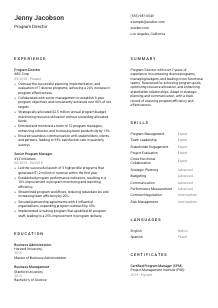
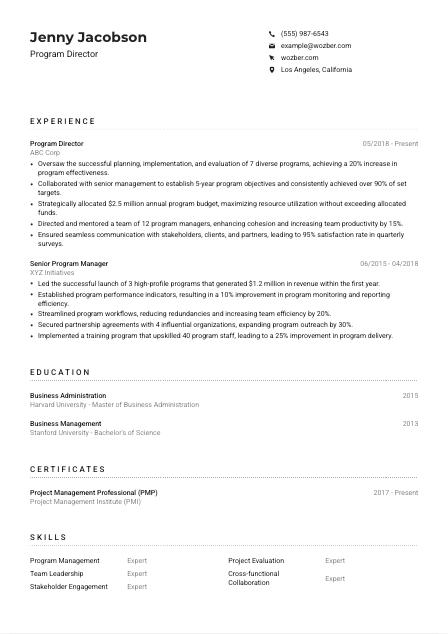
If the employer specifies a location, include your city and state in the header. In the example, listing "Los Angeles, California" immediately supports the stated location requirement. Use this kind of detail when it removes a screening question, not as filler.
A LinkedIn profile or professional website can help when it supports the same leadership story shown on the CV. Make sure titles, dates, and scope of responsibility match. For Program Director candidates, inconsistencies around team size, budget scope, or program count are easy to notice.
Your personal details should clear the basic checks quickly and professionally. If a hiring team can confirm who you are, how to reach you, and whether you meet a stated location requirement in seconds, the rest of the CV gets their full attention.




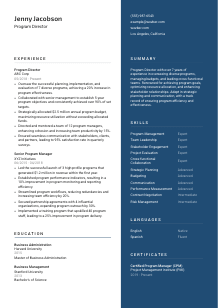
This is the section that carries the most weight for a Program Director. Employers want to see how you handled program delivery across multiple workstreams, how you worked with senior leadership, what resources you controlled, and whether your decisions improved execution, reporting, or stakeholder outcomes.
Read the posting for the core management demands behind the title. Here, the emphasis is on planning, implementation, evaluation, resource allocation, stakeholder communication, and performance reviews. Your bullets should mirror those areas with real examples from your work so the connection is immediate.
List your most recent position first and make advancement visible. For program leadership roles, hiring teams look for a pattern of increasing scope, such as moving from program management into multi-program oversight, larger budgets, broader stakeholder groups, or direct management of other managers.
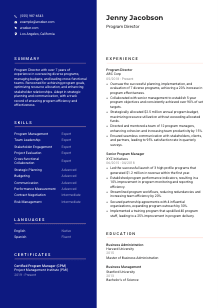
Each bullet should show what you led, what changed, and how the organisation benefited. The sample does this well with points like overseeing 7 programs and improving program effectiveness by 20%. That kind of bullet tells the reader far more than "responsible for program planning and evaluation."
Program Director work is measured through scope and outcomes. Include metrics such as number of programs, annual budget, target attainment, staff size, satisfaction scores, efficiency gains, training results, or partnership growth. Details like a $2.5 million budget, a team of 12 program managers, or 90% of objectives achieved help define the level at which you operate.
Choose accomplishments that support your candidacy for senior program oversight. Budget ownership, KPI design, stakeholder management, team development, reporting improvements, and operational execution belong here. Cut bullets that are impressive but too far removed from managing programs, people, or strategic objectives.
By the end of your experience section, the reader should understand the scale of programs you have led, the resources you controlled, and the outcomes you improved. That is the clearest proof that you can step into Program Director responsibilities with credibility.
Education matters here because the role asks for a bachelor's degree and prefers a master's. For senior program roles, the education section usually works as qualification support rather than the main selling point, but it still needs to be easy to verify and relevant to the level of responsibility involved.
If the posting requires a bachelor's and prefers a master's, list your highest relevant degree first. In the example, the MBA is worth placing prominently because it matches the preferred education level and supports leadership in budgeting, operations, and strategic planning.
Include degree, field of study, school, and graduation year in a consistent format. Program Director CVs are often reviewed quickly alongside experience and certifications, so this section should confirm qualifications without slowing the reader down.
A degree in business, public administration, nonprofit management, education, healthcare administration, or another related discipline can strengthen your case when it connects naturally to the kind of programs you lead. The example's business-focused education supports executive planning and resource management.
Coursework, capstones, or honors are useful if they reinforce your direction or explain a transition into program leadership. If you already have more than 5 years of program management experience, keep the extra academic detail selective and relevant.
For an experienced Program Director, this section should be concise. Degrees matter because they meet requirements, but extensive academic detail usually belongs to earlier-career CVs. Let education support your credibility while experience carries the operational story.
Your education should quickly show that you meet the stated degree requirements and bring academic grounding that fits program leadership. Once that is clear, the CV can return attention to execution, results, and leadership range.
Certifications carry extra weight when they reflect the way programs are planned, governed, measured, and improved. For a Program Director, they are most useful when they support your ability to run complex initiatives, manage risk, and lead teams with structured delivery practices.
If the employer calls out a certification, include it when you have it. In this case, PMP is listed as a plus, so a current Project Management Professional certification directly strengthens alignment with the role.
List certifications that support program governance, project execution, leadership, compliance, or operational improvement. A shorter list of directly relevant credentials is stronger than a long list of unrelated courses or general attendance certificates.
Add the certifying body and dates so the credential is easy to verify. If the certification is active, present it clearly. The sample's PMP and Certified Program Manager entries work because they show recognized issuers and ongoing validity.
Program leadership changes with reporting expectations, funding models, technology, and stakeholder demands. Updated certifications in areas like project management, change management, evaluation, or risk can show that your methods have stayed current as your scope has grown.
Use certifications to reinforce structured program leadership, not to pad the page. A few well-chosen credentials can strengthen your positioning, especially when the posting mentions them or your target roles involve formal program governance and measurable delivery standards.
A Program Director skills section should read like a condensed operating profile. It needs to show that you can lead teams, manage resources, work across functions, measure performance, and communicate with authority across internal and external groups.
Look for exact and implied capabilities in the description. Here, leadership, team management, communication, presentation, program oversight, and evaluation all matter. Reflect those terms naturally if they match your experience so both ATS filters and human reviewers see the connection quickly.
Prioritise capabilities that affect execution and results, such as program management, strategic planning, stakeholder engagement, budgeting, performance measurement, risk management, and cross-functional collaboration. The example skills list stays close to the actual work of directing programs, which is the right approach.
Use standard skill names and a logical order, with the most role-critical capabilities first. Avoid overcrowding the section with soft skills alone. For a Program Director, communication matters, but it carries more weight when paired with operational skills like resource allocation, KPI tracking, and team leadership.
This section should confirm that your toolkit matches the role's day-to-day demands. A hiring manager should be able to scan it and see that you can lead programs, manage people and budgets, and communicate effectively with stakeholders at several levels.
Language skills matter in Program Director roles when they affect reporting, stakeholder communication, writing, community engagement, or client relationships. Even when only one language is required, listing proficiency clearly can help remove doubt about written and verbal communication standards.
If the posting specifies language expectations, reflect them directly. Here, effective written English is required, so listing English clearly and accurately supports a stated qualification right away.
Put the language most important to the role first, then any additional languages that could support team leadership, community relationships, partner communication, or client-facing work. This keeps the section practical instead of decorative.
Additional languages can be useful if you work with diverse teams, external partners, or multilingual communities. In the example, Spanish adds value because it may support wider stakeholder engagement, though it is not a universal requirement for every Program Director job.
Choose straightforward levels such as Native, Fluent, Intermediate, or Basic. Hiring teams need a realistic sense of whether you can draft reports, lead meetings, or handle client communication in that language.
If the programs you lead involve regional, community-based, or international coordination, language capability can strengthen your profile. If not, keep the section simple and accurate. Relevance matters more than length here.
Present language skills as operational strengths, especially when they support writing, presentations, partner communication, or cross-cultural leadership. Clear language reporting helps the employer understand where you can communicate with confidence from day one.
For a Program Director, the summary should establish level, scope, and management value in a few lines. This is where you tell the reader how long you have led programs, what kinds of outcomes you improve, and what areas of oversight define your work.
Start with the responsibilities that show up most clearly in the posting. Here, that includes overseeing multiple programs, setting objectives with senior management, allocating resources, and evaluating performance. Your summary should touch those themes in concise language.
Your first line should immediately place you at the right level. The sample summary starts with "Program Director with over 7 years of experience," which quickly establishes seniority and relevance for a role asking for at least 5 years in program management or related work.
Follow with strengths that matter in program leadership, such as improving program effectiveness, managing budgets, leading cross-functional teams, strengthening stakeholder relationships, or hitting strategic targets. These points should reflect how you operate, not just traits you claim to have.
Aim for a short paragraph that sounds grounded in real work. Three to five lines is usually enough. Focus on scope, leadership, and outcomes so the reader enters the rest of the CV already understanding your level of program oversight.
Your summary should make the rest of the CV easier to read by establishing your leadership range early. If it clearly shows program scope, management strengths, and measurable impact, the hiring team will know what to look for in the experience section.
A Program Director CV works best when it makes program scope, leadership responsibility, resource ownership, and results easy to judge in one pass. Use the job description to mirror the employer's language around objectives, evaluation, communication, and team management, then support it with concrete metrics from your own work.
Wozber's free CV builder can help you organise that content into an ATS-friendly CV template, and its ATS CV scanner can highlight missing requirements and wording gaps before you apply. The final CV should make one thing clear quickly: you know how to lead programs, allocate resources wisely, and deliver outcomes that hold up under executive review.