



Use Wozber and land your dream job
Create CV
No registration required
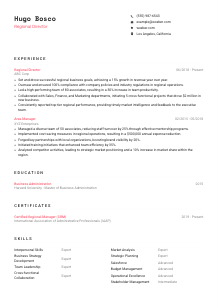
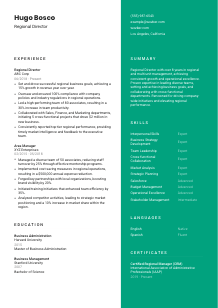
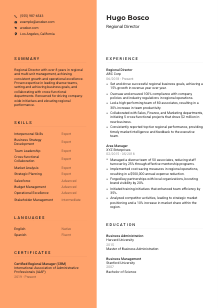
Directing across regions, but your CV feels out of place? Check out this Regional Director CV example, created with Wozber free CV builder. Learn how to blend your strategic command with job-specific expectations, driving your career as efficiently as a well-routed fleet!
Regional Director hiring usually turns on one question fast: have you already run multi-unit operations at a level where growth targets, compliance, people performance, and regional execution all moved together. A CV for this role has to make that operating scope visible early, with clear business results, team scale, and the decisions you owned across markets.
When that scope is tailored to the posting, the review gets sharper. Wozber's free CV builder helps you align titles, achievements, and business language into an ATS-compliant CV that reflects the way regional leadership roles are screened. Hiring teams should be able to see, within a few lines, whether you have managed a territory, hit targets, and led managers through execution.
At director level, the header does more than identify you. It quickly settles practical questions about level, reach, and availability before the reader gets into revenue growth, regional oversight, or team leadership.
Use your full name at the top in a clean, readable format. For senior roles, the presentation should feel polished and direct, not decorative. Keep the visual emphasis on your name so the CV opens with executive presence rather than design noise.
Place "Regional Director" directly beneath your name when that is the role you are pursuing. Matching the posted title helps position your experience correctly, especially when your recent titles include variations such as Area Manager, District Manager, or Regional Operations Leader. It also improves ATS alignment by tying your profile to the employer's language.
List a reliable phone number and a professional email address, then verify both before sending. At this level, small errors undercut the image of someone expected to oversee budgets, reporting, and execution across multiple locations. If you include an email, keep it simple and businesslike.
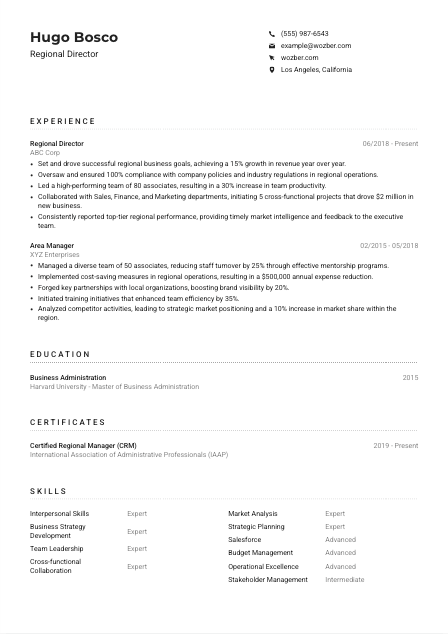
If the employer asks for a candidate based in a specific area or open to relocation, address that in your header. In the example, listing Los Angeles, California immediately answers a stated requirement and removes a practical objection before the hiring team gets into your experience. Use this only when location is relevant to the posting.
Include LinkedIn or a personal site only if it supports your candidacy with consistent titles, leadership scope, and measurable wins. For a Regional Director, that might mean a profile showing multi-unit management, market expansion work, or cross-functional initiatives. Dead links, outdated job titles, or thin profiles do more harm than good.
This section should answer the practical questions fast: who you are, what role you are targeting, and whether you are reachable and positioned for the opportunity. Keep it tight, accurate, and aligned with the posting.




This is the section that carries the most weight for a Regional Director CV. Hiring teams want to see how you led across locations, what business outcomes you delivered, how many people or managers you oversaw, and how you handled the mix of strategy, compliance, and field execution.
Read the job description for the business levers behind the title. Here, the employer is asking for regional goal setting, budget oversight, team leadership, regulatory compliance, cross-functional work, and performance reporting. Those points should shape which achievements you choose and how you phrase them.
List positions in reverse chronological order and make the leadership progression obvious. For this kind of role, titles like Regional Director, Area Manager, District Manager, or Multi-Unit Manager carry weight when paired with real operating scope. The example works because it moves from Area Manager to Regional Director and keeps the focus on scale, leadership, and business performance.
Use metrics that belong naturally to multi-unit leadership. Revenue growth, market share gains, cost reduction, headcount led, productivity improvement, retention, compliance rates, and new business generated are all strong proof points. The sample bullets do this well with results such as 15% year-over-year revenue growth, $500,000 in annual savings, and $2 million in new business tied to cross-functional projects.
Choose bullets that reflect the work of a regional operator rather than general management tasks. Prioritise territory performance, coaching managers, scaling programs across locations, market analysis, and policy execution. If an achievement does not help explain how you run a region, cut it, even if it was impressive in another context.
Do not stop at the result. Make it clear what you led, what changed, and why it mattered. "Led a team of 80 associates, raising productivity by 30%" is stronger because it links people leadership to an operational outcome. "Reported market intelligence to senior leadership" becomes more valuable when it shows how your reporting informed strategy, expansion, or performance decisions.
By the end of this section, a hiring team should understand the size of your remit, the business outcomes you improved, and how you led through managers and cross-functional partners. That is what turns past experience into a credible Regional Director case.
Education is rarely the deciding factor for a senior operations leader, but it still matters because many postings set a degree requirement. Present it clearly so the employer can confirm the academic foundation and move on to the experience that carries the application.
If the posting asks for a bachelor's degree in Business Administration, Management, or a related field, make sure your degree is easy to find and easy to read. This is especially important for ATS screening and for recruiters sorting applicants against minimum qualifications.
List the degree, field of study, school, and graduation year in a clean structure. Senior CVs do not need extra formatting here. The section should confirm credentials quickly without distracting from your operating results and leadership track record.
Degrees in business, management, finance, operations, or related areas are especially useful to highlight for regional leadership roles. In the example, both the MBA in Business Administration and the bachelor's degree in Business Management support the employer's stated preference and reinforce strategic and operational credibility.
Most experienced Regional Directors do not need coursework listed. Include honors, concentration areas, or standout academic projects only if they strengthen your positioning, such as operations strategy, finance, or organizational leadership. Otherwise, keep the section lean.
If you have completed executive programs, leadership development, or industry-specific training, add them when they support the role. Continuous learning can be useful when it connects to regional expansion, change management, compliance, or multi-site performance improvement.
This section should confirm that you meet the degree requirement and support your leadership profile without taking up space needed for business results. A concise, business-aligned entry is enough.
Certifications are not always required for Regional Director roles, but the right one can strengthen your profile when it reflects multi-unit management, operations, compliance, or executive leadership. Relevance matters more than volume.
Choose certifications tied to regional management, operations leadership, compliance, project execution, or industry-specific oversight. A credential such as Certified Regional Manager fits naturally because it reinforces experience already shown in your work history.
A short list of targeted certifications is better than a crowded section full of unrelated courses. For a Regional Director, credentials should support how you run territories, lead teams, manage performance, or maintain standards across locations.
Add the year earned and, if applicable, the active period or renewal window. This is especially useful for certifications tied to current standards, regulatory knowledge, or continuing professional development. The date on the sample certification helps show that the credential is current.
If your region involves compliance-heavy operations, sales leadership, franchise management, or workforce development, ongoing certification can sharpen your profile. Use this section to show that your professional development keeps pace with the complexity of the business you oversee.
Well-chosen certifications can strengthen the case that you are prepared for regional oversight, not just local management. Keep the section selective and tied to the work the employer actually needs covered.
For a Regional Director, the skills section should mirror how the role is executed. That means balancing leadership and commercial judgment with operational control, reporting, and cross-functional influence. Generic skill lists waste space at this level.
Start with the capabilities named in the job description, then match them only where you have real experience. In this case, that includes interpersonal leadership, business target ownership, growth strategy, cross-functional collaboration, and strong English communication. This kind of mirroring helps both ATS optimisation and human review.
Use proficiency labels only if they add clarity, and keep them credible. For senior leadership roles, the strongest skills usually include strategic planning, budget management, team leadership, market analysis, and stakeholder management. The example also includes Salesforce, which is useful when the role connects closely with sales operations and pipeline visibility.
Put the most relevant capabilities first instead of mixing strategic and minor tools randomly. Lead with business strategy, operational leadership, team development, compliance oversight, and cross-functional execution. Then add supporting tools or systems if they are part of how you manage regional performance.
A hiring manager should be able to scan this section and recognize the capabilities behind your results. Prioritise the skills that explain revenue growth, operational consistency, team performance, and executive reporting.
Language ability matters when it directly affects leadership, reporting, and market coverage. For Regional Director roles, English is often essential because strategy discussions, executive updates, and policy communication depend on it. Additional languages can help when they match the region or customer base.
If the posting states that English is required, list it plainly with an honest proficiency level such as Native or Fluent. This removes uncertainty around executive communication, reporting cadence, and team leadership across locations.
Include additional languages when they strengthen your ability to lead in the target market. In the example, Spanish is a useful addition because it can support communication in a diverse regional workforce and customer environment. That does not make it universally required, but it can be a meaningful advantage in some regions.
Choose standard labels such as Native, Fluent, Intermediate, or Basic. Avoid vague terms. Clear proficiency levels help employers judge whether a language is useful for team communication, market outreach, or stakeholder relationships.
If you mention multiple languages, be ready to support them through your experience or the market context. For regional leadership, languages matter most when they improve coaching, community engagement, client relationships, or communication across a distributed workforce.
This section should stay factual. List the languages that genuinely matter to your work and leave out anything too basic to be useful in meetings, field visits, or regional communication. Precision carries more weight than a long list.
Used well, this section shows how you communicate across teams, markets, and stakeholders. Keep the focus on what supports regional execution and leadership credibility.
The summary should read like a concise leadership brief. In a few lines, it needs to tell the employer how long you have worked at multi-unit level, what business outcomes you are known for, and what kind of regional responsibility you can step into next.
Start with the requirements that define the role, such as years in regional or multi-unit management, growth delivery, team leadership, and cross-functional execution. The sample summary does this well by leading with more than 8 years of relevant management experience and linking it to consistent growth and operational excellence.
Your first line should quickly establish seniority and specialization. For example, position yourself as a Regional Director or multi-unit leader with a track record in territory performance, operational leadership, and team development. That gives the reader an immediate frame for the rest of the CV.
Use the summary to spotlight the pattern behind your experience. That could be driving revenue growth, improving compliance, reducing turnover, expanding market share, or leading large field teams. Keep the claims broad enough for a summary, but grounded in results that appear later in the CV.
Aim for a short paragraph, not a career biography. Four focused lines are usually enough to establish tenure, leadership scope, and business impact. Every phrase should connect to how you lead a region, not just to generic executive language.
Once this section is finished, the reader should already understand your level, your core strengths, and the kind of regional results your experience points to. That gives the rest of the CV a clear frame.
A Regional Director CV works when it makes your operating scope easy to read: the size of the teams you led, the targets you hit, the regions you managed, and the cross-functional work that moved the business forward. Keep each section anchored in measurable outcomes, leadership range, and the business decisions you owned.
Wozber's free CV builder can help you turn that experience into an ATS-friendly CV template with cleaner structure, stronger role-specific wording, and sharper ATS optimisation. Use it to refine your content, then make sure the finished CV clearly shows that you can lead a region, grow performance, and report at executive level.




