



Use Wozber and land your dream job
Create CV
No registration required
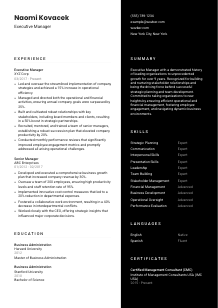
Leading the boardroom, but your CV feels like a board game? Level up with this Executive Manager CV example, created with Wozber free CV builder. Learn how to project your strategic leadership in line with job expectations, and make your career narrative as impressive as your quarterly reports!
Executive Manager hiring usually comes down to one question fast: have you led an organisation through real operational, financial, and people decisions at scale? A CV for this level needs to show more than seniority. It has to make your strategic direction, business results, leadership span, and stakeholder influence visible in a few clear passes.
When that story is tailored well, the CV reads less like a list of leadership titles and more like a record of executive ownership. Wozber's free CV builder helps you shape that story in an ATS-compliant CV by aligning your wording with the role's priorities, so hiring teams can quickly connect your background to strategy execution, financial oversight, and senior team leadership.
At executive level, the header does quiet but important work. It confirms who you are, what level you operate at, and whether you meet practical filters before anyone gets to your board-facing wins or operating results.
Use your full name as the most prominent text on the page. Keep the styling clean and senior. Executive hiring rarely rewards design flourishes, but it does reward polish and clarity from the first line.
Place "Executive Manager" under your name when it accurately reflects the role you are pursuing. This creates an immediate match with the opening and frames the rest of the CV around executive leadership, business oversight, and organizational accountability.
Add a current phone number and a professional email address you check often. At this level, missed calls often relate to recruiter outreach, board interviews, or confidential conversations, so accuracy matters more than extra detail.
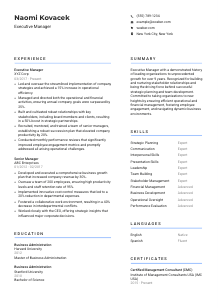
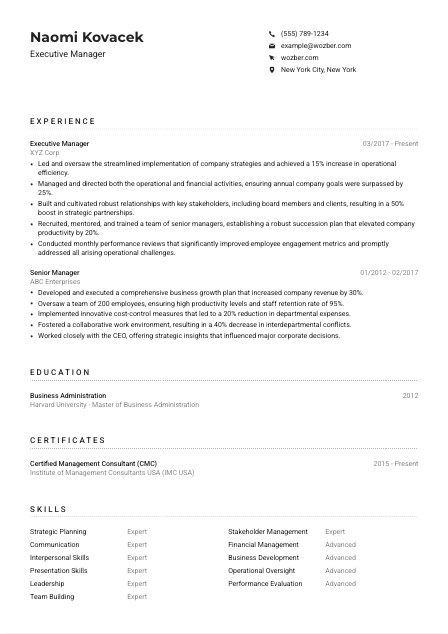
If the posting specifies a city or region, include it in your header. Here, listing New York City, New York directly answers a stated requirement and removes an easy screening objection before the employer reviews your experience.
Include LinkedIn or a professional website if it supports your executive profile. Make sure it reinforces what your CV claims, such as leadership scope, board interaction, turnaround work, growth initiatives, or speaking engagements, rather than introducing conflicting dates or titles.
This section should confirm basic eligibility without distraction. A clean header makes it easy to see your role level, your contact path, and any practical requirement such as location before the deeper evaluation begins.




For an Executive Manager, experience is where credibility is won or lost. Hiring teams look for signs that you have led strategy into execution, controlled financial and operational performance, developed senior leaders, and handled stakeholder pressure without losing business momentum.
Read the posting for the operating themes behind the title. In this case, the strongest themes are strategic planning, financial management, business development, stakeholder relations, and succession planning. Those should shape which achievements you lead with and which older details you cut.
List positions in reverse chronological order and make the movement upward easy to follow. For executive hiring, progression matters. A path from senior management into full executive accountability helps the reader quickly understand your readiness for enterprise-level decision-making.
Focus each bullet on a business action you led and the result it produced. Good executive bullets show what you directed, changed, launched, stabilized, or expanded. The sample CV does this well with points about implementing company strategy, improving efficiency, managing financial activity, and building stakeholder partnerships.
Numbers should show business effect, not just activity. Revenue growth, operating efficiency, cost reduction, retention, partnership growth, productivity, and goal attainment are all natural measures here. For example, a 15% efficiency gain or 25% improvement against annual goals tells a far clearer story than saying you "improved operations."
Prioritise evidence of strategic execution, financial stewardship, talent leadership, and cross-functional influence. If a detail does not help prove that you can lead company-wide performance, guide senior managers, or work with boards, partners, or major clients, it probably belongs off the page.
Your experience section should show that you have already handled the pressure points of executive work. When titles, scope, and outcomes line up, employers can see how you would run operations, support growth, and lead senior teams in their environment.
Education matters differently at executive level. It usually will not outweigh leadership results, but it still needs to confirm that you meet baseline requirements and bring relevant business training to strategic and financial decision-making.
If the position asks for a Bachelor's degree in Business Administration, Management, or a related field, make sure that qualification is immediately visible. If you also hold an MBA or another advanced business degree, list it first because it strengthens your executive profile.
Include degree, field of study, school, and graduation year. That is usually enough for a senior candidate. The sample education section works because it confirms both the required business foundation and added senior-level academic weight without unnecessary detail.
Use the formal degree and field names that match the employer's language when they are accurate. "Business Administration" should appear if that is your actual field, because it aligns naturally with a requirement tied to strategy, finance, and organizational leadership.
For most executive candidates, detailed coursework is optional. Include honors, leadership programs, or standout academic distinctions only if they strengthen your story, such as corporate strategy, finance, operations, or organizational development training that still feels relevant today.
The more established your executive track record, the less space education should take. Let it confirm qualification, not compete with the business outcomes in your experience section.
This section should quietly validate your academic background and then get out of the way. For Executive Manager roles, it works best when it supports the broader picture of business judgment, leadership maturity, and strategic range.
Certifications can help at executive level when they reinforce how you lead programs, advise organizations, or manage change. They are especially useful when a posting names preferred credentials or when your work spans strategy, transformation, and cross-functional execution.
If an employer mentions credentials such as CMC or PMP, place those first when you hold them. That immediately shows alignment with preferred qualifications and adds structure to your management profile beyond title alone.
List certifications tied to consulting, project governance, operations, leadership, or organizational performance. The point is not to collect badges. It is to show training that supports how you plan, execute, and lead at senior level.
Show when the certification was earned and, if relevant, that it remains active. Current credentials suggest ongoing engagement with professional standards, which matters more when the role involves leading change, managing risk, or directing complex initiatives.
If you pursue credible development in strategy, finance, governance, or talent leadership, include the certifications that genuinely strengthen your candidacy. Executive hiring often favors leaders who keep their management approach current, especially in fast-moving or high-growth environments.
Relevant certifications add weight when they connect directly to the work. For an Executive Manager, they should strengthen your case in areas such as structured leadership, program execution, advisory skill, or business transformation.
An Executive Manager skills section should read like the operating toolkit behind your results. That means choosing capabilities tied to strategic direction, financial control, stakeholder influence, people leadership, and organizational execution rather than listing broad traits without context.
Start with the language in the job description and identify the capabilities behind it. Here, that includes strategic planning, financial management, business development, communication, presentation, and senior leadership. These are the skills most likely to be searched in ATS filters and noticed in a first review.
Include both functional and leadership skills that reflect how executive work is actually done. Strategic Planning, Stakeholder Management, Operational Oversight, Performance Evaluation, and Team Building create a stronger picture than generic terms such as "hardworking" or "results-driven."
Trim the section to the skills that support the responsibilities of the target position. A focused list helps the employer quickly connect your abilities to business outcomes, whether that is hitting growth targets, mentoring senior managers, improving engagement, or managing operational performance.
This section should support the evidence in your experience, not repeat empty buzzwords. When your skills reflect the language of strategy, finance, people leadership, and stakeholder management, the match becomes much easier to see.
Language requirements matter more when the job states one directly or when the role involves broad stakeholder communication. For Executive Managers, this section is usually straightforward, but it should still support the scope of the position and the communication demands that come with it.
If the posting requires English proficiency, list English clearly with an honest level such as Native or Fluent. That simple line can satisfy a stated qualification and reassure employers about presentation, negotiation, and leadership communication.
Additional languages can be valuable when the organisation works across markets, client groups, or multicultural teams. In the example CV, Spanish adds useful breadth without distracting from the core leadership profile.
Choose standard levels such as Native, Fluent, Intermediate, or Basic. Executive roles often involve board updates, client meetings, and sensitive employee communication, so inflated language claims are easy to expose and best avoided.
Not every Executive Manager role is international, so keep this section proportional. Highlight multilingual ability when it supports partner relations, regional operations, or cross-border leadership, not simply to fill space.
Only mention current language study if it is relevant to the business context and you can discuss it credibly. At senior level, this section works best when it stays concise and useful.
For most Executive Manager CVs, this section confirms communication capability and, where relevant, wider market reach. Keep it honest, brief, and connected to the scale of leadership the role requires.
The summary should quickly explain the level at which you operate and the business outcomes you are known for. For Executive Manager roles, that usually means strategy execution, operational control, financial stewardship, stakeholder leadership, and development of senior teams.
Before writing, identify the two or three themes the employer cares about most. Here, that is not just leadership in general. It is executive leadership tied to strategy, finance, business development, and people management.
Start with your current professional identity and years of relevant leadership experience. Be accurate. If the role asks for 10+ years in progressive leadership and 5+ in executive capacity, make sure your opening line supports that level when your background truly does.
Use the next lines to highlight the outcomes and capabilities that define your executive work. The sample summary points to growth, stakeholder relationships, strategic planning, team development, and operational management. That combination works because it reflects the actual demands of the role rather than generic ambition.
Aim for three to five lines with enough detail to establish your value fast. Avoid broad claims like "visionary leader" unless the rest of the sentence proves it through scale, performance, or transformation results.
A well-written summary gives the reader a clear lens for everything that follows. It should position you as someone who can lead strategy into execution, manage the business responsibly, and develop the people who keep performance moving.
An Executive Manager CV should make leadership scope, business judgment, and organizational impact easy to read in minutes. When each section is tailored to the role, employers can quickly connect your background to strategic planning, financial oversight, stakeholder management, and senior team development.
Use Wozber's free CV builder to shape that story in an ATS-friendly CV format, and use the ATS CV scanner to check whether your language reflects the role's actual priorities. The finished CV should make one thing clear: you are prepared to lead operations, people, and business performance at executive level.