



Use Wozber and land your dream job
Create CV
No registration required
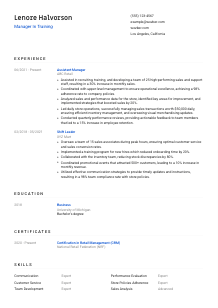
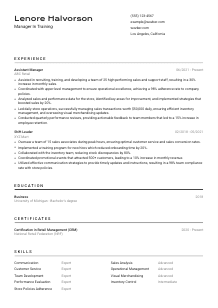
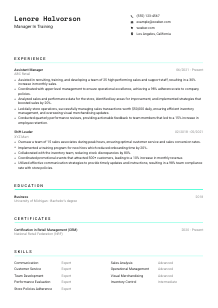
Learning the ropes, but your CV feels unwound? Check out this Manager In Training CV example, made with Wozber free CV builder. It shows how to blend your leadership aspirations with job expectations, setting your management journey on a trajectory for success.
Store leaders in training are hired on their ability to keep sales moving while coaching a team, protecting standards on the floor, and responding quickly when numbers slip. A Manager In Training CV needs to make that operating range visible. Hiring teams want to see how you handled staff development, customer-facing execution, and day-to-day store performance in real retail settings.
Retail hiring moves fast, and CVs often get screened first for direct alignment with team leadership, sales performance, and store operations. Using Wozber's free CV builder helps you shape an ATS-compliant CV around the language of the role, so recruiting, merchandising, inventory control, and performance coaching show up clearly and in the right places. That makes it easier for a hiring manager to see whether you can step into daily store leadership with minimal ramp-up.
This section is simple, but it still does important work. For a Manager In Training position, your header should confirm who you are, how to reach you, and whether you meet practical requirements such as location. Keep it clean, accurate, and fully consistent with the rest of your application materials.
Use your full name as the most prominent line in the header. Store leadership hiring is often quick, especially when multiple candidates have similar retail backgrounds, so a clear name helps recruiters and district managers keep your application straight during interviews, scheduling, and internal review.
Place "Manager In Training" directly under your name when that is the role you are applying for. This immediately connects your CV to the opening and avoids leaving your current title, such as Assistant Manager or Shift Leader, to do all the interpretive work on its own.
List a reliable phone number and a professional email address, then verify both. A missed digit or typo can cost you an interview. Use a straightforward email format such as firstname.lastname@email.com so your contact information looks as professional as the customer-facing role you want.
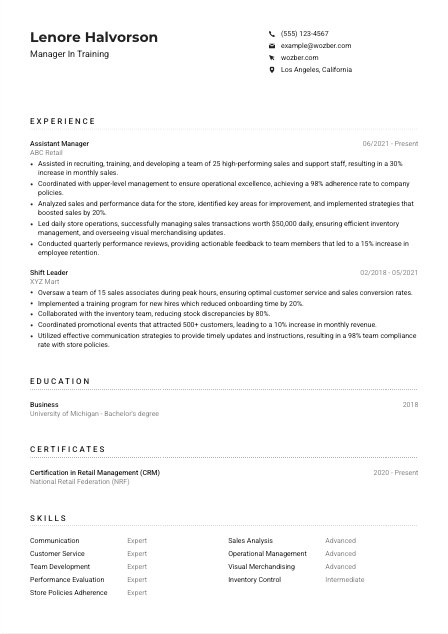
If a store or company wants someone already based in a specific market, show that clearly. Here, listing "Los Angeles, California" addresses a stated requirement and removes a practical question before it slows your application down. Use location this way when it is relevant to the opening, not as filler.
A LinkedIn profile can help if it matches your CV and gives added context on retail leadership experience, promotions, or certifications. If you include a website or profile, make sure job titles, dates, and achievements line up exactly with the CV you submit.
For this role, the personal details section should answer the basics fast: who you are, what role you are targeting, how to contact you, and whether you meet any location requirement. Once that is clear, the CV can move straight into your store leadership experience.




This is the section hiring managers will study most closely. For a Manager In Training role, your experience needs to show that you can contribute to sales, support staff performance, follow operating standards, and handle the pace of store operations without losing sight of customer service.
Read the posting for the responsibilities that define success in the role, then mirror them with real experience. In this case, that includes recruiting and training staff, analysing sales and performance data, supporting daily operations, and conducting reviews. Those are the themes your bullet points should cover first if they reflect your background.
Lead with your most recent position and make advancement visible. A path from Shift Leader to Assistant Manager, for example, tells a retail employer that you have already taken on broader accountability for staffing, sales execution, and policy compliance. Keep dates, employer names, and titles easy to scan.
Focus each bullet on what you led, improved, or supported in the store. Strong lines often start with actions like recruited, trained, coordinated, analysed, led, or reviewed. The sample CV does this well by tying team development and operational execution directly to store outcomes, rather than listing routine tasks without context.
Numbers carry weight when they reflect how store performance is actually measured. Good examples include monthly sales growth, daily transaction volume, policy adherence, employee retention, onboarding time, stock discrepancy reduction, or event-driven revenue lift. Figures such as a 30% sales increase or $50,000 in daily transactions give scale to your management work.
Trim accomplishments that do not support a retail leadership move. Prioritise team supervision, customer service performance, merchandising execution, inventory accuracy, and profit-driving improvements. The goal is to show that your experience already overlaps with the work expected from a manager in training, not to document every duty you have ever handled.
Your experience section should leave little doubt that you can support a store, coach people, and respond to performance data. When the bullets connect leadership actions to sales, compliance, and team results, you look ready for the next step in retail management.
Education matters here because many Manager In Training postings set a degree expectation, especially for larger retail organizations with structured leadership pipelines. Present your academic background clearly and make the connection to business or retail operations easy to see.
If the posting asks for a bachelor's degree in Business, Retail Management, or a related field, reflect that wording accurately in your education section. A Bachelor's degree in Business is a direct match in this example, so it deserves clear placement without extra explanation.
List your degree, field of study, school, and graduation year in a clean order. Recruiters reviewing store leadership candidates do not need a dense academic profile. They need to confirm quickly that you meet the stated education bar and have a relevant business foundation.
When your degree lines up closely with the role, make that obvious. Business, retail management, operations, or similar fields support the analytical and organizational side of store leadership, especially when the job includes sales analysis, policy execution, and staff development.
If you are early in your career or your degree title is broad, a short mention of coursework in retail operations, consumer behaviour, finance, or management can help. For candidates with several years of store leadership experience, this is usually optional rather than essential.
Academic distinctions can stay if they are genuinely notable and do not distract from your retail experience. Keep them brief. For most Manager In Training candidates, the degree match and leadership track record matter more than a long list of campus achievements.
This section does not need to do too much. It needs to show, quickly and clearly, that you meet the educational expectation and bring a business-oriented background that supports store performance, team oversight, and operational decision-making.
Certifications can add useful depth to a Manager In Training CV, especially when they relate directly to retail operations, supervision, or customer-facing management. They are most effective when they support the job requirements already visible in your experience.
Start with credentials that strengthen your case for store leadership. A certification in retail management is especially relevant here because it supports the posting's preference and reinforces your familiarity with store operations, team leadership, and commercial performance.
Keep this section focused. A few strong certificates tied to retail, supervision, customer experience, or operations are more useful than a long list of unrelated training. The sample credential from the National Retail Federation works because it aligns closely with the job's management track.
Dates help when a credential is current, recently completed, or still active. That is especially useful for programs tied to evolving retail practices, compliance standards, or leadership development. If the timing adds credibility, include it.
Employers like to see that future store leaders keep building their skills. Use certificates to show continued growth in retail management, workforce supervision, or sales operations, but let the section support your experience rather than compete with it.
The right certificate tells a retailer that you have invested in the business side of store leadership. When it complements your team, sales, and operations experience, it adds another credible layer to your candidacy.
For a Manager In Training CV, the skills section should reflect how the store actually runs. That means a mix of people leadership, sales awareness, customer service, and operational control. Keep the list tight enough to stay believable and specific enough to match the opening.
Pull out the capabilities that appear in the job description and recur across the responsibilities. Here, that includes interpersonal communication, customer service, leadership, sales analysis, team development, and operational execution. These should shape your skills section before you add anything else.
Only list skills you can back up in your experience. If you claim performance evaluation, inventory control, or visual merchandising, the work history should show where you handled reviews, reduced stock issues, or oversaw floor presentation. That consistency makes the section more convincing to hiring teams and ATS screening alike.
A shorter list of retail-specific strengths is stronger than a broad inventory of vague abilities. Communication and customer service belong here, but so do role-linked skills such as operational management, sales analysis, team coaching, policy adherence, and merchandising support. Choose the skills that best reflect how you contribute in a store environment.
Every skill listed should point back to something you have done on the floor, in the back room, or in team leadership. When the section mirrors the role and matches your experience, it strengthens both ATS alignment and human review.
Retail is customer-facing, fast-moving, and often multilingual depending on the market. Language skills can add value on a Manager In Training CV when they support customer service, team communication, and day-to-day coordination across the store.
If the posting specifically calls for English, make sure it appears clearly with an accurate proficiency level. This role states that effective communication in English is essential, so it should be listed first rather than left implied.
List required or most useful languages at the top, then add others in descending order of value. In a retail setting, that helps hiring teams quickly see how you may support customer interactions, staff communication, or service in a diverse market.
Extra languages can be a real advantage in stores serving broad communities. Spanish, for example, can strengthen customer engagement and team communication in many markets. Include it when you can speak it confidently and it reflects your actual ability.
Use clear levels such as Native, Fluent, Intermediate, or Basic. Inflated language claims become obvious in interviews and on the job, especially in roles that depend on coaching staff, handling customer issues, and giving directions clearly during busy shifts.
If your language skills have helped with customer service, staff training, or smoother team coordination, they belong on the CV. For a Manager In Training position, communication is part of execution, so language ability can support your leadership profile when it is genuinely useful on the floor.
Language skills are most persuasive when they are relevant, honestly rated, and connected to the realities of store leadership. Used well, this section adds practical value to a customer-facing management application.
The summary sits at the top of the CV, so it should quickly tell a retailer what kind of leader you are becoming. For a Manager In Training role, that usually means combining retail experience, people leadership, sales contribution, and operational discipline in a few compact lines.
Start with your current level of experience and the environment you know best. A line such as "Manager In Training with over 5 years of retail experience" or "Assistant Manager with 5+ years in high-volume retail" immediately anchors your background in the right setting.
Include two or three strengths that match the posting closely, such as training teams, hitting sales goals, improving store performance, or maintaining operational standards. The sample summary works because it highlights team development, revenue improvement, and operational excellence instead of relying on broad leadership claims.
Aim for a tight paragraph that can be read in seconds. Use direct language, and include one or two role-native outcomes if they strengthen the message, such as sales growth, team performance, or customer experience improvement. Save the full detail for your experience section.
When the summary clearly connects your experience to sales, team development, and store operations, the rest of the CV becomes easier to read in the right light. Wozber's AI CV builder can help you tighten that language, align it with the posting, and keep the final version consistent in an ATS-friendly CV format.
A Manager In Training CV works best when it shows how you support sales goals, coach staff, uphold store standards, and respond to performance data in a real retail environment. Each section should make that progression into management easier to see.
Use Wozber to organise that story in a clean ATS-friendly CV template, strengthen alignment with the job description through its ATS CV scanner, and refine wording where needed. The finished CV should make one thing clear right away: you can contribute to store results while growing into broader management responsibility.




