



Use Wozber and land your dream job
Create CV
No registration required
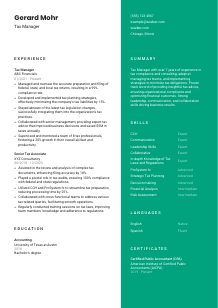
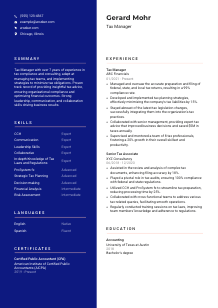
Balancing books, but your CV isn't adding up? Check out this Tax Manager CV example, created with Wozber free CV builder. Learn how to clearly present your fiscal finesse to meet job standards, putting your tax-tackling talents at the forefront of your career spreadsheets!
Tax Manager hiring usually turns on one practical question fast: can this person keep filings accurate, guide planning decisions, and stay ahead of rule changes without creating risk for the business. A CV for this level needs to make that judgment easy by showing the scope of tax work you have owned, the complexity you have handled across jurisdictions, and the business impact of your advice.
When the CV is tailored well, the reader can quickly separate tax leadership from general accounting experience, especially when federal, state, local, or international exposure is spelled out in the same language used in the posting. Wozber's free CV builder helps shape that detail into an ATS-compliant CV, so tax software experience, planning work, and team leadership surface clearly for both the system and the hiring team.
For a Tax Manager, the contact section does more than identify you. It confirms practical basics quickly, including professional presentation, target role alignment, and any location requirement that could affect the hiring process.
Use your full name in a clean, readable format and make it the most visible line on the page. Tax leadership roles are built on accuracy and professionalism, so avoid decorative formatting or nicknames that make the document feel less formal than the work itself.
Place "Tax Manager" directly under your name when that is the role you are pursuing. This helps recruiters and ATS tools categorize your CV correctly and immediately frames your background around tax compliance, planning, review responsibility, and team oversight.
List one reliable phone number and a professional email address. If you include a website or LinkedIn profile, make sure it reflects the same titles, dates, and tax experience shown on the CV, especially if it mentions public accounting, corporate tax, or specialty areas such as multistate or international filings.
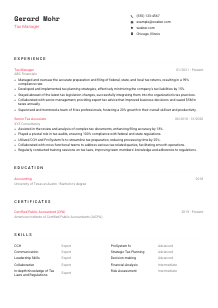
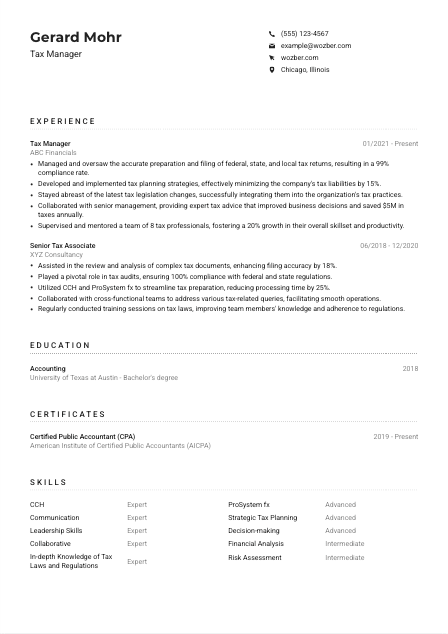
If the employer asks for a specific location, state your city and state clearly. In this example, listing Chicago, Illinois immediately answers a practical requirement. If you are relocating, say so briefly rather than leaving the employer to guess.
A LinkedIn profile can support your application when it adds useful tax-specific context, such as CPA status, software exposure, or promotion history from Senior Tax Associate to Tax Manager. Only include it if it is current and consistent with the CV.
Your personal details should remove basic friction from the review. By the time a hiring manager leaves this section, your role target, contact information, and any stated location requirement should already be clear.




This is where Tax Manager CVs usually win or lose attention. Hiring teams look for signs that you have owned filings, reduced tax exposure, interpreted law changes correctly, and guided others through complex work without sacrificing deadlines or compliance quality.
Start by marking the recurring priorities in the job description. Here, those include managing federal, state, and local returns, building tax planning strategies, tracking legislative changes, advising leadership, and mentoring staff. Those themes should appear in your bullets when they reflect work you have actually done.
List positions in reverse chronological order and keep the titles specific. A path such as Senior Tax Associate to Tax Manager tells a stronger story than generic finance labels because it shows increasing responsibility in review work, compliance ownership, planning, and team leadership.
Use metrics that are natural for the field. Compliance rates, tax savings, audit outcomes, filing accuracy, turnaround time, and team size all help. The example CV does this well with a 99% compliance rate, a 15% reduction in tax liability, and $5M in annual tax savings tied to management advice.
Prioritise work that reflects the operating level of a Tax Manager. That means return oversight, research-based recommendations, tax planning, audit support, process improvement, and supervision. Leave out bullets that are too generic or unrelated to tax operations, even if they are positive in another context.
If the posting emphasizes phrases such as "tax planning strategies," "cross-functional teams," or "mentor tax team members," use those terms in your accomplishments when they match your background. The point is not to copy wording mechanically. It is to help both ATS screening and human review connect your experience to the exact type of tax work the company needs covered.
Your experience section should make your tax judgment visible. Show what you managed, what improved under your watch, and how your work affected compliance, cash impact, and decision-making across the business.
Tax Manager roles usually have a clear academic floor because the work depends on strong accounting and finance fundamentals. Your education section should confirm that baseline quickly, then support it with any role-relevant academic depth.
If you hold a Bachelor's degree in Accounting, Finance, or a related field, make that easy to find. This posting asks for that directly, so the degree should not be buried. For candidates with a stronger tax focus, accounting is often the clearest match to the work.
Use a simple structure: degree, field, school, and graduation year. Tax hiring does not require an elaborate education section unless you are early in your career or your academic background includes specialised tax coursework worth highlighting.
Your education should support the technical side of the role, including tax law interpretation, financial reporting knowledge, and compliance work. In the example, a Bachelor's degree in Accounting aligns cleanly with the employer's stated requirement.
If you have a master's degree in taxation, accounting, or a related field, or if your CPA is prominent enough to mention here as well, it can reinforce your technical depth. This is especially useful when the posting prefers advanced study or professional licensure.
Honors, scholarships, or tax-focused academic projects can help if they add real substance, particularly for candidates with less management experience. For established Tax Managers, keep this brief and let your compliance, planning, and advisory work stay in the lead.
This section should quickly confirm that you meet the educational expectations for serious tax work. If your credentials are relevant and easy to scan, the reader can move on to the experience that carries the bigger hiring decision.
In tax hiring, certifications often carry real weight because they signal current professional standards, technical discipline, and continued engagement with changing regulation. Use this section to highlight credentials that matter in tax practice, not to list every course you have ever completed.
Lead with certifications that directly support tax leadership, especially the CPA when you have it. In this job description, CPA status is preferred, so placing it prominently helps the employer confirm a major qualification within seconds.
Choose certifications that connect to tax compliance, advisory work, reporting, or regulation. A short, relevant list is more effective than a long one filled with unrelated programs. The section should reinforce your authority in tax, not dilute it.
Show the year earned and, when relevant, the active period. That matters for licenses and credentials with renewal expectations. The example's "2019 - Present" format works because it signals that the CPA remains active.
Tax law changes constantly, so current credentials suggest more than achievement. They point to ongoing professional upkeep. If you hold specialised tax or state-level credentials, include them when they support the type of compliance or planning work you target.
For Tax Manager roles, the right credentials can strengthen your technical profile quickly. Keep the focus on certifications that support compliance judgment, tax planning credibility, and current professional standing.
A Tax Manager skills section should read like the operating toolkit for the job. That means tax software, regulatory knowledge, planning capability, and leadership skills that support review cycles, deadline management, and cross-functional advisory work.
Pull both technical and interpersonal requirements from the posting. This role clearly calls for tax compliance expertise, tax planning, knowledge of federal, state, and international tax law, tax software proficiency, communication, and leadership. Your list should reflect that mix if it is grounded in your experience.
Lead with the skills that directly affect performance in the role. For this kind of position, that often means software such as CCH or ProSystem fx, strategic tax planning, tax law knowledge, and leadership. The example CV gets this right by placing tax software and core management capabilities near the top.
Use a tidy format and avoid long descriptive phrases when a clear skill name will do. Separate technical tools from broader capabilities if needed. An ATS and a hiring manager should both be able to spot the essentials quickly, especially software, regulatory knowledge, and people-management strengths.
Your skills section should give an immediate sense of how you operate as a Tax Manager. If the reader can quickly see the systems, tax knowledge, and leadership strengths you bring, the section is doing its job.
Language requirements in tax roles are usually practical rather than decorative. The employer needs to know whether you can handle client communication, internal guidance, documentation, and regulatory discussion clearly, especially when English is an explicit requirement.
If the job requires English, list it clearly with an accurate proficiency level. That is the baseline for meetings, written tax guidance, return review notes, and communication with finance leadership in many Tax Manager roles.
If you speak more than one language, place the most relevant ones after the required language. Extra language ability can be valuable in multinational companies, cross-border tax work, or teams serving diverse client bases, but only when you can genuinely use it in a professional setting.
Use clear labels such as Native, Fluent, or Professional Working Proficiency rather than vague claims. Tax work involves nuance, and overstating language ability can create problems if the role includes technical discussion, written analysis, or stakeholder meetings in that language.
Additional languages become more valuable when they support real tax work, such as communicating with international subsidiaries, reviewing foreign-source documentation, or coordinating across jurisdictions. If your target roles include international tax exposure, this context can strengthen the section.
Include languages when they add something concrete to your candidacy. In the example, Spanish supports broader communication capability, but English remains the key requirement because it is explicitly requested in the job description.
List language skills when they support how you work. For a Tax Manager, that usually means clear business communication first, with additional languages adding value when the tax scope crosses teams, regions, or jurisdictions.
The summary should quickly tell the reader what level of tax work you handle and where your value shows up. In a few lines, it should connect your years of experience to the parts of tax management that matter most for the target role.
Before writing the summary, identify the main themes in the job description. Here, those are tax compliance, planning strategy, regulatory knowledge, leadership, and collaboration with senior management. Your summary should reflect that mix without turning into a keyword list.
Begin with your title and a clear statement of experience, such as more than 7 years in tax compliance and consulting. This gives the reader immediate context on seniority and specialization, which is especially important when screening candidates with broader accounting backgrounds.
Choose strengths that match the target position closely. For a Tax Manager, that might include minimizing tax liabilities through planning, overseeing complex filings, advising leadership on tax implications, or managing and developing a tax team. The example summary uses this approach well by combining compliance, consulting, team leadership, and financial outcomes.
Limit the summary to the points that frame the rest of the CV best. Avoid generic adjectives and focus on substance. A compact summary that mentions tax scope, management responsibility, and business impact will do more work than a longer paragraph filled with broad claims.
A good summary tells the employer, in a few focused lines, what kind of tax leader you are. It should make the reader expect solid compliance judgment, useful planning insight, and credible management experience in the sections that follow.
A Tax Manager CV works when it makes tax ownership easy to see. Filing accuracy, planning results, software fluency, regulatory range, and team leadership should all appear in the places where hiring teams expect to find them, with metrics and scope that match your actual experience.
Wozber's AI CV builder can help you refine that language, strengthen ATS optimisation, and present everything in an ATS-friendly CV format that keeps tax-specific details readable. Once your CV clearly shows how you manage compliance, reduce liability, and advise the business, you are ready to apply with confidence.