



Use Wozber and land your dream job
Create CV
No registration required
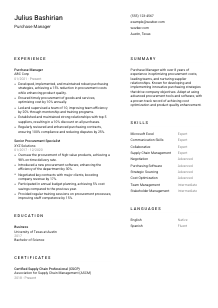
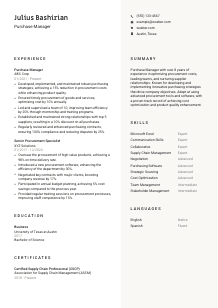
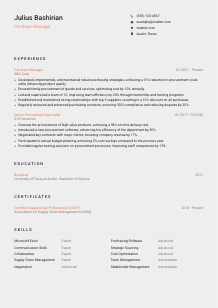
Mastering supply chains, but your CV isn't adding up? Check out this Purchase Manager CV example, created with Wozber free CV builder. It shows how to present your procurement prowess to match job needs, ensuring your career is always well-stocked and in-demand!
Purchase Managers are trusted with margins, supplier performance, and the steady flow of goods that keeps operations moving. A CV for this work needs to make commercial judgment visible. Hiring teams look for proof that you can negotiate terms, control spend, improve purchasing processes, and lead a team without letting quality or delivery slip.
When that track record is tailored to the opening, the CV reads less like a general procurement profile and more like a manager who can run the purchasing function the employer needs. Wozber's free CV builder helps organise that experience into an ATS-friendly CV format, so tools and reviewers can quickly connect your background to purchasing strategy, vendor negotiations, contract review, and team leadership. That clarity matters early.
For a Purchase Manager, the header should do one practical job well. It should confirm who you are, how to reach you, and whether you meet any immediate logistics or communication requirements. Keep this section clean and businesslike, just as you would expect in a vendor-facing procurement document.
Use your full name in a clear, readable font at the top of the page. There is no need for decoration. Procurement leadership is associated with precision and control, so your header should feel organised and professional from the start.
Place the job title directly under your name when it matches the role you are pursuing. If you are applying for a Purchase Manager opening, say "Purchase Manager." That immediately frames your background around purchasing strategy, supplier management, and team oversight rather than broader supply chain work.
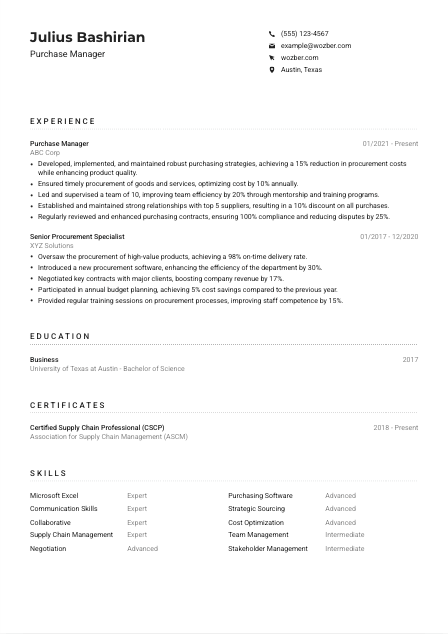
If the job calls for a specific city or relocation readiness, include that information in your header. In the example, listing Austin, Texas directly answers a stated requirement and removes a common screening question before anyone gets to the experience section.
Add a LinkedIn profile or professional website if it supports your candidacy. Keep it aligned with your CV, especially around job titles, dates, supplier-facing achievements, and tools such as procurement systems or Excel-heavy analysis work.
Your personal details should resolve the basics in seconds: identity, role focus, contact information, and any stated location requirement. Once those are clear, the reader can move straight to your purchasing record instead of getting stuck on avoidable questions.




This is the section that carries the most weight for a Purchase Manager. Employers want to see how you handled spend, supplier relationships, service levels, contract terms, and team performance in real operating environments. Write your experience as business results tied to procurement decisions, not as a list of routine duties.
Start by identifying the core demands of the opening. Here, the emphasis is on purchasing strategy, timely procurement, cost and quality control, supplier negotiations, contract review, and managing a purchasing team. Those points should shape which achievements you choose and how you phrase them.
List roles in reverse chronological order and include your title, employer, and dates. That straightforward structure helps the reader follow your progression from hands-on procurement work into management responsibility, which is especially important when the role asks for both procurement experience and several years in a leadership capacity.
Each bullet should show what changed because of your work. Strong Purchase Manager bullets often cover savings, supplier performance, process improvements, contract results, risk reduction, or team output. The example does this well by tying strategy to a 15% procurement cost reduction and linking supplier relationship management to a 10% discount across purchases.
Quantify your scope and results wherever you can. Useful metrics in this field include cost reduction, on-time delivery, compliance rates, dispute reduction, purchase cycle improvements, team size, contract value, and supplier count. Results like 98% on-time delivery, 100% contract compliance, or leading a team of 10 tell a hiring manager far more than vague claims about efficiency.
Prioritise experience that reflects purchasing ownership. If you have held roles in procurement, sourcing, supply chain, or vendor management, lead with the accomplishments most relevant to the opening. Broader operations work can stay, but the main story should centre on sourcing decisions, supplier management, pricing control, and the leadership judgment expected from a Purchase Manager.
By the end of this section, the reader should be able to see your purchasing scope, the results you delivered, and the level of responsibility you held. If your bullets show savings, stronger supplier terms, reliable delivery, and effective team leadership, your experience is doing its job.
Education matters here because many Purchase Manager roles set a degree as a baseline requirement. Keep this section simple, accurate, and aligned with the field. It should confirm that you have the academic foundation expected for work involving purchasing strategy, commercial analysis, and supply chain decision-making.
If the posting asks for a Bachelor's degree in Business, Supply Chain Management, or a related field, list that clearly. In the example, a Bachelor of Science in Business directly supports the requirement and should appear without extra wording that hides the match.
Include the degree, field of study, school name, and graduation year. That is usually enough for an experienced Purchase Manager. Keep the format clean so the section confirms qualifications quickly and does not distract from the experience section where most hiring decisions will be formed.
If your degree maps closely to the wording in the job ad, use the formal degree and field names that make that connection obvious. For example, "Business" or "Supply Chain Management" should not be buried under abbreviations or informal labels if those exact terms appear in the posting.
Mid-career candidates usually do not need to expand this section, but there are exceptions. If you completed work in procurement analytics, inventory planning, supplier management, or pricing analysis, include it only when it adds relevant depth and your professional experience does not already cover that ground.
Honors, relevant student organizations, or academic distinctions can stay if they reinforce commercial, analytical, or supply chain credibility. If they do not add anything meaningful to your current level of experience, leave them out and keep the focus on your purchasing record.
For most Purchase Manager applications, education is a checkpoint rather than the headline. Once the required degree is clear and relevant, the rest of the CV should carry the deeper story about spend control, supplier relationships, and leadership.
Certifications can strengthen a Purchase Manager CV when they reflect recognized knowledge in procurement, sourcing, or supply chain operations. They are especially useful when they support your management experience with formal training in planning, supplier strategy, or end-to-end supply chain thinking.
Even if the posting does not require a credential, relevant certifications can add weight to your profile. A certification such as CSCP signals formal knowledge that complements hands-on experience in purchasing strategy, supplier management, and process improvement.
List certifications that connect directly to procurement, supply chain management, sourcing, contract management, or analytics. One respected and relevant credential is more useful than a longer list of generic training courses that do not relate to purchasing decisions or vendor performance.
Show the year earned and, if applicable, the active period. That helps employers understand whether your training is current, especially in a field where procurement practices, systems, and compliance expectations continue to evolve.
If you are actively pursuing a certification that is relevant to purchasing leadership, you can include it. Just label it clearly. This works best when the credential supports a real gap or adds depth in areas like strategic sourcing, supply chain planning, or procurement operations.
A well-chosen certification tells the reader that your purchasing knowledge is current and intentional. Keep this section focused on credentials that strengthen your authority in procurement rather than filling space.
A Purchase Manager skills section should reflect how the job is actually done. That means a mix of commercial, analytical, system, and people-management capabilities. The best lists mirror the language of the posting while staying grounded in skills you can back up through your work history.
Start with the skills the employer has made visible. In this opening, that includes procurement software, advanced Microsoft Excel, purchasing processes, pricing models, negotiation, communication, and team leadership. Those are not filler keywords. They point to how performance in the role will be judged day to day.
Choose the skills that are both relevant and demonstrated by your experience. If you have negotiated supplier agreements, managed strategic sourcing, used procurement platforms, and worked heavily in Excel for spend tracking or pricing analysis, those skills belong near the top. The example also supports this with strengths such as strategic sourcing, cost optimisation, and stakeholder management.
Present your skills in a format that is easy to scan. You can group them loosely into technical and interpersonal strengths if that helps, but do not overdesign the section. The key is to make essential capabilities easy to find, especially those tied to purchasing systems, supplier negotiations, and cross-functional communication.
This section works best when it reinforces the rest of the CV. If you list Excel, negotiation, procurement software, and team management here, the experience section should show how those skills improved cost, delivery, contract performance, or supplier relationships.
Language ability can be useful in procurement, especially when supplier networks, manufacturing partners, or internal stakeholders span regions. Even when the role is not global, language requirements in the posting should be handled clearly so there is no ambiguity about your ability to communicate in the role.
If the employer requires English, list it clearly with an accurate proficiency level. In this case, English is a stated requirement, so it should appear first and be easy to find.
Order your languages by relevance. For many Purchase Manager roles, English will lead because it is needed for vendor communication, contract discussions, reporting, and internal coordination. Additional languages can follow.
Extra languages can strengthen your profile when they help with cross-border sourcing, supplier relationship management, or work across diverse teams. For example, Spanish may be helpful in some procurement environments, but it should be presented as an added asset rather than a universal requirement.
Use clear labels such as Native, Fluent, Intermediate, or Basic. Honest language ratings are important because procurement work often involves negotiation, issue resolution, and written communication where overstatement can quickly become obvious.
If the company buys internationally or works across multiple regions, language skills can carry more weight. Where the role is primarily domestic, they may be secondary. Either way, include them only if they are real and professionally usable.
Handle this section plainly. Confirm the required language first, then add any others that genuinely support supplier communication or broader market reach. That keeps the value of the section practical.
The summary sits at the top of the CV, so it needs to frame your background quickly and accurately. For a Purchase Manager, that usually means establishing your years in procurement, the level of responsibility you have held, and the purchasing results you are known for. Keep it compact, but make every line earn its place.
Read the opening closely and decide what the employer needs to understand first. In this case, leadership experience, purchasing strategy, procurement systems knowledge, negotiation ability, and cost-quality balance all belong in the opening summary if they reflect your background.
Start with a direct statement of who you are, how long you have worked in procurement or supply chain, and your level of responsibility. "Purchase Manager with 8+ years of experience" works because it immediately places you in the right professional lane.
Use the next lines to highlight the outcomes that matter most in purchasing. Good examples include reducing procurement costs, improving supplier terms, leading a team, increasing on-time delivery, or strengthening contract compliance. The example summary works because it connects cost optimisation, team leadership, supplier relationships, and product quality improvement in a tight space.
Aim for three to five lines with no filler. Avoid generic claims about being results-driven or detail-oriented unless you immediately tie them to procurement outcomes, supplier negotiations, or operational improvements. The summary should read like an executive snapshot, not a soft introduction.
A hiring manager should finish the summary with a clear picture of your purchasing scope and management value. If those opening lines point to savings, supplier control, systems fluency, and leadership, the rest of the CV has a strong foundation.
A Purchase Manager CV needs to show that you can protect cost, manage supplier relationships, and keep procurement operations reliable under real business pressure. When each section is tailored around those points, the document reads like a manager who can take ownership of purchasing decisions rather than someone with general supply chain exposure.
Use Wozber's free CV builder to shape that story in an ATS-compliant CV, and take advantage of its ATS CV scanner and ATS-friendly CV templates to align your language with the role more precisely. The finished CV should make it easy to judge your command of purchasing strategy, negotiation results, contract oversight, and team leadership.




