



Use Wozber and land your dream job
Create CV
No registration required
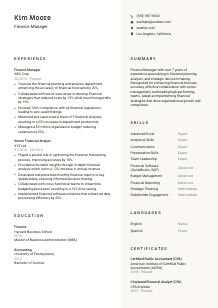
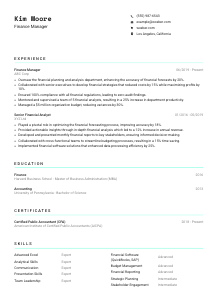
Balancing budgets, but your CV feels bankrupt? Check out this Finance Manager CV example, created with Wozber free CV builder. Learn how to smoothly allocate your financial fluency to fit job specifications, keeping your career trajectory always in the green!
Finance Manager hiring usually turns on one practical question: can you turn financial data into decisions leaders trust? Employers want more than a list of reporting duties. They look for someone who can improve forecast accuracy, control budgets, explain variances, guide analysts, and keep finance operations compliant while the business moves quickly.
A tailored CV makes that operating range visible fast. When the language in your experience, skills, and summary reflects the posting's priorities, both hiring teams and ATS screening can quickly connect your background to FP&A leadership, budgeting, and executive reporting. Wozber's free CV builder helps organise that alignment into an ATS-compliant CV, so your strongest finance outcomes are easy to spot from the first scan.
Personal details may look simple, but for a Finance Manager they set the tone for accuracy and professionalism. This section should confirm who you are, how to reach you, and whether you meet any practical requirement stated in the posting, without clutter or extra narrative.
Use your full name in a clear, readable format at the top of the page. Finance leaders are expected to communicate cleanly, whether in board packs or monthly reporting, and your header should reflect that same discipline.
Place the role title you are pursuing directly under your name when it reflects your actual background. Using "Finance Manager" here immediately frames your CV around budgeting, forecasting, analysis, and team oversight instead of leaving the reader to infer your direction.
List a reliable phone number and a professional email address. In finance, small errors undermine confidence quickly. A mistyped digit or outdated email can suggest the same carelessness no employer wants near forecasts, budgets, or compliance reporting.
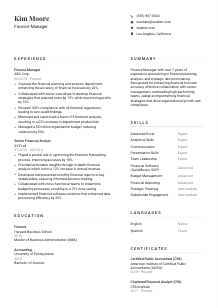
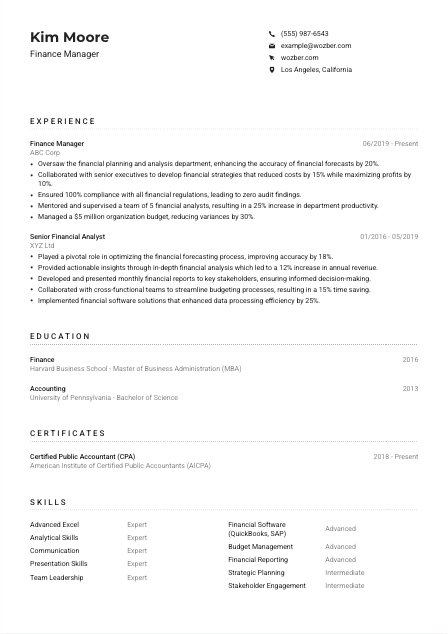
If a role specifies a location requirement, show that clearly in your header. In the example, listing Los Angeles, California directly supports the employer's stated need. For other Finance Manager roles, include city and state when location affects eligibility, commute expectations, or local market knowledge.
Include your LinkedIn profile or professional website if it strengthens your application. Make sure it matches your CV on titles, dates, and major achievements. For finance candidates, that consistency matters, especially when hiring teams compare your reporting scope, certifications, and leadership history across platforms.
Your header should do what a solid finance report does: present essential facts clearly, with no noise and no inconsistencies. Once that foundation is clean, the rest of the CV can focus on strategic and operational value.




The experience section carries the most weight for a Finance Manager. Hiring teams want to see how you handled forecasting, budgets, cost control, reporting, compliance, and analyst leadership in real business settings, and what changed because of your work.
Start by isolating the responsibilities and requirements that define the role. For Finance Manager openings, this often includes financial planning and analysis, variance review, executive recommendations, regulatory compliance, and team supervision. Use those themes to decide which achievements deserve space and which older bullets can be cut.
List positions in reverse chronological order and include title, employer, and dates for each one. Clean structure matters because finance hiring often involves fast comparison of scope. Reviewers should be able to see your progression from analyst work into ownership of planning cycles, strategic input, and team management without hunting for context.
Each bullet should show what you owned and what improved. Prioritise results tied to forecast quality, cost reduction, budget control, reporting cadence, profit improvement, process efficiency, or team performance. The sample CV does this well by pairing responsibilities with outcomes such as reducing costs by 15%, improving profits by 10%, and lifting department productivity by 25%.
Numbers carry real weight in finance CVs because they show scale and credibility. Include metrics such as budget size, forecast accuracy gains, expense reductions, revenue growth supported by analysis, cycle-time improvements, or audit results. A bullet like "Managed a $5 million budget and reduced variances by 30%" says far more than a generic claim about budget oversight.
A Finance Manager CV should emphasize work that supports planning, analysis, decision support, and leadership. If you have broad finance experience, select the bullets that best show executive partnership, analyst mentorship, budgeting discipline, and reporting quality. Even strong achievements should be removed if they do not strengthen your case for this level of finance ownership.
This section should make it easy to picture you running a planning process, presenting to leadership, and keeping financial performance under control. When your bullets connect ownership to measurable outcomes, your experience starts to read like management-ready finance work.
Education matters in finance because employers often use it as an early qualification check, especially when a posting names a degree field or prefers advanced study. Present it clearly, and make the most relevant credentials easy to find.
If the posting calls for a Bachelor's degree in Finance, Accounting, or a related field, make sure your degree and field are stated plainly. When you also have an MBA or Master's degree, include it prominently because many Finance Manager roles treat advanced study as a plus, especially for candidates involved in strategic planning and executive communication.
List the degree, field of study, school, and graduation year in a consistent structure. Finance CVs benefit from orderly presentation. A hiring manager should be able to confirm your academic qualifications as quickly as they would confirm a figure in a summary report.
Order can influence emphasis. If your MBA or Master's degree strengthens your candidacy for a leadership-focused finance role, place it before your undergraduate degree. In the example, the MBA in Finance immediately reinforces strategic and managerial depth alongside the accounting foundation.
You do not need to turn this into a transcript. If coursework, projects, or honors directly support your finance profile, include them briefly. That is most useful for earlier-career candidates or for roles where specialised training in corporate finance, valuation, accounting, or analytics adds context.
Academic distinctions, scholarships, or finance society involvement can help, but only if they support your current level and do not distract from your professional record. For experienced Finance Managers, education should confirm qualifications, not compete with your operating results.
Your education section should confirm that you meet the role's academic baseline and, where applicable, show added depth through an MBA or related advanced degree. Keep it clear enough that the reviewer can move on quickly to the work that proves how you apply that training.
Certifications matter more in finance than in many other fields because they point to technical depth, standards knowledge, and ongoing professional commitment. If a posting asks for CPA or CFA, this section can become a deciding factor rather than a nice extra.
Read the requirement line carefully and mirror the relevant certification language where it truthfully applies. For this opening, CPA or CFA is explicitly requested, so those credentials should appear clearly and without abbreviation confusion. Do not bury a required certification below less relevant coursework or memberships.
List credentials that strengthen your case for financial analysis, reporting integrity, regulatory knowledge, or strategic finance leadership. CPA and CFA are especially relevant because they signal rigor in accounting, analysis, valuation, and professional standards. Secondary certifications can follow if they add something distinct.
Show when the certification was earned and whether it is current if that matters. In regulated or standards-driven finance work, recency and active standing can matter as much as the credential itself, especially for employers concerned with compliance and up-to-date practice.
Finance changes with regulation, reporting expectations, systems, and market conditions. If you pursue continuing education, advanced training, or renewal activity tied to your certification, that supports your profile as someone who keeps current on the discipline rather than relying on old credentials alone.
Well-chosen certifications strengthen your authority in forecasting, reporting, and financial oversight. When they are relevant, current, and clearly presented, they add immediate weight to your CV.
The best Finance Manager skills sections do more than list traits. They surface the tools, analytical strengths, and communication abilities that support budgeting, forecasting, executive reporting, and team leadership, while staying readable for both ATS screening and human review.
Look for both technical and business-facing requirements. In this posting, advanced Excel, financial software, analytical ability, communication, and presentation skills all matter because the role involves forecasting, reporting, recommendations to senior management, and oversight of analysts. Use the posting's language where it matches your real background.
Prioritise the capabilities most connected to the role's actual work. For a Finance Manager, that often means FP&A, budgeting, financial reporting, variance analysis, advanced Excel, ERP or accounting systems, and team leadership. The sample CV also strengthens this section by naming software examples such as QuickBooks and SAP instead of leaving "financial software" too vague.
Do not overload the section with every finance-adjacent capability you have ever used. A shorter list of skills tied to planning, analysis, controls, presentation, and stakeholder communication is usually stronger than a crowded inventory. Relevance matters more than volume, especially in ATS optimisation where the right terminology should appear naturally, not repetitively.
Your skills section should support the same picture your experience creates: someone who can analyse performance, manage planning cycles, work confidently in financial systems, and communicate with leadership. Keep it specific enough to strengthen both ATS matching and hiring confidence.
Language skills are rarely the main selection factor for a Finance Manager, but they can still matter when the role requires clear communication with leadership, cross-border stakeholders, or diverse teams. Present them accurately and in the right order of importance.
If the posting specifies English proficiency, make that visible. Finance Managers are often expected to explain forecasts, present results, and discuss variances with senior leaders, so language proficiency is tied directly to job performance rather than treated as a minor personal detail.
Include other languages when they are real strengths and potentially useful in the role. If an employer works across regions, serves multilingual clients, or coordinates with international teams, additional fluency can support smoother communication and stronger partnership across functions.
Use clear levels such as Native, Fluent, Professional, or Conversational. Finance work often depends on precise communication in meetings, written reporting, and presentations, so overstating a language ability can become obvious very quickly.
Not every Finance Manager role needs multilingual ability. If the business is highly domestic, English may be enough. If the company has international reporting lines or regional finance operations, extra languages become more relevant and can be worth keeping visible.
Do not let this section distract from more important finance qualifications. Lead with the required language and treat additional languages as supporting value. In the example, English is rightly listed first, while Spanish adds range without competing with the core finance narrative.
This section works best when it confirms that you can handle the communication demands of the role, from written reports to presentations and stakeholder discussions. Keep it truthful, relevant, and secondary to your core finance strengths.
Your summary should quickly establish your level, specialization, and most relevant results. For Finance Manager roles, that usually means showing strength in financial planning and analysis, budget oversight, strategic support, compliance, and team leadership in just a few lines.
Before writing, pull out the few themes that define the opening. Here, those include FP&A leadership, financial strategy, cost control, compliance, and analyst management. Those themes should shape your wording so the summary reflects the actual demands of the role rather than a generic finance profile.
Start with your title or closest equivalent and your years of experience. Then anchor that experience in the right finance areas, such as planning, analysis, reporting, or business partnering. The sample summary works because it immediately places the candidate in Finance Manager territory with more than 7 years focused on financial planning, analysis, and strategic decision-making.
Use brief, concrete achievements that match the posting's priorities. Improvements in forecast accuracy, cost reduction, budget variance control, compliance outcomes, or team productivity are all strong summary material because they show both technical command and management value without repeating the full experience section.
Aim for a short paragraph that reads like an executive snapshot. Skip broad descriptors and focus on scope, strengths, and outcomes. If every sentence points to how you improve financial planning, decision support, or operational discipline, the summary will do its job well.
A well-written summary should make your direction and value clear within seconds. By the time a reviewer reaches your experience section, they should already expect to see stronger forecasting, smarter cost decisions, and confident leadership behind the numbers.
A Finance Manager CV should leave little doubt about your ability to run planning cycles, manage budgets, guide analysts, and support leadership with sound financial judgment. When each section reinforces those strengths, the document starts to read like a record of business performance, not just employment history.
Use Wozber's free CV builder to shape that story in an ATS-friendly CV format, refine role-specific language, and check alignment with the posting through focused ATS optimisation. The final result should make one thing easy to judge: you can step into the finance seat and improve decision-making from day one.