




Use Wozber and land your dream job
Create CV
No registration required
Balancing budgets, but feeling out of sync with your CV? Check out this Financial Administrator CV example, created with Wozber free CV builder. It shows how to align your fiscal expertise with job requirements, turning your career portfolio into an investment that consistently yields high returns!
Financial administrators are trusted with the details that keep a business financially steady. Hiring teams look for people who can keep records clean, close the month accurately, reconcile accounts without drift, and support budgets with practical analysis. Your CV should make that operational reliability visible through the work you have handled, the systems you have used, and the financial outcomes you improved.
A tailored CV quickly clarifies whether your background matches the employer's finance workflow, from statements and reconciliations to budgeting support and audit preparation. Wozber's free CV builder helps shape that experience into an ATS-compliant CV by aligning your wording with the job description, so the hiring team can immediately see where you have managed reporting cycles, cost controls, and account accuracy.
Finance roles value accuracy from the first line. Your personal details should be easy to scan, error-free, and aligned with practical requirements in the posting, especially when the employer has specified location or communication expectations.
Use your full name as the header in a clean, readable format. In finance and accounting hiring, a polished header sets the tone for the rest of the document. It signals care with presentation, which matters in roles built around precise records and reporting.
Place the role title directly under your name and match the posting when it makes sense. For this opening, "Financial Administrator" is the right choice. It keeps your positioning clear and helps both recruiters and ATS screening connect your CV to the vacancy faster.
Include a reliable phone number and a professional email address you check often. Strong communication is part of the role, especially when coordinating with management, auditors, or internal departments, so your contact information should look dependable and business-ready.
If the employer requires candidates to be based in a certain city, include your city and state. Here, listing New York, NY directly supports the stated requirement. You do not need a full street address, but you do want to remove any doubt about location eligibility.
A LinkedIn profile or professional website can help if it reinforces your CV with consistent titles, certifications, and career progression. For a Financial Administrator, that profile should support your work with budgeting, reconciliations, reporting, audits, or ERP and accounting systems, not distract from it.
This section should answer practical questions right away: who you are, what role you are targeting, how to reach you, and whether you meet any stated location requirement. Clean basics help the hiring team move straight to your financial experience.




This is the section where finance hiring teams look for day-to-day scope. They want to see whether you have managed records, handled reconciliations, supported monthly or yearly reporting, monitored budgets, and worked accurately inside established controls.
Before editing your bullets, mark the recurring responsibilities in the job description. For this role, those include maintaining financial records, preparing financial statements, monitoring departmental budgets, reconciling bank statements, tracking receivables and payables, supporting audits and tax work, and helping implement financial policies. Those themes should appear clearly in your experience if they reflect your actual background.
List your positions in reverse chronological order with job title, employer, and dates. Finance CVs benefit from a format that reads like a clean ledger: easy to follow, consistent, and free of ambiguity. Clear chronology also helps show progression from analyst-level support into broader administrative ownership.
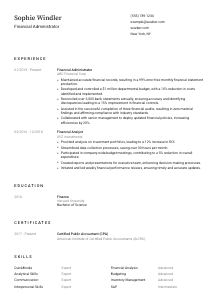
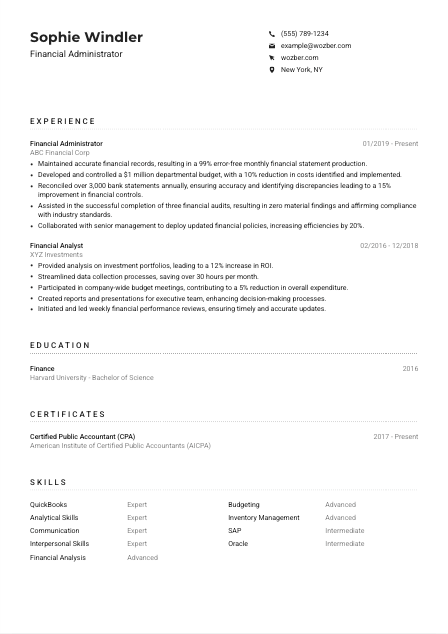
Each bullet should show what you handled and what changed because of your work. Instead of saying you were responsible for budgeting, show the scale and result. The example CV does this well with a bullet about managing a $1 million departmental budget and identifying a 10% cost reduction. That tells the reader both scope and business impact.
Numbers carry weight here because the work itself is measured through accuracy, timeliness, cost control, and compliance. Include figures such as budget size, number of reconciliations completed, time saved in reporting cycles, reduction in errors, improvement in controls, audit results, or percentage savings. Example metrics like 99% error-free statement production, 3,000 bank reconciliations annually, and zero material audit findings make the candidate's contribution concrete.
Keep the section focused on tasks and achievements that map to the target role. Reporting support, account tracking, variance analysis, financial software use, inventory updates, and policy implementation belong here. Generic administrative duties or unrelated achievements can dilute the message, especially when the employer is looking for someone who can step into month-end, budgeting, and reconciliation work quickly.
By the end of this section, the employer should be able to see the financial processes you have owned, the controls you have supported, and the scale of the work you can handle. In this field, a well-written experience section should read like reliable operational proof.
For Financial Administrator roles, education usually serves as the baseline qualification that supports your technical foundation. It tells the employer you have formal grounding in finance, accounting, reporting, and quantitative analysis before they look deeper into your hands-on experience.
If the posting asks for a bachelor's degree in Finance, Accounting, or a related field, make that easy to find. Place the degree, field, school, and graduation year in a straightforward format. A Bachelor of Science in Finance, like the example CV shows, lines up cleanly with this requirement.
Use a consistent structure across all education entries. Hiring teams reviewing finance CVs often check this section quickly before returning to experience, so clarity matters. Degree first, then field, institution, and year is usually the easiest order to scan.
If your degree is in business, economics, or another related discipline, make the finance connection obvious through the field name, coursework, or concentration if relevant. This helps when your work history is strong but the degree title is not an exact wording match to the posting.
You do not need to list classes if you already have solid professional experience. But if you are earlier in your career or your coursework directly supports the role, relevant subjects like managerial accounting, financial reporting, budgeting, taxation, or financial analysis can add useful context.
Honors, scholarships, or memberships in finance and accounting organizations can be worth including if they are genuinely relevant and do not crowd out stronger professional content. Use them when they reinforce discipline, subject depth, or sustained interest in the field.
Your education section should quickly confirm that you meet the academic baseline and have credible grounding in finance or accounting concepts. Once that is clear, the rest of the CV can focus on the financial work you have already delivered.
Certifications matter most when they reinforce the type of finance work in the posting. For a Financial Administrator, credentials tied to accounting standards, reporting discipline, compliance, and financial management can add weight, especially when the employer lists them as a plus.
If you hold credentials such as CPA or CMA, list them prominently because they connect directly to accounting, reporting, audit support, and financial oversight. This job description names both as valuable additions, so they deserve top placement when you have them.
Lead with the certifications most closely tied to the work. A CPA or CMA will usually matter more here than a general business certificate because the role involves financial statements, reconciliations, budgeting, and audit preparation.
Include dates or current standing if the certification requires ongoing maintenance. In finance, active credentials suggest continued engagement with professional standards and current practice. The example CV handles this clearly by showing ongoing CPA and CMA status.
If you are still growing into the role, certifications can strengthen your profile between levels of experience. Prioritise programs that support accounting controls, budgeting, financial analysis, tax exposure, or ERP-related financial operations rather than collecting broad credentials with weak relevance.
Certifications do not replace hands-on finance experience, but they can sharpen your profile and reinforce trust in your technical grounding. When they align with the employer's preferred credentials, they make your CV easier to shortlist.
The best skills sections for Financial Administrator CVs reflect how the work actually gets done. Employers want to see the systems you use, the financial tasks you can handle, and the communication strengths that support coordination with leadership, auditors, vendors, and internal teams.
Use the posting to identify the hard and soft skills that should appear on your CV. Here, that includes financial software proficiency, analytical strength, communication, interpersonal skills, budgeting, and financial analysis. Match that language where it reflects your real experience so your CV reads naturally in both ATS and human review.
Lead with the tools and capabilities most central to financial administration. Accounting and ERP systems such as QuickBooks, SAP, or Oracle belong near the top when you have used them. Then support them with functional strengths like reconciliations, accounts payable and receivable tracking, budget monitoring, financial reporting, and inventory control.
A simple structure works best. You might separate software, financial operations, and professional skills, or list the most relevant technical items first followed by communication and stakeholder skills. The example CV does this effectively by combining platform knowledge like QuickBooks with finance capabilities such as budgeting and financial analysis.
A hiring manager should be able to glance at your skills section and see whether you can step into the employer's finance environment, use the required systems, and communicate clearly around numbers, controls, and reporting.
Language ability matters in finance when the role requires clear written reporting, accurate communication, and smooth coordination across teams. If the posting specifies English, treat that as a core requirement rather than an extra detail.
This opening specifically calls for strong English speaking and writing abilities, so list English clearly with an honest proficiency level. That matters in roles involving financial statements, audit support, policy documentation, and communication with management.
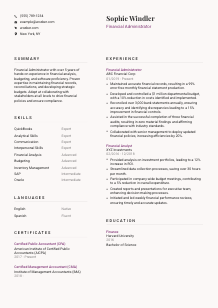
If you speak other languages, include them using simple proficiency terms such as Native, Fluent, Intermediate, or Basic. The example CV lists Spanish as Fluent, which adds useful context without overstating its importance.
Additional languages can be helpful in firms with international vendors, multilingual teams, or cross-border reporting needs. They are not a substitute for financial capability, but they can support collaboration in broader operating environments.
Avoid vague claims like "proficient" unless your CV uses a consistent scale. Clear labels help hiring teams understand whether you can draft reports, participate in meetings, or simply manage basic communication in that language.
For most Financial Administrator positions, language skills are secondary to accounting accuracy, system proficiency, and financial analysis. Include them, but do not let them overshadow stronger evidence from your experience, software knowledge, and reporting work.
This section should confirm that you can communicate effectively in the required business language and, where relevant, operate comfortably in a broader team or client environment. Keep it accurate and concise.
Your summary should give a fast read on your financial scope. In a few lines, it needs to establish your level of experience, the core areas you cover, and the kind of results or responsibilities that match the target role.
Focus on the work the role is centered on, such as financial record maintenance, budgeting, reconciliations, statement preparation, audit support, and financial software use. This keeps the top of your CV aligned with the actual demands of the job instead of drifting into generic finance language.
Start with a direct professional line that names your role and years of experience. The example summary does this cleanly with a statement about more than 5 years in financial analysis, budgeting, and software-backed finance work. That immediately places the candidate at the right level.
Use the next sentence or two to highlight practical strengths such as maintaining accurate records, managing reconciliations, controlling budgets, improving processes, or collaborating with leadership on financial policies. If you mention achievements, choose ones that reflect the role's daily value, like cost reduction, stronger controls, or clean audit outcomes.
Aim for a short paragraph that can be read in seconds. Three to five lines is usually enough. Avoid broad claims about being driven or detail-oriented unless they are tied to finance work, such as producing accurate monthly statements, supporting zero-finding audits, or improving reporting efficiency.
After reading the summary, the employer should already understand your finance background, your operational strengths, and the kind of environment you can support. A focused opening makes the rest of the CV easier to trust.
A Financial Administrator CV works best when every section supports the same message: you can keep financial records accurate, support reporting cycles, manage budgets responsibly, and work confidently with accounting systems and internal stakeholders.
Use Wozber's free CV builder to tighten structure, apply ATS-friendly CV formatting, and refine wording with the job description in view. Wozber's ATS CV scanner can also help you check whether key requirements such as budgeting, financial statements, reconciliations, software proficiency, and audit support are clearly reflected across the CV.
Once that alignment is in place, your application will give hiring teams a much clearer read on whether you can step into the financial administration work they need handled well.




