




Use Wozber and land your dream job
Create CV
No registration required
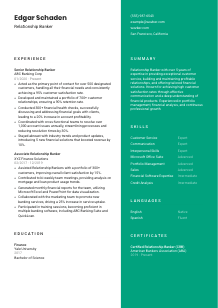
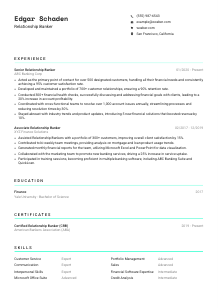
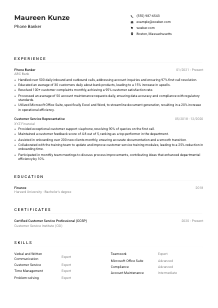
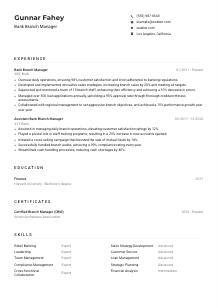
Building connections, but your CV feels like an account in the red? Take a look at this Relationship Banker CV example, created with Wozber free CV builder. It shows how to present your financial finesse in line with the job's deposit details, ensuring your banking pathway stays prosperous and bond-strong!
Relationship banking sits at the point where product knowledge meets trust. Hiring teams want to see whether you can guide customers through everyday account needs, lending conversations, and longer-term financial goals without losing the relationship along the way. Your CV should make that mix of service, judgment, and portfolio ownership easy to spot.
When the CV mirrors the language of the posting, it becomes much easier to separate branch-level customer service experience from true relationship management experience. Wozber's free CV builder helps you shape that story in an ATS-friendly CV format, so account portfolio work, financial health reviews, and product recommendations are visible early instead of buried in general banking duties.
Relationship Bankers are expected to sound polished and dependable from the first interaction. Your contact section should reflect that same standard by being clean, accurate, and aligned with practical hiring requirements.
Use your full name as the clearest identifier on the page. Keep it prominent and easy to read so the hiring manager can immediately connect your application to the client-facing professional brand you are presenting.
Place "Relationship Banker" directly under your name if that reflects the work you do or are targeting. This helps frame the rest of the CV around banking relationships, portfolio management, and financial guidance rather than broader retail or customer service work.
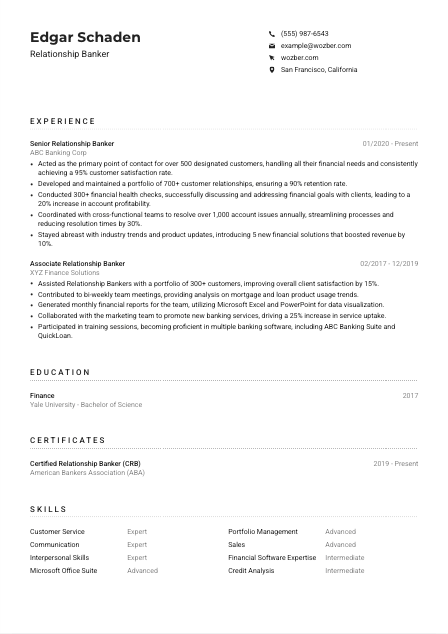
If the role calls for candidates in a specific market, list your city and state clearly. In this example, "San Francisco, California" immediately confirms local availability and removes an avoidable concern during early screening.
Include LinkedIn or another professional profile if it supports your application with matching titles, dates, and achievements. For a Relationship Banker, that profile should reinforce customer portfolio scope, product knowledge, and branch or banking experience, not introduce conflicting details.
This section should read like a banker who is organised, reachable, and already aligned with the market and role. Small details matter here because accuracy and professionalism are part of the job.




This is where a Relationship Banker CV starts to separate itself from a general banking or customer service CV. Hiring teams look for proof that you managed client relationships, recommended the right products, resolved account issues, and improved retention, satisfaction, or portfolio performance.
Read the job description for the day-to-day work behind the title. In this case, the strongest cues are being the primary point of contact, managing a customer portfolio, conducting financial health checks, coordinating with internal teams, and advising on products such as loans, mortgages, and investments. Those ideas should show up in your experience section using your own real results.
List your positions in reverse chronological order and give the most space to jobs tied to branch banking, customer relationship management, or financial services. If you have held both general service and banker roles, make the progression visible so the reader can see how you moved closer to portfolio ownership and advisory responsibility.
Each bullet should show what you handled and what changed because of your work. A line such as conducting hundreds of financial health checks that increased account profitability is much stronger than saying you "assisted customers with financial needs." The sample CV does this well by pairing client conversations with outcomes like profitability gains and faster issue resolution.
Relationship banking performance is often measured through retention, customer satisfaction, cross-sell activity, account growth, resolution time, and portfolio size. Include numbers where they are natural. Managing 500 customers, retaining 90% of a portfolio, or reducing issue resolution time by 30% gives concrete context to your scope and execution.
Trim bullets that do not support the target role. General cashiering, unrelated administrative tasks, or broad sales claims should give way to work that shows advisory conversations, onboarding support, account servicing, collaboration with lending or operations teams, and customer retention. Relevance matters more than volume.
Your experience section should show that customers trusted you with real financial conversations and that you handled those relationships with measurable results. By the end of this section, the reader should understand your portfolio scope, product exposure, and service performance.
For Relationship Banker roles, education usually serves as foundational proof that you understand business or financial concepts well enough to support customer conversations and product recommendations. Keep it straightforward and connected to the role's stated requirements.
If the posting asks for a bachelor's degree in Business, Finance, or a related field, present that qualification clearly. A degree such as Bachelor of Science in Finance, like the one in the example, directly supports work involving financial products, account analysis, and customer guidance.
List your degree, field of study, school, and graduation year in a simple structure. That is usually enough for banking hiring teams unless the employer requests additional academic detail.
Name the major exactly rather than leaving it broad. "Finance" or "Business Administration" connects more directly to lending, deposit products, and financial planning conversations than a generic degree label.
If your degree is adjacent rather than directly in finance or business, relevant coursework can help bridge the gap. Classes in financial analysis, consumer banking, accounting, economics, or investment principles can reinforce your readiness for customer-facing banking work.
Honors, scholarships, or leadership in finance-related organizations can add value if they support your professional story. Keep these extras concise and include them only when they strengthen your case for a banking role rather than crowding the section.
This section should confirm that you meet the role's educational baseline and have studied subjects relevant to banking conversations and financial decision-making. Clear formatting and precise degree wording do that well.
Certifications are not always required for Relationship Banker positions, but they can strengthen your credibility in customer advisory work, banking operations, and product knowledge. Use this section to show current, role-relevant professional development.
Start with the job description. If no certification is required, do not force unrelated credentials into the CV. Choose certificates that support relationship management, retail banking, lending, compliance, or customer financial guidance.
List certifications that align with the actual work of the role. The example's "Certified Relationship Banker" is a strong match because it reinforces customer relationship management within a banking setting. Similar banking, lending, or advisory credentials can serve the same purpose when they reflect your experience.
Show the issue date or active period, especially for credentials that remain current over time. This helps the employer see that your knowledge is recent and still relevant to today's products, regulations, and service expectations.
Banking products, compliance standards, and customer expectations change. Recent training in consumer lending, fraud prevention, financial planning, or relationship management can show that you continue to build practical expertise beyond formal education.
A well-chosen certificate tells the employer that your banking knowledge is current and intentional. Keep this section focused on credentials that strengthen your advisory credibility and day-to-day effectiveness with customers.
A Relationship Banker needs a mix of customer-facing judgment and practical banking fluency. Your skills section should reflect how you build trust, navigate products, and work within branch systems, not just repeat broad business buzzwords.
Start with the skills the employer already values. Here, that includes communication, interpersonal strength, knowledge of loans, mortgages, and investment options, plus proficiency with banking software and Microsoft Office. These are strong anchors because they connect directly to the role's daily work.
Choose a mix that reflects the full job. Hard skills may include portfolio management, credit analysis, banking software, Microsoft Office, and financial product knowledge. Soft skills should support the client-facing nature of the work, such as customer service, relationship building, and clear communication.
Place the most role-specific skills first so the reader quickly sees your strongest match. For example, customer service and communication matter, but in a Relationship Banker CV they are even stronger when paired with portfolio management, financial software proficiency, and knowledge of deposit and lending products.
This section should reflect the actual blend of client service and banking knowledge the role requires. When the skills match the posting and the experience section backs them up, the CV reads as a much stronger fit.
Relationship Bankers often work with customers who need clarity, reassurance, and precise financial explanations. If language skills help you serve a broader client base or meet a stated requirement, they deserve a place on the CV.
If the posting states that you must express ideas clearly in English, list English first with an honest proficiency level. For a customer-facing banking role, this supports everything from explaining account options to handling sensitive service issues.
Order languages by business usefulness, not personal preference. English should be prominent when it is explicitly required or central to the customer base you will serve.
Additional languages can be a real advantage in branch banking, especially in diverse communities. The example includes Spanish, which can help with customer rapport and service coverage, though that will vary by market and employer needs.
Use clear labels such as Native, Fluent, Advanced, or Conversational, and choose the level you can support in a professional setting. Banking conversations often involve nuance, compliance language, and product explanations, so accuracy matters.
Extra languages are most useful when they improve trust, reduce misunderstandings, and help customers discuss financial goals more comfortably. That connection is especially relevant in relationship-driven banking roles.
This section works best when it clarifies how you communicate with customers clearly and professionally. For a Relationship Banker, language ability is most valuable when it supports trust, service quality, and smoother financial conversations.
Your summary should quickly place you in the right lane of banking. For this role, that means combining customer relationship strength with knowledge of financial products, portfolio responsibility, and measurable service results in a few sharp lines.
Start from the work that defines relationship banking: managing customer relationships, understanding financial products, and guiding clients toward appropriate solutions. This keeps the summary aligned with what branch and retail banking employers actually need to see first.
Lead with a direct statement that establishes your background, such as years in retail banking, customer portfolio management, or client-facing financial services. The sample summary does this effectively by combining tenure with relationship building and tailored financial solutions.
Bring in two or three relevant strengths from the job description, such as knowledge of loans and mortgages, financial health checks, customer retention, or banking software proficiency. Keep the wording natural and tied to real experience rather than turning the summary into a keyword list.
Aim for 3 to 5 lines. That is enough space to show your banking background, customer-facing strengths, and one or two business outcomes like high satisfaction, profitable portfolio growth, or strong retention without repeating your experience bullets.
A strong summary tells the employer, within seconds, what kind of Relationship Banker you are and what results tend to follow your work. Keep it specific enough that the rest of the CV feels like proof, not explanation.
A Relationship Banker CV works best when it shows how you manage customer relationships, recommend appropriate financial products, and support branch performance with measurable results. Each section should reinforce that picture, from local availability and education to portfolio metrics, product knowledge, and communication strength.
Use Wozber's free CV builder to shape those details into an ATS-compliant CV that reflects the language of the job description without losing the reality of your experience. The finished document should make it easy to judge your readiness for client conversations, account growth, and long-term relationship management.




