



Use Wozber and land your dream job
Create CV
No registration required
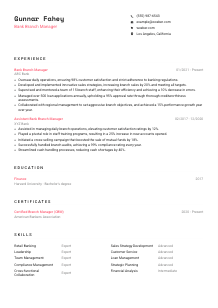
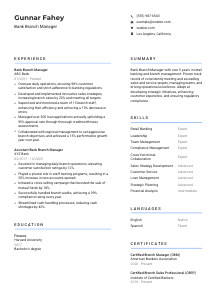
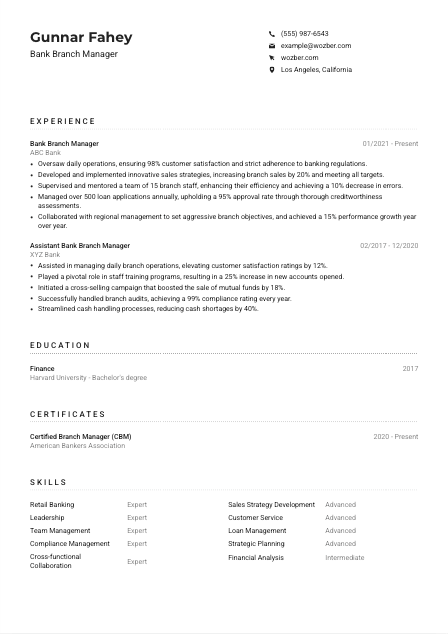
Steering bank branches, but feeling lost with your CV? Check out this Bank Branch Manager CV example, created with Wozber free CV builder. It shows how to present your leadership and financial savvy to match job expectations, banking on your career to yield returns as impressive as a well-invested portfolio!
A Bank Branch Manager sits at the point where revenue goals, customer trust, lending decisions, and regulatory discipline all meet. That mix needs to come through on the CV. Hiring teams want to see how you run a branch day to day, improve sales performance, coach frontline staff, and keep operations aligned with policy when the pressure is on.
When that experience is tailored to the posting, the first read becomes much clearer. Instead of looking like a general retail banking profile, your CV shows branch-level ownership through the exact language used for operations, loan oversight, staff development, and target attainment. Wozber's free CV builder helps organise that into an ATS-friendly CV format, so both hiring teams and ATS screening can quickly recognize your branch management scope.
Personal details are straightforward, but they still shape the first impression. For a Bank Branch Manager, this section should immediately confirm that you are a local, professional, branch-level candidate who is ready to step into customer-facing leadership and operational accountability.
Place your full name at the top in a clean, readable format. In banking, presentation matters. A clear header reflects the same professionalism expected in customer interactions, audit documentation, and branch communications.
Add "Bank Branch Manager" directly beneath your name if that is the role you are pursuing. Matching the title helps frame the rest of the CV around branch leadership, retail banking performance, and operational oversight from the first line.
Include a reliable phone number and a professional email address. Double-check both. Branch leadership roles move through interviews quickly, and a missed call or an unprofessional email can undercut an otherwise credible application.
If the posting calls for a specific location, show it clearly. In this example, listing Los Angeles, California directly answers a stated requirement and removes any doubt about local availability. Only do this when location is relevant to the target role.
If you include LinkedIn or a professional website, make sure it matches your CV. Titles, dates, branch leadership scope, and metrics like sales growth or customer satisfaction should be consistent across both.
This section does not need flair. It needs accuracy, professionalism, and the few details that immediately confirm you are positioned for branch leadership.




Experience carries the most weight in a Bank Branch Manager CV because the role is measured through results. Hiring teams look for branch performance, staff leadership, customer outcomes, lending judgment, and compliance discipline. Your bullets should show how you handled those responsibilities in real operating conditions.
Before writing bullets, identify the recurring demands in the job description. For this role, that includes daily branch operations, sales strategy, team supervision, loan approval, and collaboration with senior leadership. Those themes should appear naturally in your recent banking roles, using terms that match the employer's language where they reflect your real work.
List positions in reverse chronological order and make sure the most relevant branch or retail banking experience gets the most space. A progression like Assistant Bank Branch Manager to Bank Branch Manager works well because it shows increasing responsibility for staff, performance targets, and operational control.
Quantified results carry real weight here because branch managers are judged on targets, service levels, audit performance, and lending activity. The sample CV does this well with figures like 98% customer satisfaction, 20% sales growth, more than 500 loan applications managed annually, and 15% year-over-year performance growth. Use your own numbers to show scale, consistency, and business impact.
Choose accomplishments that connect directly to branch management. Strong examples include improving cross-sell results, reducing teller errors, raising account openings, maintaining audit scores, coaching branch staff, or strengthening loan review processes. Leave out work that does not help prove your readiness to lead branch operations.
Each bullet should make clear what you handled, what you changed, and what improved because of it. In banking, that often means pairing an operational action with a measurable result, such as redesigning cash handling controls and reducing shortages, or coaching staff on product conversations and lifting sales conversion. That combination shows management judgment, not just activity.
By the end of this section, a reader should be able to see the size of your team, the targets you managed, the controls you upheld, and the business results you delivered.
Education will rarely outweigh branch performance, but it still matters in banking. A relevant degree supports your credibility in financial decision-making, customer advisory work, and branch operations, especially when the posting asks for a bachelor's degree in finance, business, or a related field.
Start with your bachelor's degree and make the field of study easy to spot. If your degree is in Finance, Business Administration, or another closely related area, that should be clear at a glance because it directly addresses the requirement.
List the degree, field, school, and graduation year in a simple format. Hiring teams do not need a long academic story here. They need to confirm that you meet the educational baseline without hunting for the details.
If the employer asks for a specific educational background, mirror that wording when it is accurate. A "Bachelor's degree in Finance" aligns neatly with the sample requirement and helps both recruiters and ATS screening connect your background to the role.
Honors, relevant coursework, or finance-related projects can help if you are earlier in your management career or if they connect to banking operations, lending, or financial analysis. For a more experienced branch manager, keep the emphasis on degree relevance and let the experience section do the heavy lifting.
If you have recent training in lending, compliance, sales leadership, or branch operations, you can include it when it adds current relevance. Banking changes through regulation, products, and customer expectations, so recent development can reinforce that you stay current.
This section works best when it quickly confirms that you meet the stated degree requirement and supports the broader picture of financial and managerial credibility.
Certifications matter in branch management because they add recognized proof of banking knowledge, sales capability, or leadership development. They are especially useful when the job description names preferred credentials or when you want to show continued investment in branch operations and professional standards.
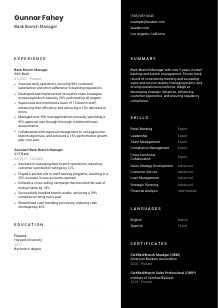
Lead with certifications that relate directly to branch leadership, retail banking performance, sales, or compliance. In this example, CBM and CBSP are worth featuring because the posting names them as a plus and they support both management and revenue responsibilities.
A short list of well-chosen credentials is stronger than a crowded section with unrelated courses. Focus on certifications that support branch oversight, customer-facing sales leadership, lending knowledge, or regulatory awareness.
Show the year earned or the active date range when possible. That helps employers understand whether the certification is current and whether your professional development has continued alongside your branch management experience.
Banking leaders are expected to stay current as products, procedures, and compliance standards evolve. If you have newer certifications or active renewals, they help reinforce that you are keeping your knowledge current in a role where policy adherence matters every day.
When they connect directly to banking leadership and branch performance, certifications strengthen the picture of a manager who is prepared for both operational control and growth targets.
Skills for a Bank Branch Manager should reflect how the branch actually runs. That means a mix of operational banking knowledge, people leadership, sales execution, customer service standards, and control awareness. Keep the list focused on the abilities you use to hit targets while protecting the branch from avoidable risk.
Start with the capabilities the posting emphasizes. For this role, that includes retail banking, leadership, interpersonal communication, sales strategy, compliance, loan management, and collaboration with senior management. These are the skills that should anchor the section because they describe how the branch succeeds day to day.
Branch managers need more than product knowledge. Your skills list should show that you can drive sales and service results while coaching staff, handling escalations, reviewing lending decisions, and maintaining procedural discipline. A mix like retail banking, team management, compliance management, customer service, and financial analysis creates that balance.
Arrange skills so the most role-critical ones appear first. You can group them around areas such as branch operations, sales and service, leadership, and financial oversight. The sample CV's emphasis on retail banking, leadership, team management, compliance management, and sales strategy is a good model because it mirrors the priorities of the job.
A hiring manager should be able to scan this section and immediately connect your capabilities to branch growth, staff management, customer experience, and operational control.
Language skills can be a practical advantage in branch banking, especially in markets where customer relationships depend on clear, trust-building communication. This section should stay factual, but it can also support your profile when the branch serves a diverse local client base.
If the posting names a language requirement, include it clearly. Here, strong English proficiency is essential, so English should be listed prominently with an honest level such as Native or Fluent.
Additional languages can strengthen your profile when they help with customer conversations, account opening, issue resolution, or community engagement. Spanish, for example, can be valuable in many retail banking environments, but it should be presented as an added strength rather than a universal requirement.
List the languages you can actually use in a business setting, starting with the strongest and most relevant. This keeps the section useful and avoids turning it into a list of partial or rarely used abilities.
Use clear labels such as Native, Fluent, Advanced, or Intermediate. In a customer-facing banking role, overstating language ability can create service issues, especially when handling financial explanations, account questions, or lending discussions.
If a branch serves multilingual communities, language skills can support relationship banking, customer retention, and smoother service interactions. Keep that context in mind when deciding whether this section deserves more visibility on your CV.
Used well, this section shows that you can communicate clearly with the customers and teams your branch actually serves.
The summary is where you establish your level fast. For a Bank Branch Manager, it should combine years of experience with the outcomes that matter most in the role, such as branch performance, team leadership, service results, lending oversight, and compliance discipline. Keep it concise, but make every line do work.
Read the posting closely before writing this section. If the employer emphasizes branch operations, sales targets, staff development, and loan approval, your summary should reflect those same priorities in language that matches your background.
Start with a direct statement of who you are professionally. A line such as "Bank Branch Manager with 5+ years in retail banking and branch leadership" immediately places you in the right lane and aligns with the stated experience requirement.
Include outcomes that matter in branch management, not generic traits. Strong examples include exceeding branch sales goals, improving customer satisfaction, managing a lending pipeline, strengthening compliance performance, or leading a team through measurable growth. The sample summary works because it stays close to these operating realities.
Aim for 3 to 5 lines. That is enough space to establish your banking background, management level, and performance strengths without repeating details that already appear in the experience section. Short, concrete phrasing is usually more persuasive than broad claims.
When this section is done well, the rest of the CV reads through the lens you want: a banking leader who can grow business, guide staff, and keep branch operations under control.
A Bank Branch Manager CV needs to show more than tenure in banking. It should make your branch results, leadership range, lending judgment, and compliance discipline easy to recognize from the first scan.
Use Wozber to shape that experience into an ATS-compliant CV with language that reflects the posting and structure that supports ATS optimisation. The finished document should make one thing clear: you know how to run a branch, grow performance, and lead a team responsibly.