



Use Wozber and land your dream job
Create CV
No registration required
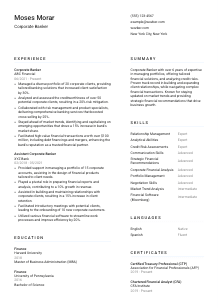
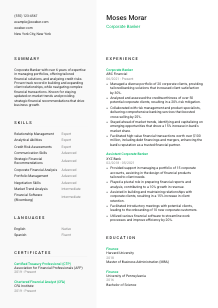
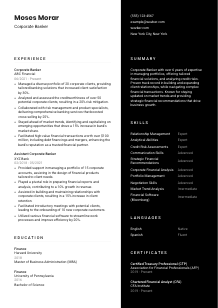
Juggling stocks and bonds, but your CV seems interest-rate flat? Check out this Corporate Banker CV example, created with Wozber free CV builder. It shows how to align your financial prowess with job demands, propelling your career to growth and dividends!
Corporate banking CVs are often weakened by broad banking language when the work itself is highly specific. Hiring teams need to see how you manage corporate relationships, weigh credit risk, and move transactions forward across real client portfolios. Your CV should make that operating range visible, from financial analysis and deal support to the judgment you bring when advising companies on funding and growth.
A tailored CV changes how quickly your background reads as corporate banking rather than general finance or relationship management. When the language mirrors the role, an ATS-compliant CV can surface the right terms around portfolio management, credit assessments, and transaction support, while Wozber's free CV builder helps organise that experience into a format that makes your client coverage and banking scope easier to recognize.
In corporate banking, the header needs to do one practical job well. It should identify you immediately, confirm you are reachable, and remove any friction around basics that matter for client-facing hiring processes.
Use your full name in the most visible text on the page. Keep it clean and professional so the recruiter, banker, or hiring lead can identify you at a glance during a fast initial review.
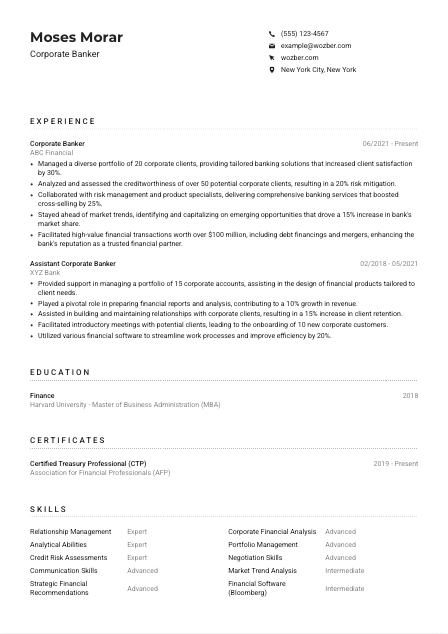
Place "Corporate Banker" directly under your name when that matches the role you are pursuing. This helps frame the rest of the CV around corporate client coverage, credit work, and transaction support instead of leaving your profile open to broader banking interpretations.
List a current phone number and a professional email address. In a client-facing finance role, small errors here can suggest carelessness, so double-check every detail before sending your application.
If the posting specifies a city or market, include it clearly in your personal details. In the example, listing New York City, New York directly addresses the stated location requirement. Use this only when location is relevant to the role you are targeting.
Include your LinkedIn profile or professional website if it supports your candidacy with consistent titles, deal exposure, certifications, or market focus. Skip links that do not strengthen your case as a corporate banking professional.
This section does not need flair. It needs accuracy, a clear role label, and any practical detail that removes doubt early, especially for location-based corporate banking openings.




This is where corporate banking hiring decisions usually sharpen. Your experience should show the size of the client portfolio you managed, the financial analysis you handled, the internal teams you worked with, and the transactions or outcomes your work supported.
Mark the responsibilities that define the role before you start editing. For corporate banking, that often means portfolio management, credit risk assessment, client relationship development, cross-functional coordination, and transaction execution. Those priorities should shape which bullets stay, which get rewritten, and which move higher on the page.
Start with your most recent banking position and work backward. For each role, include your title, employer, and dates so the reader can quickly trace your progression from support work into broader client ownership, credit responsibility, or more complex deal exposure.
Rewrite each bullet so it shows what you handled and what changed because of your work. The example does this well by moving beyond "managed clients" to "managed a diverse portfolio of 20 corporate clients" and tying that work to a 30% increase in client satisfaction. That kind of phrasing shows both scope and result.
Quantify the portfolio, number of credit reviews, transaction value, revenue contribution, cross-sell growth, retention, or risk reduction where you can support the numbers. In this field, figures like 50 client assessments, $100 million in transactions, or a measurable lift in market share carry more weight than vague claims about impact.
Prioritise experience that supports corporate client coverage, financial structuring, risk analysis, treasury discussions, or product coordination with internal specialists. If a detail does not help explain your ability to manage corporate relationships or advise on financing needs, cut it and make room for stronger banking evidence.
The experience section should leave no doubt about the level of banking work you have done. Show the client scope, the financial judgment, and the business results clearly enough that the reader can picture you handling a corporate portfolio.
Education matters in corporate banking because it establishes your grounding in finance, economics, and business decision-making. It will not carry the application on its own, but it should reinforce the analytical base behind your client and credit work.
List your highest relevant qualification first, especially when the role calls for a bachelor's degree in Finance, Economics, Business Administration, or a related field. If you also hold an advanced degree that strengthens your commercial or financial profile, place that above your undergraduate degree.
Use a simple structure: degree, field of study, school, and graduation year. Clean formatting helps the hiring team confirm your academic background quickly without distracting from the more important story in your experience section.
When your education lines up closely with the posting, let that alignment work for you. In the example, both an MBA in Finance and a bachelor's degree in Finance support the role directly. If your degree is adjacent rather than exact, your field-related coursework or experience can provide the bridge.
If you are early in your career, relevant study in corporate finance, credit analysis, financial modeling, accounting, or capital markets can strengthen this section. For experienced bankers, coursework is usually less important than deal history and portfolio results.
Honors, major finance projects, investment competitions, or leadership in finance societies can add value when they support your banking profile. Keep them brief and relevant so they do not crowd out stronger professional material.
This section should confirm that your training matches the analytical demands of corporate banking. Keep it concise, relevant, and supportive of the heavier proof in your work history.
In corporate banking, certifications can sharpen your credibility in areas like treasury, valuation, markets, and financial analysis. They are rarely a substitute for portfolio and client experience, but they can strengthen how your technical depth is read.
If the employer mentions credentials such as CTP or CFA, include them clearly. That is especially useful when the role involves credit analysis, strategic financial recommendations, or broader advisory conversations with corporate clients.
List certifications that support your banking work, such as treasury, credit, investment analysis, or commercial finance qualifications. A shorter list of high-value credentials reads better than a long list of unrelated coursework or minor certificates.
Add the year earned, expected completion, or active status when relevant. In finance roles, current standing can matter, especially for certifications that signal recent technical study or maintained professional membership.
Corporate banking changes with regulation, market conditions, and product mix. Continuing education in areas such as credit underwriting, cash management, debt markets, or sector analysis can strengthen future applications and support stronger conversations in interviews.
Relevant credentials help confirm that your banking knowledge goes beyond on-the-job familiarity. When they align with the role, they add useful weight to your client, credit, and transaction experience.
The skills section should reflect how corporate bankers actually operate. That means a mix of client-facing strength, financial judgment, credit capability, and the tools or analysis methods you use in day-to-day coverage work.
Read the posting closely and note both explicit and implied skills. For this profession, that often includes relationship management, complex financial analysis, credit risk assessment, strategic recommendations, negotiation, and communication with clients and internal partners.
Use the employer's wording where it accurately reflects your background. For example, skills such as "Relationship Management," "Credit Risk Assessments," and "Analytical Abilities" connect directly to the sample posting and help position your CV for both human review and ATS matching.
Lead with the capabilities most tied to performance in corporate banking, such as portfolio management, corporate financial analysis, deal support, and stakeholder coordination. You can also include relevant tools like Bloomberg or other financial platforms when they are part of your actual workflow.
A focused skills section should sound like the toolkit of someone who can manage corporate clients, assess risk, and support financing activity. Keep it aligned with the work you have already proven elsewhere in the CV.
Language ability matters in corporate banking when it improves communication with clients, internal teams, or cross-border stakeholders. Include it when it adds genuine value, and keep the presentation clear and credible.
If the posting specifies English communication, list English clearly with the right proficiency level. For a role that involves relationship management, client calls, and transaction discussions, this should never be left ambiguous.
Use straightforward labels such as Native, Fluent, Advanced, or Intermediate. That gives hiring teams a practical read on how comfortably you can handle meetings, documentation, or client communication in each language.
Extra languages can be useful in corporate banking, especially when client coverage includes multinational firms, regional business communities, or cross-border financing activity. In the example, Spanish adds broader client communication value without overstating its role as a universal requirement.
Do not inflate proficiency. If a language comes up during interviews or client-facing work, overstating your ability can quickly undermine your credibility.
When relevant, languages show more than personal background. They can support relationship-building, smoother communication across functions, and stronger client service in diverse markets.
For corporate banking, language skills are most useful when they support real client interaction or market coverage. Present them clearly so the reader can judge where they add practical value.
The summary should quickly establish the level of corporate banking work you do. In a few lines, show your years of experience, the kind of clients or transactions you handle, and the strengths that matter most for the target role.
Before writing the summary, identify the few requirements that define the job. For a corporate banker, that usually means client portfolio management, credit analysis, financial recommendations, transaction support, and relationship-building with corporate decision-makers.
Open with a direct statement about who you are and how long you have worked in banking. The example summary uses "over 6 years" effectively because it immediately places the candidate above the posting's minimum 5 years of experience.
Choose the capabilities most central to the role and support them with concrete framing. A useful summary might reference managing corporate portfolios, analysing credit risk, supporting high-value financing transactions, or expanding client relationships, rather than relying on generic claims about being results-driven.
Aim for three to five lines. Every phrase should earn its place by clarifying your banking scope, your commercial value, or your technical judgment. If a sentence could apply just as easily to retail banking or a general finance role, rewrite it.
Your summary should make the rest of the CV easier to read in the right context. With a targeted profile and a polished structure from Wozber's AI CV builder, you can present an ATS-friendly CV format that immediately points to corporate client coverage, credit capability, and transaction experience.
A well-tailored corporate banker CV should show how you manage relationships, evaluate credit, and contribute to financing outcomes in language that matches the role you want. When those elements are organised clearly, hiring teams can quickly understand your level of client responsibility and commercial judgment.
Use Wozber to build and refine an ATS-friendly CV template, check alignment with an ATS CV scanner, and tighten the wording around the banking work you actually do. The finished CV should make one thing easy to judge: you can step into a corporate client portfolio and handle the analytical and relationship demands that come with it.




