



Use Wozber and land your dream job
Create CV
No registration required
Juggling vaults, but your CV seems bankrupt? Deposit your trust in this Bank Manager CV example, created with Wozber free CV builder. Learn how to align your financial stewardship with job requirements, setting your career to prosper as richly as the bank's coffers!
Bank managers are trusted with two results at once: a branch that runs cleanly under policy and a team that still grows deposits, loans, and customer relationships. That balance should be obvious on your CV. Hiring teams want to see that you can manage daily operations, coach staff, respond to local market conditions, and handle high-value client needs without losing control of risk or service quality.
A tailored CV changes how quickly that balance comes through, especially when banking employers screen for branch leadership, regulatory knowledge, and sales performance in an ATS. Wozber's free CV builder helps you align your wording with the job description, keep an ATS-compliant CV structure, and surface the banking results that matter first, so your application reads like someone ready to run a branch, not just work in one.
Banking CVs are expected to feel orderly and credible from the first line. Your personal details section should do exactly that. Keep it clean, professional, and aligned with any practical requirement named in the posting, especially title, contact information, and location when branch presence matters.
Use your full name in a larger font than the rest of the page so it anchors the CV immediately. For a management role in banking, this should feel polished and formal, closer to a business card than a creative header.
Place "Bank Manager" directly under your name when that is the role you are pursuing. Matching the posted title helps both recruiters and ATS tools connect your background to branch leadership, operations oversight, and team management without making them infer your next step.
Include a reliable phone number and a professional email address. Banking employers move quickly when scheduling interviews for branch leadership roles, so accuracy matters. If you add a website or LinkedIn profile, make sure it reflects the same job titles, dates, and performance results shown on the CV.
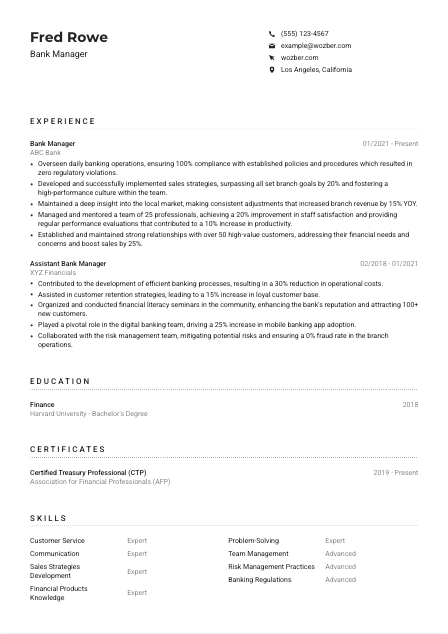
If the role specifies a local market, list your city and state clearly. In the example, "Los Angeles, California" works well because the employer explicitly wants someone based there. That kind of detail removes questions about branch availability, commute, or relocation timing.
For bank managers, an updated LinkedIn profile can reinforce your progression from assistant manager or branch operations leadership into full branch management. Keep it aligned with your CV, especially around compliance, sales growth, customer portfolio management, and team size.
This section should confirm that you are easy to contact, professionally presented, and practically available for the role. In banking, that kind of clarity supports the rest of the story.




Experience carries the most weight on a Bank Manager CV because this role is judged through operating results. Hiring teams look for evidence that you can lead staff, protect compliance, grow revenue, and manage customer relationships in a branch environment. Your bullets should connect day-to-day banking work with business outcomes.
Before writing bullets, mark the responsibilities and requirements that define the role. For this job, that includes daily operations, compliance, sales strategy, local market awareness, team management, and high-value customer relationships. Those are the themes your recent roles should reflect, using the same banking language where it matches your experience.
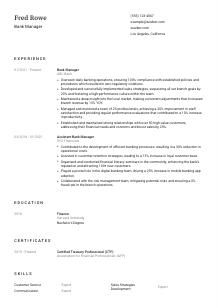
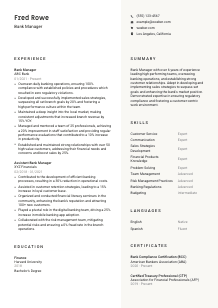
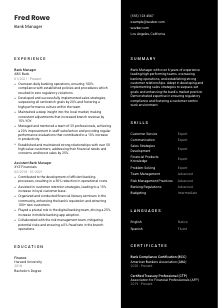
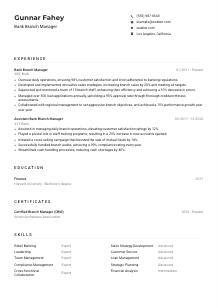
List your most recent role first and include job title, bank or employer name, and dates. For a Bank Manager position, your progression matters. A move from Assistant Bank Manager into Bank Manager, like in the example, tells a coherent story of increasing responsibility across branch operations, staff supervision, and performance ownership.
Each bullet should show what you owned and what improved because of your work. Bank management CVs are stronger when they mention compliance rates, branch goal attainment, portfolio growth, customer retention, operational efficiency, or team productivity. The example bullet about surpassing branch goals by 20% works because it ties strategy to a measurable branch outcome.
Use numbers wherever they reflect how banking performance is actually tracked. Percent growth, audit results, fraud reduction, customer counts, revenue lift, adoption of digital banking tools, and team size all help. In the sample CV, "zero regulatory violations," "15% YOY revenue increase," and management of a team of 25 each give the hiring team a clearer picture of scope and control.
Trim older or less relevant work that does not support branch management. If you include earlier positions, emphasize transferable pieces such as customer service standards, process improvement, sales support, lending operations, or risk controls. Every bullet should make it easier to see you handling the demands of a branch, not just participating in them.
A Bank Manager CV works best when the experience section shows control, growth, and judgment at the branch level. If your bullets make it easy to picture you leading people, protecting compliance, and hitting targets, this section is doing its job.
Education is straightforward on a Bank Manager CV, but it still matters. A degree in finance, business administration, or a related field supports the technical side of branch leadership, especially when the role includes financial products, sales oversight, and regulatory accountability.
If you hold a bachelor's degree in Finance, Business Administration, or a related area, list it plainly and prominently. The example's Bachelor's Degree in Finance lines up directly with the posting and immediately checks an important requirement.
Include your degree, field of study, school name, and graduation year or date range. Banking employers do not need extra decoration here. They need quick confirmation that your academic background supports the business and financial judgment expected in branch management.
When your degree closely matches the posting, keep the wording easy to recognize. A finance or business degree reinforces the rest of your CV by supporting your experience in branch operations, product knowledge, budgeting, and performance management.
If you are earlier in your career, you can mention coursework, projects, or academic focus areas tied to banking, finance, accounting, or management. For more experienced bank managers, that space is usually better spent on branch results unless the coursework is unusually relevant.
Academic honors, leadership activities, or finance-related student organizations can help if they add meaningful context, especially for candidates with less management experience. For seasoned banking professionals, keep this section concise and let your operational record lead.
This section should confirm that your academic background supports the commercial, operational, and regulatory demands of bank management. Once that is clear, let your experience carry the heavier weight.
Certifications matter in banking because they show continued development in areas tied to risk, treasury, compliance, and professional standards. For Bank Manager roles, they can strengthen your profile when the employer wants deeper financial knowledge or proof of current industry commitment.
Start with the certification that most closely matches the posting. Here, a Certified Treasury Professional designation is specifically preferred, so it should appear at the top if you have it. That immediately reinforces your fluency with financial operations and treasury-related knowledge.
Include certifications that support branch leadership, regulatory awareness, risk management, treasury work, lending, or compliance. The sample CV pairs CTP with a Bank Compliance Certification, which is a useful combination because it supports both financial expertise and policy discipline.
List the year earned and, if applicable, ongoing status. In regulated industries, recency matters. Current dates suggest that your knowledge of banking standards, compliance expectations, and professional practice is being maintained rather than left stale.
Banking changes through regulation, digital adoption, fraud controls, and product shifts. Updated certifications tell employers that you keep pace with those changes and bring current judgment into branch decision-making, staff coaching, and customer guidance.
You do not need a long list. You need credentials that support the kind of branch leadership the role requires. When chosen well, this section adds depth to your operational and financial credibility.
A Bank Manager skills section should look like it belongs to someone who runs a branch, not someone who only supports one. That means combining banking knowledge with people leadership, sales execution, customer relationship management, and operational control. Keep the list tight and relevant.
Pull out the capabilities the employer actually names and match them to your background. In this case, that includes financial products knowledge, banking regulations, risk management, sales, team management, customer service, and English communication. Using that language naturally improves ATS alignment and makes your fit easier to see.
Do not separate leadership from banking expertise as if they are unrelated. A Bank Manager needs both. Pair items like risk management practices, compliance knowledge, and budgeting with team management, coaching, customer service, and sales strategy development.
Choose the skills you can support in your experience section. A shorter list of well-matched capabilities is stronger than a long inventory of vague strengths. The sample CV does this well by focusing on customer service, financial products knowledge, sales strategy, regulations, risk management, and team leadership rather than listing every banking function possible.
When this section is tailored well, it quickly shows that you understand the business, can lead people, and can operate within policy. That combination is central to Bank Manager hiring.
Language skills can add real value in banking, especially in branches that serve diverse communities or relationship-driven customer bases. This section should stay practical. List required language ability first, then any additional languages that help you communicate with customers more effectively.
If the posting calls for professional English, make sure English appears clearly with an honest proficiency level. That requirement is not decorative in banking. It affects customer communication, policy interpretation, internal reporting, and staff management.
Extra languages can strengthen your application when they help with customer service, community outreach, or relationship management. In the example, Spanish is a useful addition because it can support branch service in a diverse local market. That will not be universal for every role, but it can be a meaningful advantage where customer demographics support it.
Use clear labels such as Native, Fluent, Intermediate, or Basic. A Bank Manager may need to handle escalated customer conversations, explain products, or coach staff, so overstating language ability can create the wrong expectation.
If the role includes a strong local-market focus, relationship banking, or service to multilingual communities, language ability becomes more than a nice extra. It can support trust, retention, and smoother customer interactions across savings, lending, and advisory conversations.
Banks value communication that is accurate and reassuring. Additional languages can help you handle customer concerns with more nuance and build stronger long-term relationships, particularly with high-value clients or community-based accounts.
This section is most useful when it shows how you can serve customers and lead clearly in the environments where the bank operates. Keep it honest, relevant, and tied to client and branch needs.
The summary sits at the top of the CV, so it needs to establish your management level quickly. For a Bank Manager, that means a compact introduction that combines years of experience with branch operations, team leadership, sales performance, customer relationship management, and compliance awareness.
Start with your title or professional identity and your years of relevant experience. A line such as "Bank Manager with 6+ years in retail banking and branch leadership" gives immediate context and works better than a vague claim about being results-driven.
Focus on capabilities that matter most for the target position. For this posting, that would likely include overseeing banking operations, leading high-performing teams, developing sales strategies, and maintaining strong customer relationships. The sample summary handles this well by tying leadership to branch growth and customer-centric management.
Three to five lines is enough. Use concrete language linked to banking performance rather than broad adjectives. If you mention achievements, point to outcomes such as surpassing branch goals, strengthening compliance, improving team performance, or growing market presence.
End on a statement that reinforces your operating style or specialty. For example, you might emphasize consistent compliance, relationship banking, revenue growth, or coaching teams to deliver stronger service and sales results. That leaves the reader with a clear picture of how you lead.
By the time someone finishes these opening lines, they should already understand your level, your banking strengths, and the results you are used to owning. That makes the rest of the CV easier to read in the right context.
A strong Bank Manager CV shows that you can protect the bank's operations while growing the branch's business. When your experience, skills, certifications, and summary all point to compliance, sales leadership, team development, and customer relationship management, the hiring team can picture you in charge of the branch from the first read.
Use Wozber's free CV builder to shape that story into an ATS-friendly CV format, align your wording with the posting, and refine section-by-section detail with the ATS CV scanner. The finished CV should make one thing easy to judge: you know how to lead a branch, serve the market, and deliver results under banking standards.




