



Use Wozber and land your dream job
Create CV
No registration required
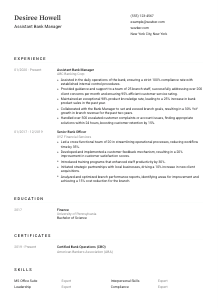
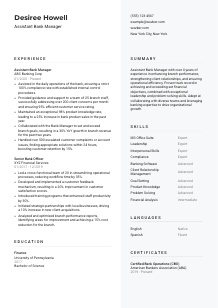
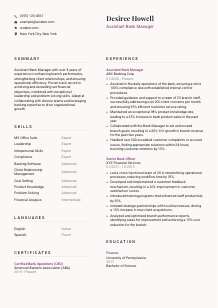
Holding the vault, but your CV feels locked up? Check out this Assistant Bank Manager CV example, created with Wozber free CV builder. Learn how to align your financial fluency and leadership skills with the job description, and pave the way to unlock your career's full potential at the bank!
Assistant Bank Managers sit close to the daily pressure points of branch banking. They keep operations moving, uphold internal controls, support frontline staff, and step in when client issues escalate. A CV for this role needs to show that you can handle branch rhythms without losing sight of compliance, service quality, or revenue goals.
Banking CVs are often screened first for operational relevance. If your experience is buried under generic management language, hiring teams may miss your work with branch controls, customer issue resolution, product sales, or staff oversight. Wozber's free CV builder helps you shape that experience into an ATS-compliant CV with the right banking terminology, so your application reads clearly for both the system and the branch leader reviewing whether you can support day-to-day performance.
Branch hiring starts with a quick practical check. Can this person be reached easily, are they presenting themselves professionally, and do they meet any location requirement named in the posting. Your personal details should answer those questions cleanly and then get out of the way.
Place your full name at the top in a larger, readable font so it anchors the page immediately. In banking, where CVs may move between recruiters, branch managers, and regional leadership, clear identification matters. Wozber's ATS-friendly CV template helps keep this header structured so your details remain readable in both digital and printed review.
Add the job title under your name when it matches your background and the role you are pursuing. Writing "Assistant Bank Manager" tells the reader right away that your experience sits in branch leadership, customer service oversight, and bank operations. It also helps ATS screening connect your CV with the posting's core title.
Include one reliable phone number and a professional email address, ideally based on your name. If you use LinkedIn, add it only if the profile reflects your branch experience, promotions, certifications, and measurable results such as branch growth, service ratings, or compliance performance.
Some bank roles are tied closely to branch presence, commute expectations, or relocation availability. Here, the employer specifically asks for someone based in or willing to relocate to New York City, New York, so stating that clearly can remove a basic screening concern early.
If you include a website or LinkedIn profile, make sure the content supports a banking leadership profile. That means consistent job titles, accurate dates, and visible credentials, not a generic page with little operational context. Hiring teams notice when your digital profile reinforces experience in branch management, client issue resolution, or staff supervision.
Your personal details should confirm professionalism, availability, and any stated location requirement without distraction. Once that is clear, the reader can move straight to your branch experience and operating record.




This is the section that carries the most weight for an Assistant Bank Manager. Banks want to see how you contributed to branch operations, handled service pressure, supported staff performance, and protected compliance standards. Broad management claims are less useful than clear examples tied to customer volume, revenue, controls, or turnaround time.
Read the job description and mark the operational themes that repeat. For this role, those include daily branch operations, internal control procedures, staff guidance, product knowledge, goal tracking, and escalated customer issues. Your bullets should mirror that language where it matches your real work, because banking employers tend to scan for familiar operational responsibilities before they look for broader leadership claims.
Start with your most recent banking role and work backward. That order makes it easier to follow your progression from frontline or senior officer work into branch leadership responsibilities. It also helps reviewers quickly see whether you already operate at the level of supervising staff, supporting the manager, and handling branch performance.
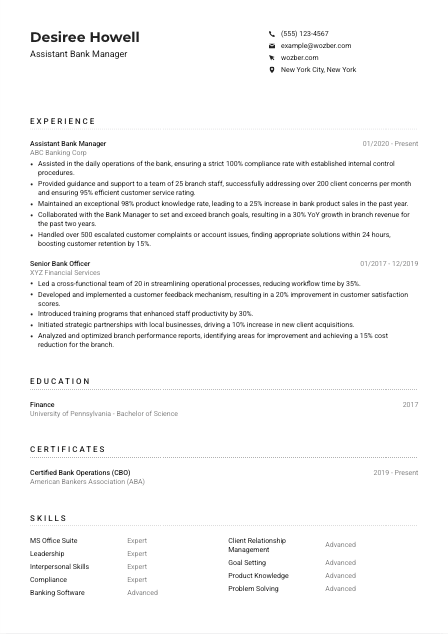
Do not stop at "assisted with operations" or "supported customer service." Show what that looked like in practice. The example CV does this well by tying branch work to outcomes such as a 100% compliance rate, a 25% increase in product sales, and a 30% year-over-year growth in branch revenue. Those are the kinds of branch-level results that make your scope easier to understand.
Quantify your work with measures that hiring teams in banking recognize. Useful examples include compliance rates, customer service scores, cross-sell growth, complaint resolution time, retention gains, workflow reduction, team size, or monthly client volume. A bullet about resolving more than 500 escalated issues within 24 hours says far more than a generic claim about problem-solving.
If you have a mixed background, give the most space to roles that show branch operations, retail or commercial banking exposure, staff coaching, and customer issue handling. Even a strong management bullet from another industry will usually matter less than evidence that you understand teller operations, account issues, controls, and branch targets. Keep the focus where the hiring decision is likely to be made.
Your experience section should make it easy to see the scale of branch work you have handled, the standards you maintained, and the results you improved. When those points are clear, your CV starts to read like someone ready to support branch performance from day one.
For most Assistant Bank Manager openings, education is a qualification checkpoint rather than the main selling point. Still, it needs to be presented clearly, especially when the employer asks for a bachelor's degree in finance, business administration, or a related field.
List the degree that best aligns with the role's stated requirement. A bachelor's in finance, business administration, accounting, economics, or a closely related field usually fits well. In the example, a Bachelor of Science in Finance maps directly to the bank's preference, which makes this section easy for both ATS screening and human review.
Present each entry with the school name, degree, field of study, and graduation year or date. Banking employers do not need design-heavy treatment here. They need quick confirmation that your academic background supports work in branch operations, financial services, or business management.
Do not leave the degree vague if the field helps your case. "Bachelor of Science in Finance" tells the reader much more than simply "Bachelor's degree." When the role touches product knowledge, branch targets, and financial processes, subject specificity adds useful context.
Most experienced banking candidates can keep this section brief. If you are earlier in your career, selected coursework in banking, accounting, risk management, financial analysis, or business law can help connect your education to branch work. The same applies to leadership programs or finance-related extracurricular roles if they add credible context.
If you completed post-degree training in compliance, bank operations, lending, customer relationship management, or supervisory development, include it where it fits best. This shows ongoing development in the areas Assistant Bank Managers actually use, especially when branch procedures or regulatory expectations keep evolving.
Education should confirm that you meet the role's baseline requirement and support your banking profile without taking space away from stronger operational experience. Clear, relevant, and easy to scan is enough here.
Certifications can sharpen your CV in a field where process discipline and regulatory awareness matter. For Assistant Bank Manager roles, they are especially useful when they reinforce branch operations knowledge, compliance credibility, or leadership readiness.
When a bank calls out a credential, make it easy to find. This posting lists CBO and CRCM as plus factors, so candidates who hold either should place them prominently. In the example CV, including both certifications immediately reinforces operational and compliance depth.
Prioritise certifications tied to bank operations, compliance, financial services, lending, risk, or management. Generic courses in communication or software can be useful elsewhere on the CV, but this section should favor credentials that carry weight in a branch environment.
Add the year earned or the active date range where relevant. That timing helps reviewers understand whether your knowledge is current, especially for compliance-related credentials where standards, procedures, and regulatory expectations can shift over time.
Banking careers benefit from visible continuing education. Renewed certifications, updated compliance training, and recognized operational credentials show that you are staying current with the rules, controls, and service expectations that shape branch management work.
The right credentials add substance to your banking profile, especially when they connect directly to operations and compliance. They should support the story already visible in your experience, not sit on the page as isolated extras.
An Assistant Bank Manager skill list should read like the toolkit behind branch performance. That means a mix of operational software knowledge, customer-facing judgment, and team leadership. Generic buzzwords do less here than specific capabilities tied to daily banking work.
Start with the skills the employer names directly, then add closely related capabilities you have used in real branch settings. Here, that includes banking software, MS Office Suite, leadership, interpersonal skills, product knowledge, compliance, and customer issue resolution. This approach keeps the section relevant for ATS matching and credible in a hiring review.
Lead with the tools and capabilities that support branch execution, such as banking software, compliance knowledge, reporting, account handling, financial analysis, and MS Office. Then add people-management strengths like coaching, client communication, conflict resolution, and goal setting. That order reflects how the role is actually performed.
Do not turn this section into a long inventory. Keep the focus on skills that help run a branch, support staff, solve client problems, and contribute to sales or service targets. The example CV works because it stays close to the role, with entries like compliance, client relationship management, product knowledge, and problem solving instead of unrelated filler.
A focused skill list should confirm that you can manage branch workflows, support customers, and work within bank procedures. If every skill points back to how an Assistant Bank Manager performs on the job, the section is doing its job.
Assistant Bank Managers often serve a broad client base, support frontline staff, and step into sensitive account conversations. Language skills can matter more than they first appear, especially in branches with diverse communities or frequent escalations.
This role specifically asks for proficiency in English, so list it plainly and use a proficiency level that reflects your ability to handle customer conversations, policy explanations, and internal communication. For many banking roles, English is assumed, but when it appears in the posting, it should appear on the CV too.
Additional languages can strengthen your profile even when they are not required. In customer-facing banking, they may support account discussions, issue resolution, or relationship building with local communities. The example's Spanish fluency is a strong illustration of how another language can add practical branch value.
Choose clear descriptors such as Native, Fluent, Intermediate, or Basic. Hiring teams need an honest picture of whether you can conduct day-to-day conversations, explain products, or only manage simple exchanges.
Language relevance depends on the customer base. In some markets, a second language may materially improve service quality and trust during account support or complaint resolution. Mentioning a language that matches local client demographics can add useful context without overstating its importance across all banking roles.
Only include languages you can use with confidence. In banking, a second language matters most when it helps with real interactions such as onboarding clients, clarifying account issues, or supporting a diverse branch team.
List languages that improve communication with customers and colleagues, and describe them honestly. When relevant to the market you are targeting, this section can quietly strengthen your customer service profile.
The summary sits at the top of the page, so it should establish your banking level quickly. For an Assistant Bank Manager, that usually means showing years of banking experience, branch operations exposure, staff leadership, and a record of improving service, compliance, or sales performance.
Start with a direct line that tells the reader who you are professionally. A phrase like "Assistant Bank Manager with 4+ years of branch banking experience" works because it anchors your profile in the right environment immediately. If your title differs slightly, use the version that best reflects your actual level and target role.
Follow with two or three points that reflect the work itself. Useful themes include branch operations, internal controls, customer issue resolution, team supervision, product knowledge, and goal attainment. The example summary succeeds because it combines branch performance, client relationships, and operational efficiency instead of relying on vague leadership language.
Aim for a short paragraph of about 3 to 5 lines. That is enough room to show experience level, functional strengths, and one or two concrete outcomes without repeating bullets from later sections. In banking, concise top-level positioning works better than a long introductory statement.
Borrow the employer's wording selectively for skills and responsibilities you genuinely have. If the posting emphasizes compliance, branch goals, staff support, and customer service, those ideas should appear near the top of your CV. Wozber's AI CV builder can help align your wording with the job description so the summary reflects both ATS terms and real branch experience.
Your summary should tell the reader, within seconds, that you understand branch operations and can support both people and performance. When that message is clear, the rest of the CV has a much easier job.
A well-tailored Assistant Bank Manager CV should make branch leadership potential easy to see. Focus on the parts of your background that prove you can support daily operations, guide staff, resolve client issues, and contribute to branch growth while maintaining control standards.
Use Wozber to build and refine an ATS-friendly CV format that reflects the language of the role and the realities of branch banking. With clear structure, targeted wording, and measurable outcomes, your CV will show what hiring teams need to judge quickly: whether you can step into the branch and perform with confidence.




