



Use Wozber and land your dream job
Create CV
No registration required
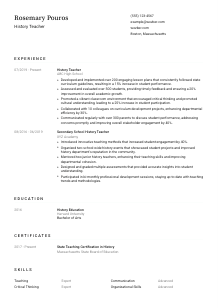
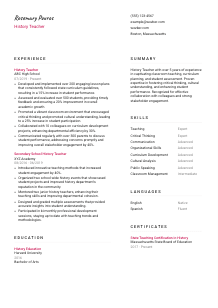
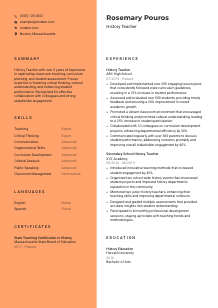
Leading class discussions, but your CV feels like it's stuck in the past? Check out this History Teacher CV example, created with Wozber free CV builder. Learn how to chronicle your knowledge to fit current job criteria, making your career story as captivating as a historic event!
History teaching asks for more than subject knowledge. Schools want teachers who can turn complex events, sources, and cultural context into lessons students can actually engage with, while keeping instruction aligned with curriculum standards and measurable academic progress. Your CV should make that classroom impact visible, not just list that you taught history.
A tailored CV quickly clarifies whether your background matches the level, certification, and teaching scope the school needs. Using Wozber's free CV builder helps you align your wording with the posting and present it in an ATS-friendly CV format, so lesson planning, assessment results, and parent communication are easy to identify from the first scan.
Schools usually review the top of the CV in seconds, and for teaching roles they often check practical basics right away. Your heading should confirm who you are, what role you teach, and whether your location and contact details support a smooth hiring process.
Use your full name in the largest text on the page so administrators can immediately connect your application, certification records, and interview notes. Keep the presentation clean and professional rather than decorative.
Place your target title directly under your name. For this role, "History Teacher" is the clearest choice because it matches the posting language and immediately positions you within the right subject area. If your recent title was something adjacent, such as "Secondary School History Teacher," you can still use the target title in the heading when it accurately reflects your background.
List a current phone number and a professional email address with no formatting errors. Since this example role specifies Boston, Massachusetts, including Boston, Massachusetts in your location line removes a common screening question early in the process.
Include a website or profile only if it supports your teaching candidacy. A polished LinkedIn page, teaching portfolio, or classroom website with curriculum work, student project examples, or department contributions can reinforce the experience listed below.
Skip details such as age, marital status, or other personal identifiers that do not help a school understand your teaching qualifications. Keep this section focused on the information needed to contact you and confirm role alignment quickly.
This section does not need personality or storytelling. It needs to confirm that you are a History Teacher the school can contact easily, place correctly, and move forward in the hiring process without extra questions.




For a History Teacher, experience is where hiring teams look for proof that you can manage a classroom, deliver standards-based instruction, and move students forward academically. The most effective entries show what you taught, how you taught it, and what changed for students, families, or the department because of your work.
Before rewriting bullets, mark the responsibilities the school cares about most. In this posting, that includes lesson planning tied to state curriculum, student assessment, critical thinking, collaboration with colleagues, and regular parent communication. Those themes should appear clearly in your experience section instead of being buried under generic teaching duties.
Use reverse chronological order so schools can see your current teaching level, subject continuity, and years of experience right away. For a secondary history opening, recent roles such as "History Teacher" or "Secondary School History Teacher" are especially useful because they show direct classroom relevance without the reader having to infer it.
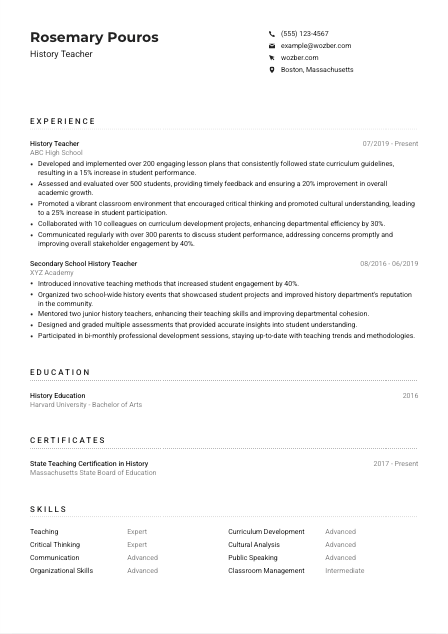
Strong bullets combine instruction with outcomes. Instead of writing that you "created lessons" or "graded assignments," show scope and effect. The sample CV does this well with points like developing more than 200 lesson plans aligned to state guidelines and linking that work to a 15% increase in student performance.
Metrics make teaching impact easier to understand when they reflect real educational work. Good examples include student growth, participation rates, number of students assessed, family communication volume, curriculum projects completed, or department improvements. The sample's 20% academic growth improvement and regular communication with more than 300 parents are useful models because they connect effort to school outcomes.
Prioritise bullets that reflect the classroom and collaboration demands in the posting. If the role stresses historical analysis and cultural understanding, include examples of discussion-based lessons, source analysis, writing instruction, or projects that increased engagement. If it emphasizes collaboration, keep curriculum work, mentoring, or department initiatives visible, as seen in the example's work with 10 colleagues on curriculum development.
Your experience section should leave little doubt about your classroom range and teaching effectiveness. When lesson design, assessment, student growth, and school collaboration are easy to see, your background reads like a direct match for the position.
Teaching roles often have clear academic baselines, and schools check them quickly. Your education section should confirm that your degree supports both your subject knowledge and your path into classroom instruction.
This posting asks for a bachelor's degree in History, Education, or a related field. Make sure your degree title and field are written clearly enough that a reviewer can confirm that requirement at a glance. A degree such as "Bachelor of Arts in History Education" directly supports both the content area and the teaching focus.
List the institution, degree, field of study, and graduation year in a consistent order. Schools do not need a complicated layout here. They need to verify your academic preparation quickly, especially when reviewing many licensed teaching applicants at once.
When your degree is closely related to the posting, name it precisely rather than shortening it. A specific field like History Education carries more hiring value than a vague entry because it points to both historical content knowledge and training in pedagogy.
If you are early in your teaching career, include selected coursework, honors, or academic projects tied to the role. Classes in world history, U.S. history, historiography, adolescent education, or curriculum design can help show depth if your classroom record is still developing.
Honors, education society memberships, research presentations, or leadership in history or teaching organizations can add value when they connect to classroom credibility. Keep them selective and relevant rather than turning this section into a full academic profile.
For a History Teacher, this section should quickly show that your degree backs up both subject expertise and classroom preparation. If the requirement is clear on first read, the hiring team can move on to your teaching impact.
Certification is often a gatekeeping requirement in school hiring, especially for subject-specific teaching positions. If the posting asks for a state credential in History or Social Sciences, make that information impossible to miss.
This role specifically asks for a state teaching certification in History or Social Sciences, so that credential belongs at the top of the section. It is one of the first qualifications a school will confirm before looking deeper into your application.
List the certifications that directly support your ability to teach the subject and grade level in question. Additional training can help, but the main teaching license should take precedence over broader or less relevant certificates.
Add the certifying authority and the dates or active status so the school can see whether the credential is current. In the example CV, listing the Massachusetts State Board of Education and showing the certification as active from 2017 to present gives immediate clarity.
If you have recent endorsements, training in curriculum standards, student assessment, inclusion practices, or AP or honors-level instruction, include them when they strengthen your profile. They help show that your teaching practice continues to evolve with school and classroom needs.
For teaching roles, certification is not a minor detail. Present it clearly so the school can confirm your eligibility quickly and move its attention to the quality of your instruction and student results.
The skills section should read like a snapshot of how you teach, manage learning, and contribute to a department. For History Teachers, the most useful skills combine instructional practice, subject-specific thinking, and the communication needed to work with students, families, and colleagues.
Start with the exact language in the job description, then add closely related terms that reflect real experience. Here, that includes communication, interpersonal skill, organisation, historical knowledge, lesson planning, assessment, and the ability to foster critical thinking and cultural understanding.
When the posting names a skill directly, use that wording if it truthfully matches your background. This helps both ATS screening and human review. For example, "curriculum development," "classroom management," and "critical thinking" are stronger than vague phrases that could apply to almost any educator.
Choose a concise mix of hard and soft skills that support the role. For a History Teacher, that might include lesson planning, student assessment, classroom management, curriculum development, historical analysis, communication, and cultural analysis. The sample CV works because its list stays close to actual teaching practice instead of drifting into generic personality traits.
A useful skills section helps a school imagine your classroom and your contribution to the team. Every item should connect back to instruction, student learning, or collaboration within a history or social studies department.
Language ability matters in teaching because instruction, family communication, and classroom discussion all depend on it. For a History Teacher, this section should first confirm that you can teach and communicate clearly in the language required by the school, then show any additional language strengths that could support a diverse student community.
This posting specifically states that the ability to negotiate effectively in English is essential. List English at the top with an accurate proficiency level such as "Native" or "Fluent" so there is no ambiguity about your ability to teach, communicate with families, and handle school discussions professionally.
Additional languages are not mandatory for every History Teacher role, but they can be useful in multilingual schools and family-facing communication. They may also support broader cultural context in the classroom when used appropriately.
Choose clear levels such as Native, Fluent, Intermediate, or Basic. Schools need an accurate sense of how confidently you can communicate, especially if a language might be relevant in parent meetings, student support, or school events.
If you speak another language, it can reinforce your ability to bring cross-cultural perspective into historical discussion or build rapport with a wider school community. For example, Spanish on the sample CV adds a practical plus without distracting from the required English proficiency.
Do not overstate limited language ability. Even basic knowledge can be worth listing if it is real, but the section should stay factual and tied to communication, instruction, and school relationships rather than personal interest alone.
This section should confirm that you can communicate at the level the role requires and, where relevant, show added language strengths that support students, families, and culturally informed history instruction.
Your summary sits at the top of the CV, so it needs to state your teaching profile with precision. For a History Teacher, that means quickly covering your years of experience, subject area, classroom strengths, and one or two outcomes that matter in school hiring.
Read the job description before drafting this section and note the themes repeated across requirements and responsibilities. In this case, the most important ideas are history instruction, curriculum-aligned lesson planning, student assessment, critical thinking, and communication with families and colleagues.
Start with a direct line that names your profession and years of practice. A summary such as "History Teacher with 5+ years of secondary school experience" gives the reader immediate context and helps frame everything that follows.
Include strengths that match the school's priorities and are backed by your experience section. Good examples include improving student performance, designing engaging history lessons, fostering analytical discussion, or maintaining strong parent communication. The sample summary works because it ties classroom teaching, curriculum planning, and student assessment together in a compact way.
Aim for a short paragraph that can be read quickly without losing substance. Avoid broad claims about passion or dedication unless they are supported by concrete teaching outcomes, grade-level context, or subject-specific strengths.
When this section is done well, the school immediately understands what level you teach, what kind of history instruction you deliver, and what results tend to follow. That sets up the rest of the CV to read with much more clarity.
A History Teacher CV should make your instructional range, subject expertise, and student impact easy to recognize. When your degree, certification, classroom achievements, and communication strengths line up with the posting, the application feels ready for interview review rather than general consideration.
Use Wozber's free CV builder to organise that story in an ATS-compliant CV, refine your wording with role-specific language, and check alignment with an ATS CV scanner. The final result should make it easy for a school to see that you can step into the classroom, teach history well, and support student growth from day one.




