



Use Wozber and land your dream job
Create CV
No registration required
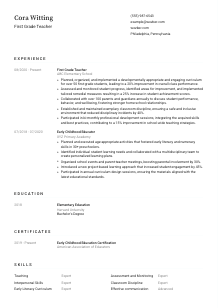
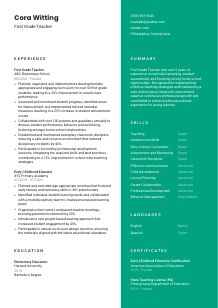
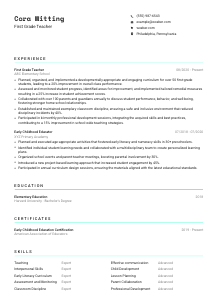
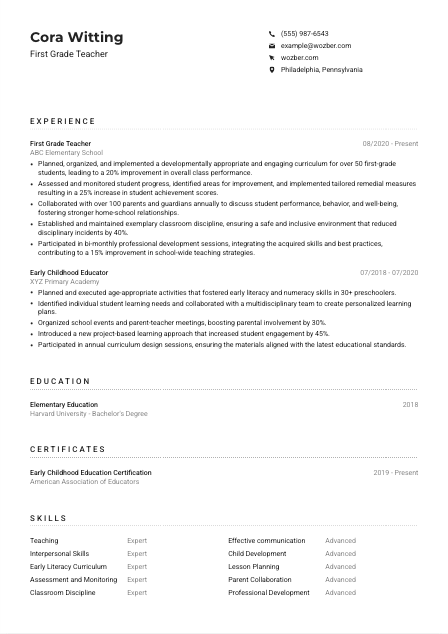
Nurturing fresh minds, but your CV feels like a finger painting mix-up? Check out this First Grade Teacher CV example, created with Wozber free CV builder. It shows how to match your enthusiastic teaching style to job expectations, making sure your career doesn't end up in the time-out corner!
First grade is where classroom teaching becomes foundational work. Schools look for teachers who can turn early literacy, behaviour routines, and developmental support into steady daily progress for six- and seven-year-olds. Your CV needs to show that you can run that kind of classroom with intention, not just that you care about children or enjoy teaching.
When a CV is tailored well, the difference shows up fast. School leaders can immediately see whether your background matches the grade-level work in front of you, from literacy instruction to parent communication to progress monitoring. Wozber's free CV builder helps shape that into an ATS-compliant CV, so the language, structure, and priorities point clearly to your readiness to teach first grade.
In school hiring, the top of the CV does quiet but important work. It should tell a principal or hiring coordinator exactly who you are, what role you are targeting, and whether there are any practical barriers to moving forward. Keep this section clean, direct, and aligned with the position.
Use your full name as the heading and make it the easiest item to find on the page. A simple, readable font works best. For teaching roles, clarity matters more than stylistic flair, especially when your CV may be reviewed quickly between classroom observations, parent meetings, and staffing decisions.
Place "First Grade Teacher" directly under your name if that is the role you are pursuing. This helps both ATS screening and human review by removing guesswork. If your recent title was broader, such as Early Childhood Educator, you can still target the new role here as long as the experience section supports that move.
Include a reliable phone number and a professional email address. Double-check both. In K-12 hiring, missed calls and bounced emails can cost you an interview slot, especially when schools are moving quickly to fill classrooms before term starts.
If a school specifies a city or relocation expectation, include your city and state. In the provided example, listing Philadelphia, Pennsylvania immediately answers a stated requirement and removes uncertainty about commute or relocation timing. Use this only when location is relevant to the opening.
A LinkedIn profile, teaching portfolio, or school-facing professional page can strengthen this section if it is current and consistent with your CV. For teachers, that might include grade-level experience, literacy initiatives, classroom projects, or professional development highlights. Skip it if it is sparse or outdated.
This section should answer the basic hiring questions in seconds: who you are, what role you want, and how the school can reach you. When those details are clean and aligned, the reader can move straight to your classroom experience.




For a First Grade Teacher, experience is the section hiring teams read most closely. They want to see what happened in your classroom, how you supported learning, how you handled student needs, and whether your results hold up in the routines of an elementary school. Focus less on broad teaching claims and more on the work you actually carried out.
Read the job description and mark the classroom responsibilities that appear most central. For first grade openings, that often includes lesson planning, early literacy instruction, behaviour management, student assessment, parent communication, and developmentally appropriate support. Those themes should shape the bullets you choose and the language you use.
List positions in reverse chronological order, with school name, title, and dates in a consistent format. That structure helps a hiring manager quickly trace your path from early childhood or general elementary work into grade-specific teaching. If you have both classroom teaching and related educational roles, the progression should feel clear.
A line like "planned and implemented first-grade curriculum" is accurate but incomplete. Add what changed because of your work. The sample does this well by tying curriculum planning to a 20% improvement in class performance and remedial support to a 25% increase in achievement scores. Use metrics when you have them, and when you do not, describe scope, student group, or instructional results clearly.
Education work is measurable in more ways than test scores. You can include student growth, attendance improvements, reduced behaviour incidents, family participation, intervention caseload, or number of students supported. In the example, figures such as 50 students taught, 100+ parent collaborations, and a 40% drop in disciplinary incidents give the reader a more concrete picture of classroom effectiveness.
Choose bullets that show age-appropriate instruction, early reading and numeracy development, classroom routines, and communication with families. If you have older-grade or non-classroom experience, keep only the parts that translate directly, such as differentiated instruction, assessment, or inclusive classroom practices. Every bullet should help the school picture you running a first-grade classroom.
Your experience section should make the classroom visible. When your bullets show student growth, family partnership, instructional planning, and behaviour support in concrete terms, schools can picture how you would perform from the first week of school.
Teaching CVs are reviewed against credential standards as well as classroom experience. Your education section needs to confirm that you have the academic preparation behind your instruction, especially when the posting names a degree in Elementary Education or a related field.
If the position asks for a Bachelor's degree in Elementary Education or a related field, make that connection easy to spot. The sample CV does this by listing a Bachelor's Degree in Elementary Education, which lines up cleanly with the posting. If your degree is in a related area, use the official title and let your experience and licenses reinforce the connection.
List school, degree, field of study, and graduation year. That is usually enough for an experienced teacher. In education hiring, this section is checked for qualification and relevance, so a clean structure helps the reviewer confirm the requirement quickly.
Do not shorten or paraphrase your degree in a way that weakens the match. "Elementary Education" carries more value here than a vague line such as "Education Studies" if that is not your official field. Precision matters because school systems often sort applicants by required academic background.
If you are early in your teaching career, selected coursework can help, especially in reading instruction, child development, classroom management, or assessment. If you already have solid classroom experience, the degree itself usually carries the section. Save room for stronger evidence elsewhere rather than overloading education details.
Honors, student teaching distinctions, or relevant education projects can be useful if they support the role. For example, a literacy practicum, early childhood research project, or recognition tied to classroom instruction can add substance for a newer candidate. Leave out achievements that do not help a school understand your readiness to teach young learners.
This section does not need flourish. It needs to confirm, quickly and clearly, that you have the educational background expected for elementary classroom work.
In teaching, certifications are not decorative extras. They are often part of the minimum hiring threshold. This section should immediately show that you are licensed appropriately and current on any credentials that matter for the grade level or school setting.
Pull the mandatory credentials from the posting and place those first. Here, a valid state teaching license or certification tied to Early Childhood Education or Elementary Education is essential. The example CV handles this well by listing both a Pennsylvania teaching license and an Early Childhood Education certification.
Include certificates that support your ability to teach the role, such as state licensure, reading instruction training, ESL endorsements, special education coursework, or early childhood credentials. Leave out unrelated certificates that do not strengthen your candidacy for elementary instruction.
Schools need to know whether a credential is active. Include issue dates, renewal periods, or active ranges when relevant. A line such as "2019 - Present" quickly communicates current standing and avoids back-and-forth about whether the license is still valid.
If you hold additional credentials or recent training that sharpen your classroom practice, include them when they matter to the role. That might be literacy intervention training, trauma-informed teaching, or behaviour support certification. For elementary teachers, current learning signals that your instruction and classroom methods keep pace with school expectations.
Schools often screen for licensure early. Put the most relevant, active teaching credentials where they can be found fast, and use this section to reinforce that you are ready to step into the classroom without qualification gaps.
A skills list is most useful when it reads like the job in condensed form. For a First Grade Teacher, that means balancing instructional skills, classroom management, developmental knowledge, and family communication. Keep the list grounded in day-to-day teaching rather than generic strengths.
Look beyond the obvious nouns in the posting. In addition to direct requirements like child development knowledge, early literacy curriculum, communication, and interpersonal skills, many first-grade jobs also imply lesson planning, progress monitoring, behaviour support, differentiation, and parent partnership. Build your list from that full picture.
If the posting says "assess and monitor student progress," use that phrasing if it accurately reflects your work. The same goes for "developmentally appropriate curriculum" or "safe and inclusive environment." This helps with ATS optimisation and also makes your teaching profile feel closely aligned with the role.
Do not turn this section into a master inventory of everything you can do. Prioritise the skills a principal would expect from someone leading a first-grade classroom: early literacy instruction, classroom discipline, assessment, child development, lesson planning, parent communication, and behaviour management. The sample CV is strongest where the skills clearly connect back to the classroom work described in experience.
The best skills section sounds consistent with your teaching history. When the same strengths appear in your skills, experience, and summary, your profile feels focused and credible for first-grade instruction.
Language ability matters differently in education than in many other fields. A school may require English proficiency for instruction, documentation, and parent communication, while additional languages can expand how you connect with families and support an inclusive classroom.
If the posting specifies English proficiency, list English first and state your level clearly. For a teaching role, this is not a formality. It speaks to lesson delivery, classroom communication, report writing, and family updates.
If you speak another language, add it when it is useful and accurate. In many school communities, bilingual ability can help during parent conversations, student support, and community outreach. In the example, Spanish adds useful context without overshadowing the required English proficiency.
Terms like Native, Fluent, Intermediate, and Basic are easy to understand and scan. Avoid vague descriptions. Schools need a realistic sense of whether you can hold a parent conference, support a multilingual learner, or simply navigate basic conversation.
Extra language ability has the most value when it helps in the actual work of the role. For first-grade teaching, that may mean clearer communication with caregivers, stronger relationships with multilingual families, or better support in a diverse classroom. Keep the emphasis on how the language serves the school community.
For teaching roles, language skills should connect back to instruction and family partnership. Keep this section accurate, practical, and relevant to the school environment you want to join.
Your summary should read like the top-line case for your candidacy. In a few lines, it needs to show your classroom background, your grade-level strengths, and the kind of learning environment you know how to build. This is one of the first places a school will look for role alignment.
Before writing the summary, decide which priorities appear most central in the job ad. For this role, that includes developmentally appropriate instruction, student progress monitoring, family communication, and a safe, inclusive classroom. Your summary should bring those themes together in a natural way rather than listing them mechanically.
Start with a direct statement of who you are professionally, including your title and years of experience. The sample summary does this effectively with "First Grade Teacher with over 5 years of experience," which immediately frames the candidate at the right level for a school reviewing classroom readiness.
Use the middle of the summary to highlight the teaching work you do best, such as early literacy instruction, assessment-driven support, home-school communication, or classroom management. Choose strengths that also appear in your experience section so the summary feels earned, not inflated.
Aim for a compact paragraph, usually three to five lines. School leaders often review many CVs in a short window, so your summary should surface the essentials fast. Save detailed examples and metrics for the experience section, where they can do more work.
A well-written summary tells the reader what kind of classroom teacher they are about to meet on the page. Keep it specific to first-grade teaching, grounded in real experience, and consistent with the results shown in your work history.
A First Grade Teacher CV works best when it makes the classroom visible. Your degree, license, instructional experience, parent communication, and student support should all point in the same direction: you know how to help young learners grow academically and socially.
Use Wozber's free CV builder to shape that experience into an ATS-friendly CV format, strengthen role-specific wording, and refine alignment with the posting through practical ATS optimisation. The final result should make it easy for a school to see that you are ready to lead a first-grade classroom.




