




Use Wozber and land your dream job
Create CV
No registration required
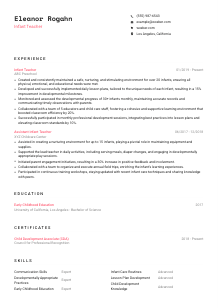
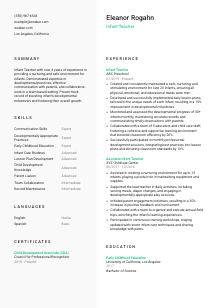
Shaping tiny hearts, but your CV feels like a crying baby? Coax it into harmony with this Infant Teacher CV example, created with Wozber free CV builder. Learn how to match your childcare skills with job essentials, giving your career the same joy-filled calm as a naptime nursery.
Infant teaching is hands-on work built around routines, observation, and trust. Hiring teams want to see that you can keep babies safe, respond to developmental cues, support feeding and diapering schedules, and create early learning experiences that fit each child's stage rather than forcing a one-size-fits-all classroom approach.
A tailored CV makes that day-to-day judgment easier to make. When your wording reflects infant care practice, developmental tracking, parent communication, and classroom collaboration, Wozber's free CV builder can help you shape it into an ATS-compliant CV that surfaces the right qualifications quickly. That helps employers see whether you can step into an infant room and handle both care routines and developmental support with confidence.
For an Infant Teacher, the top of the CV should read as calm, professional, and easy to act on. This section does not need creativity. It needs clean contact information, the right role title, and any location detail that removes friction for a childcare centre trying to fill classroom coverage.
Start with your full name in a slightly larger font than the rest of the header. Keep it simple and readable. In early education hiring, directors often review many CVs quickly, so your name should be immediately visible without decorative styling getting in the way.
Place "Infant Teacher" directly under your name when that is the role you are applying for. That instantly positions your experience in the right classroom context. If your current title is "Assistant Infant Teacher" but you are applying for a lead infant role, your experience section can show the progression while the header keeps your target clear.
List a phone number you answer reliably and a professional email address based on your name. Childcare employers often move quickly when scheduling interviews or checking availability, so one typo in your contact details can cost you a response. Include only the channels you actively monitor.
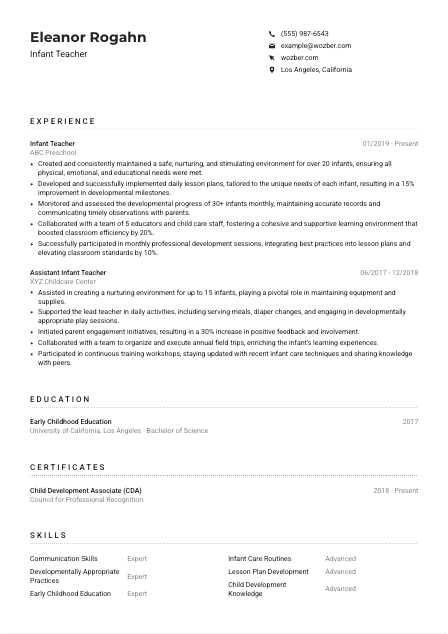
If the employer specifies a city or asks for local availability, include your city and state. Here, Los Angeles, California matters because the posting names it directly. Showing that location in the header, as the example CV does, removes an immediate question about commute or relocation.
You can include LinkedIn or a professional website if it adds something useful, such as education credentials, recommendations, or early childhood training. For Infant Teachers, this is optional. A link is worth keeping only when it supports your classroom credibility, parent-facing professionalism, or ongoing development in early education.
Your header should answer three practical questions right away: who you are, what role you are pursuing, and how the centre can reach you. If location is part of the hiring requirement, make that clear here and move on.




Experience carries the most weight on an Infant Teacher CV because this role depends on judgment in real classroom conditions. Employers want more than proof that you worked in childcare. They want to see infant-specific care, developmental support, documentation habits, and the ability to work with families and staff throughout the day.
Start with positions that clearly involve infants, licensed childcare settings, or early education classrooms. If you have mixed age-group experience, make the infant portion visible in the bullet points by naming routines, developmental activities, feeding support, sleep schedules, and observation-based care. The posting asks for at least 2 years with a specific infant focus, so that detail should never be left implied.
For every job, list your title, the school or childcare centre, and dates of employment in a consistent format. That structure helps hiring teams track your classroom progression, such as moving from Assistant Infant Teacher to Infant Teacher. In a field where licensing standards and supervision matter, clear chronology also helps show stable experience in regulated environments.
Do not stop at "cared for infants" or "supported classroom activities." Show what your work changed or improved. Strong bullets mention safe environments, individualized lesson planning, parent updates, developmental observations, or smoother classroom routines. The sample CV does this well by linking lesson plans to a 15% improvement in developmental milestones instead of listing planning as a task alone.
Numbers help hiring teams understand your range and consistency. Use them for infant group size, frequency of assessments, number of families updated, team size, or measurable improvements tied to classroom operations. Examples include supporting 20 infants, tracking progress monthly for 30+ children, or improving classroom efficiency through better team coordination. These are natural metrics in childcare because they show both care load and follow-through.
Choose accomplishments that match the actual work of an Infant Teacher. Prioritise safety, routines, developmental practice, communication with parents, collaboration with educators, and professional development tied to infant care. If a past role included general childcare tasks that do not strengthen your case, trim them back in favor of bullets that show you can manage an infant classroom with intention and consistency.
After reading your experience, a hiring manager should be able to picture you in the room. Your bullets should show that you can run infant routines, observe development carefully, communicate with families, and contribute to a stable classroom team.
Education matters in infant teaching because the role draws on child development knowledge, classroom planning, and age-appropriate practice. This section should make it easy to confirm that your academic background supports the work you are describing in the classroom.
If the role asks for a bachelor's degree in Early Childhood Education, Child Development, or a related field, list that credential clearly and without extra wording. When your degree directly matches the posting, as the example does with a Bachelor of Science in Early Childhood Education, it should be easy to find in seconds.
List your degree, field of study, school, and graduation year in a straightforward format. For most Infant Teacher roles, that is enough. Education reviewers are usually checking alignment with licensing or program requirements, so clarity matters more than added design elements.
If your field is closely tied to infant teaching, keep that wording prominent. Early Childhood Education, Child Development, and related disciplines signal preparation in attachment, developmental milestones, observation, and responsive caregiving. If your degree title is broader, you can still reflect relevance through the field name or related coursework when appropriate.
Relevant coursework can help if you are earlier in your career or your degree title is less direct. Focus on subjects that connect to infant classrooms, such as infant and toddler development, developmental psychology, behaviour guidance, health and safety, or family engagement. Keep it selective and tied to the job, not a long academic list.
Honors, research projects, practicum placements, or capstones are worth mentioning if they relate to early childhood settings or infant development. For example, a practicum in a licensed infant room says more than a generic academic award. Use details that reinforce classroom relevance rather than filling space.
This section should quickly confirm that your training supports infant care and development work. If your degree aligns directly with the posting, let that speak clearly without overcomplicating the presentation.
Certifications carry real weight in early childhood hiring because they speak to compliance, professional standards, and continued training. For Infant Teachers, this section should highlight credentials that support classroom eligibility and current practice with young children.
If the job mentions a CDA or an equivalent state-recognized credential, place it prominently in this section. That requirement appears directly in the posting, so it should not be buried. The example CV handles this well by listing the Child Development Associate clearly with the issuing body.
Keep the list focused on credentials that strengthen your case for infant classroom work. CDA, infant or pediatric CPR, first aid, mandated reporter training, and state-required early childhood certifications are usually more useful here than broad certificates unrelated to childcare operations or developmental practice.
Add issue dates, expiration dates, or active status when that information helps confirm that the certification is current. In childcare, recent validity matters because centers often need up-to-date documentation for compliance, staff records, and classroom licensing requirements.
Infant care standards, safety guidance, and developmental practice continue to evolve, so current training matters. If you are working toward a required credential, say so clearly. If you regularly complete workshops tied to infant routines, observation, or family communication, include the most relevant examples to show you stay engaged with the field.
This section should reassure employers that you meet, or are actively completing, the credentials needed for infant classroom work. Keep it focused on qualifications that support compliance, safety, and day-to-day teaching practice.
The skills section should read like the working toolkit of an Infant Teacher. Instead of broad personality traits, focus on abilities that connect to infant development, daily routines, family communication, and coordinated classroom care.
Start with the wording in the posting and identify both technical and interpersonal requirements. Here, that includes developmentally appropriate practices for infants, infant care routines, verbal and written communication, lesson planning, record keeping, and collaboration with educators and caregivers. Those terms are more useful than generic phrases like "hardworking" or "people person."
Choose skills you can back up with examples from your experience. If you list lesson plan development, your experience section should show infant activities or milestone-related outcomes. If you include parent communication, support it with notes about regular updates, conferences, or family engagement. The example CV does this by pairing communication and parent liaison skills with measurable parent feedback and developmental reporting.
Put infant-specific skills near the top. Developmentally appropriate practice, infant care routines, child development knowledge, lesson planning, parent communication, and record maintenance all belong ahead of broader workplace abilities. Organise the section so that someone scanning quickly sees your classroom capability before your general teamwork skills.
A well-chosen skills list should sound consistent with your classroom experience. When the section mirrors the language of infant care, development, and family communication, it strengthens both ATS alignment and human review.
Language matters in early childhood settings because much of the role depends on clear communication with parents, caregivers, and coworkers. For an Infant Teacher, this section should support the communication side of the job rather than feel like a decorative extra.
Check the posting first. Here, strong spoken and written English is essential, so English should appear clearly with an accurate proficiency level. If you can also communicate in another language used by families in your community, that can add practical value in parent interactions and classroom relationships.
When English is explicitly required, place it at the top of the section and label it honestly, such as Native or Fluent. This immediately answers a stated hiring need and supports responsibilities like writing progress notes, documenting observations, and speaking with parents about routines and development.
Extra languages can be helpful in childcare programs that serve multilingual families. For example, Spanish may support day-to-day parent communication in some communities, including many Los Angeles programs, but it is an advantage rather than a universal requirement unless the posting states otherwise.
Stick to familiar levels such as Native, Fluent, Intermediate, or Basic. Avoid vague labels that do not tell employers whether you can hold a parent conversation, read classroom instructions, or write clearly. Accuracy matters more than sounding impressive.
For Infant Teachers, language skills are most useful when they improve parent updates, teamwork, or communication in a diverse care setting. Frame the section with that practical value in mind instead of treating it as a general background detail.
If language skills are included, they should reinforce your ability to communicate clearly with families and staff. Put required English proficiency first, then add other languages that genuinely support the classroom community you hope to serve.
The summary should give a hiring manager a quick, accurate read on your experience with infants before they move into the rest of the CV. It works best when it combines years of experience, age-group focus, and a few strengths that matter in daily classroom life.
Start by pulling together the clearest overlap between your background and the role. For an Infant Teacher, that usually means years in licensed childcare, infant-specific classroom work, knowledge of developmentally appropriate practice, and communication with parents. The summary should feel grounded in the job, not copied from a generic teaching profile.
Begin with your title and relevant experience level, such as "Infant Teacher with 4+ years of experience." That gives the reader immediate context. If your background includes assistant and lead-level infant classroom work, you can reflect that progression in the wording without making the sentence too long.
Choose strengths that are central to infant teaching and supported elsewhere in the CV. Good options include building nurturing classroom environments, planning age-appropriate activities, tracking developmental milestones, and maintaining strong family communication. The sample summary works because it connects those strengths to real outcomes in developmental growth and team-based classroom support.
Aim for a compact paragraph of about 3 to 5 lines. Every sentence should add useful information. Avoid broad statements about passion or love for children unless the rest of the sentence ties that quality to concrete classroom work, such as responsive caregiving, observation, or developmental planning.
By the time someone finishes your summary, they should already understand your infant classroom focus, your level of experience, and the strengths they will see repeated in the rest of the CV. Keep it concise, credible, and rooted in the work.
An effective Infant Teacher CV makes your childcare experience easy to read through the lens that matters most: safe infant care, developmental support, reliable documentation, and clear communication with families. When each section reinforces those points, the CV feels focused instead of broad.
Wozber's free CV builder can help you organise that experience in an ATS-friendly CV format, strengthen wording with AI-assisted tailoring, and keep your CV aligned with the posting through smarter ATS optimisation. The final result should make one thing clear without delay: you are ready to support infants, families, and classroom teams from day one.




