



Use Wozber and land your dream job
Create CV
No registration required
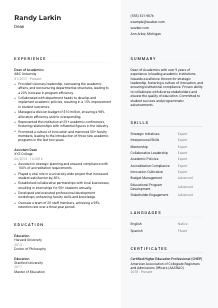
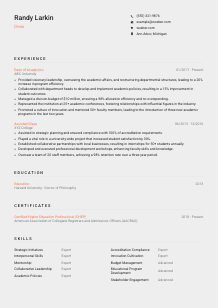
Guiding academies, but your CV is playing truant? Check out this Dean CV example, created with Wozber free CV builder. Learn how to bring together your leadership strengths with the institution's needs, making sure your career grades as high as your graduates'!
A Dean is trusted with decisions that shape academic quality, faculty performance, student outcomes, and the institution's public standing. That level of responsibility should come through in your CV. Hiring committees look for more than senior titles. They want a clear record of leading academic operations, guiding policy, managing budgets, supporting accreditation, and moving programs forward across departments.
CV tailoring matters quickly in dean-level hiring because the first review often sorts broad higher education leadership experience from direct academic administration leadership. Wozber's free CV builder helps you align your language with the posting and create an ATS-compliant CV that highlights the priorities a committee will look for first, such as strategic initiatives, accreditation oversight, and cross-campus leadership. The CV needs to make your scope and institutional impact easy to recognize.
At the dean level, personal details are simple but still strategic. This section should confirm that you are reachable, professionally presented, and aligned with any location or communication requirements stated in the posting.
Your name should sit at the top in a clean, prominent format. For senior academic roles, a cluttered header can make the document feel dated. Keep it polished and formal so the CV opens with the same credibility you would bring to a board meeting or faculty senate discussion.
Place "Dean" beneath your name if that is the role you are pursuing. This creates immediate alignment with the posting and keeps your application from reading like a broad higher education leadership CV. If your recent title is more specific, such as "Dean of Academics," that can still support the same direction when the rest of the CV clearly maps to dean-level responsibilities.
List a phone number you answer reliably and an email address that looks appropriate for executive or academic leadership hiring. A format based on your name works best. Double-check every character. At this level, small errors in contact information suggest a lack of care that committees may not ignore.
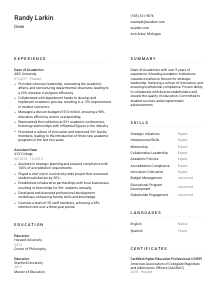
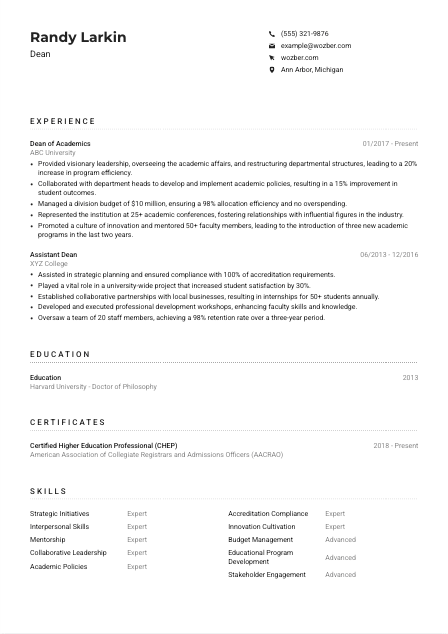
If a role specifies a location requirement, show your city and state clearly. In the example, listing "Ann Arbor, Michigan" immediately addresses the employer's stated expectation. Use location this way when it removes a practical question from the committee's review, not as filler.
A LinkedIn profile, faculty bio page, or institutional profile can help when it reinforces your record in academic leadership, committee service, publications, conference participation, or public engagement. Only include it if the content is current and consistent with your CV.
This section should remove administrative friction. Clear contact details, a matching title, and any required location cue help the committee focus on your academic leadership record instead of basic logistics.




For a Dean, the experience section carries most of the decision-making weight. It should show how you have led academic units, improved programs, managed resources, supported faculty, and represented the institution in settings where judgment and credibility matter.
Before editing bullets, identify the operating priorities behind the job ad. Here, the role centers on academic affairs leadership, strategic initiatives, team management, accreditation awareness, stakeholder collaboration, and budget oversight. Those themes should shape which achievements you feature and the language you use to describe them.
Reverse chronological order works especially well in senior education hiring because committees want to see your current scope first. Start with the role that best reflects your present authority over programs, departments, faculty, budgets, or institutional planning. Titles such as dean, associate dean, assistant dean, provost-side leadership, or senior academic administrator should appear early and clearly.
A dean CV should not read like a job description. Focus each bullet on what changed under your leadership. The example does this well by tying academic restructuring to a 20% increase in program efficiency and policy collaboration to a 15% improvement in student outcomes. That kind of phrasing shows administrative action and institutional result in the same line.
Numbers help committees understand the weight of your work. Use metrics that fit academic administration, such as division budgets, faculty mentored, student outcome improvements, retention gains, number of conferences represented, new programs launched, or accreditation results. Managing a $10 million budget at 98% allocation efficiency tells a much stronger story than simply saying you handled financial planning.
Cut or shorten bullets that do not strengthen your case for academic leadership. Committee members will care most about policy development, faculty development, student success, compliance, cross-functional collaboration, and strategic execution. If you have a long career history, give the most space to accomplishments that show institutional influence rather than earlier operational tasks.
By the end of your experience section, a hiring committee should be able to see your leadership range clearly: what you oversaw, who you worked with, what improved, and how your decisions affected academic quality, compliance, and resource use.
Education matters differently in dean hiring than it does in many other fields. Your degrees are part of your credibility with faculty, executive leadership, and accreditation-facing stakeholders, so this section should be structured with care and relevance.
If the posting asks for a master's degree in Education, Business Administration, or a related field, make sure that qualification is unmistakable. If you also hold a doctorate, list it first because it strengthens your standing for senior academic leadership roles. In the example, the doctorate in Education supports the employer's stated preference without needing extra explanation.
Use a consistent structure for degree, field, institution, and graduation year. Senior hiring reviewers often skim first, then return for detail. Clean formatting helps them confirm your academic background quickly, especially when multiple advanced degrees are listed.
When a dean role spans academic leadership and resource management, degrees in education and administration both add value. A combination such as an M.Ed. and an MBA can signal fluency in academic strategy and fiscal decision-making. Use the order and presentation to reinforce the type of leadership the role requires.
For most dean candidates, you do not need to list coursework. Include dissertation focus, research themes, or notable academic distinctions only if they strengthen your profile in areas such as higher education leadership, governance, curriculum, institutional effectiveness, or organizational management.
If honors, fellowships, or major academic recognition support your authority in the field, include them. Keep the emphasis on credentials that matter in leadership review, not on turning the section into a full academic CV unless the institution specifically expects one.
Your education section should confirm that you meet the formal academic threshold for the role and bring the level of scholarly and administrative preparation expected in senior higher education leadership.
Certifications are rarely the deciding factor in dean hiring, but they can strengthen your profile when they show ongoing development in higher education practice, leadership, compliance, or institutional operations.
Start with credentials that support the actual demands of the role. For a Dean, that may include higher education administration, accreditation, student affairs, leadership development, compliance, or governance-related training. The example's "Certified Higher Education Professional" works because it aligns with the responsibilities of institutional leadership rather than adding a generic credential.
A short, focused certificate section is stronger than a long list of loosely related courses. Include only credentials that add a meaningful layer to your qualifications, especially if they reinforce areas such as faculty leadership, policy implementation, or educational operations.
If a certification is current, recently earned, or actively maintained, include the date. That signals continued engagement with professional standards and current practice. In regulated or accreditation-aware environments, recency can matter more than volume.
Senior academic leaders are expected to keep pace with changes in higher education, from compliance standards to leadership practice and institutional strategy. Certificates can quietly demonstrate that you continue to invest in your effectiveness, even after reaching leadership roles.
Treat certifications as supporting proof of current professional engagement. When they connect directly to academic administration, they add weight without distracting from your leadership record.
The skills section should reflect how you operate as an academic leader. Focus on capabilities tied to institutional results, faculty collaboration, governance, compliance, planning, and stewardship of resources.
Start with the competencies named or implied in the posting. For this role, skills such as strategic initiatives, accreditation compliance, collaborative leadership, budget management, faculty mentorship, and stakeholder engagement are directly relevant. Mirroring that language helps both ATS screening and committee review when those skills genuinely match your background.
Terms like "communication" or "teamwork" are too broad on their own for a dean CV. Replace them with sharper, role-specific skills such as academic policy development, institutional planning, faculty development, resource allocation, assessment leadership, or community partnership building. These describe work a Dean is actually expected to lead.
Do not overload this section with every capability you've used in higher education. A focused set of skills is easier to scan and more persuasive. The example balances strategic, interpersonal, compliance, and operational skills well, which gives a fuller picture of dean-level scope without becoming unfocused.
This section should read like the operating profile of a senior academic leader. Every skill listed should support the kind of decisions, collaboration, and institutional oversight the role requires.
Language requirements in dean hiring are usually practical. Institutions need leaders who can communicate clearly with faculty, staff, students, boards, community partners, and accrediting bodies, especially in formal written and public-facing settings.
If the posting specifies proficiency in spoken and written English, list English prominently with an accurate level such as "Native" or "Fluent." That immediately addresses a stated requirement and matters in a role that involves policy communication, meetings, presentations, and institutional representation.
Additional languages can be valuable when the institution serves multilingual communities, supports international programs, or works with diverse external partners. They are not always required, but they can broaden how your candidacy is understood. In the example, Spanish adds another dimension to community and stakeholder communication.
Keep proficiency descriptions straightforward. Terms such as "Native," "Fluent," "Advanced," or "Intermediate" are easy to interpret and more useful than vague claims. The hiring team should be able to gauge how confidently you can communicate in each language.
Some dean roles are heavily campus-facing, while others involve international partnerships, community engagement, or system-level representation. If your language abilities have practical value in those settings, include them. If not, keep the section concise and centered on the required language.
Do not overstate proficiency. Senior leaders may be asked to speak publicly, negotiate, or write in the languages they list. Honest language ratings protect your credibility and keep expectations aligned with your actual capability.
For a Dean, language proficiency supports leadership communication. List what is required first, add other languages when they are genuinely useful, and keep the ratings precise.
The summary should give a fast, grounded picture of the kind of academic leader you are. It is especially useful in dean hiring because it can connect years of administration, institutional priorities, and leadership outcomes before the committee reaches the rest of the CV.
Pull in the themes that define the position, such as academic affairs leadership, strategic planning, faculty support, student experience, budget stewardship, and accreditation awareness. This keeps the summary relevant to dean-level work instead of sounding like a generic education executive profile.
Start with a direct line that tells the reader who you are in institutional terms. A phrase such as "Dean of Academics with 9+ years of experience in academic administration" works because it establishes level, domain, and leadership context in one sentence.
Choose the strengths that best match the posting and support them with concrete language. The example summary points to strategic leadership, innovation, compliance, stakeholder collaboration, and educational quality. That works because each theme ties back to actual dean responsibilities rather than abstract leadership claims.
Aim for 3 to 5 lines. At this level, a summary should be dense with relevant information, not broad and promotional. Keep the writing calm, specific, and focused on institutional impact, leadership scope, and the value you bring to academic operations.
Your summary should quickly position you as a credible academic leader with the right scope, judgment, and results for the role. If it is working, the rest of the CV reads as proof of that opening claim.
A dean CV should present a coherent leadership story across every section: advanced education, senior academic administration experience, faculty and stakeholder leadership, resource stewardship, and measurable institutional outcomes. When each part reflects the role's priorities, the hiring committee can quickly see where your background aligns with their academic mission.
Use Wozber's free CV builder to shape that story into an ATS-friendly CV format, strengthen ATS optimisation with role-specific language, and keep the final document polished and easy to review. The finished CV should make one thing clear without effort: you are prepared to lead academic affairs at an institutional level.