



Use Wozber and land your dream job
Create CV
No registration required
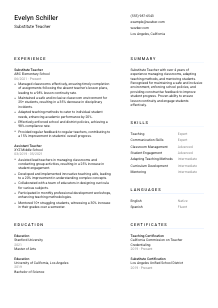
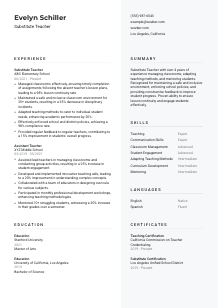
Stepping in wherever class is in session, but your CV doesn't make the chapter? Flip through this Substitute Teacher CV example, created with Wozber free CV builder. Learn how to highlight your versatility and adaptability, so your teaching story always makes the right impact, even if it's just for a day!
Substitute teaching gets reviewed through the reality of the classroom. Schools need someone who can step into an unfamiliar room, keep instruction moving, manage behaviour consistently, and leave the regular teacher with a clear sense of what happened during the day. Your CV should make that day-one reliability visible through lesson continuity, classroom management, student engagement, and communication with staff.
When your CV is tailored to the posting, schools can quickly see whether your background matches their immediate needs, especially in ATS screening for certification, teaching experience, and classroom coverage. Wozber's free CV builder helps organise that language into an ATS-compliant CV that reflects real teaching work, so hiring teams can quickly recognize that you can maintain order, follow plans, and support students without disrupting instruction.
This section should read like a school-ready header, not filler. For substitute teaching, the basics matter because districts often move fast when filling openings, and missing contact details or location information can slow down an otherwise qualified application.
Set your name at the top in a clean, readable format so it anchors the CV immediately. Keep it simple and professional. In education hiring, clarity matters more than design flourishes, especially when your CV may be reviewed quickly by district staff or school administrators.
Place "Substitute Teacher" directly under your name when that is the position you are applying for. Matching the job title helps frame your experience correctly from the first line and supports ATS alignment. If your recent background includes related work such as Assistant Teacher, keep that for the experience section and let the header reflect the role you want now.
Include a reliable phone number and a professional email address you check often. Schools may contact candidates on short notice to confirm availability, so this information needs to be accurate. If you add a website or LinkedIn profile, make sure it supports your classroom background, certifications, or education work rather than distracting from it.
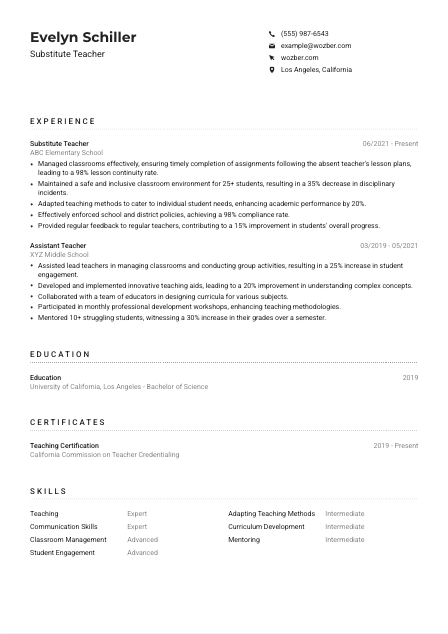
Some substitute teaching openings are tied to district coverage needs, commute expectations, or state-specific eligibility. Here, listing Los Angeles, California directly supports the employer's location requirement and removes doubt about local availability. Keep it brief with city and state unless the school specifically asks for a full address.
Any optional detail should help a school understand your classroom value. A teaching portfolio, classroom resources page, or professional profile focused on student support and instruction can work well. Skip personal links or general social profiles that do not reinforce your work with lesson delivery, student behaviour, or school communication.
Your header should answer the practical questions first: who you are, what role you want, how to reach you, and whether you meet location expectations. Once that is clear, the reader can move straight to your teaching background.




Substitute teaching experience carries weight when it shows what happened in real classrooms. Hiring teams look for signs that you can maintain lesson flow, manage student behaviour, adjust instruction, and communicate clearly with the regular teacher after the class is over.
Start by identifying the work the school needs covered consistently. In this posting, that means following lesson plans, keeping the classroom safe and inclusive, adapting to different learning needs, enforcing school policies, and reporting student progress back to the regular teacher. Those responsibilities should guide which experiences and bullet points you prioritise.
List positions in reverse chronological order with job title, school name, and dates. This straightforward structure helps both ATS systems and busy school staff understand your teaching timeline quickly. For substitute and support roles, the title matters, so make sure entries like "Substitute Teacher" and "Assistant Teacher" are easy to spot.
Your bullet points should show how you handled the room, not just that you were present in it. Instead of writing "followed lesson plans," show the result, such as maintaining assignment completion or keeping the class on schedule. The sample CV does this well with points like managing classrooms effectively and maintaining a 98% lesson continuity rate, which translates a routine duty into hiring-relevant performance.
Education metrics do not need to be complicated to be persuasive. Student count, reduction in disciplinary incidents, assignment completion, improvement in engagement, and academic progress all help a school picture your effectiveness. A line such as maintaining a safe environment for 25+ students or contributing to a 15% improvement in progress gives concrete scale to your work.
Prioritise experience that proves you can step into different classrooms and keep learning moving. That includes classroom management, differentiated instruction, student engagement, policy enforcement, and teacher communication. If you include adjacent experience, such as assistant teaching, frame it around transferable value like supporting instruction, mentoring students, or collaborating with lead teachers rather than listing unrelated school tasks.
By the end of this section, a principal or district reviewer should be able to picture you covering a class with minimal disruption. Your experience should show control of the classroom, continuity of instruction, and dependable communication with staff.
For substitute teaching, education is more than a checkbox because it supports both eligibility and classroom credibility. Schools want to see that your academic background connects naturally to instruction, child development, or a related field that prepares you to work with students.
If the posting asks for a bachelor's degree in Education or a related field, make that easy to find. List the degree, field of study, school, and graduation year clearly. In the example, a Bachelor of Science in Education aligns directly with the requirement and should appear prominently.
Keep formatting simple so both people and ATS software can read it quickly. A standard layout such as "Bachelor of Science, Education, University Name, 2019" works well. Avoid overdesigning this section, especially for school hiring processes that value clarity and compliance.
If you have a master's degree, include it when it supports your instructional depth or commitment to the field. The sample CV's Master of Arts in Education adds weight because it suggests deeper study of teaching practice. That will not be required for every substitute role, but it can strengthen your profile when included cleanly.
Coursework, honors, student teaching, or education-related activities can help if you are early in your career or your classroom experience is still building. Choose details that connect to substitute teaching, such as literacy instruction, special education exposure, child development, or behaviour support. If you already have several years of classroom work, keep this section tighter and let experience do more of the talking.
Professional development can reinforce that you stay current with classroom practice, student support strategies, or district expectations. Workshops in classroom management, inclusive instruction, trauma-informed practice, or differentiated learning are especially relevant. Include them when they strengthen your teaching profile, not just to lengthen the section.
This section should confirm that you meet the academic requirement and have a credible foundation for classroom instruction. Keep it direct, relevant, and closely tied to the teaching work you want to do.
Certifications often decide whether a substitute teacher application moves forward. Districts and schools need quick confirmation that you are cleared or credentialed to work in their classrooms, so this section should be easy to scan and directly connected to the posting.
This role asks for teaching certification or state-specific substitute certification, so those credentials should appear clearly and early. The example CV includes both a Teaching Certification and a Substitute Certification, which directly addresses the stated requirement. If your target district uses different naming, match the official wording exactly.
List the certifications that prove you can legally and practically serve in the classroom before any optional credentials. Teaching licenses, substitute permits, and district-issued certifications belong first. Other education certificates can follow if they support student instruction or classroom management.
Add the issuing body and the validity period so a reviewer can confirm status quickly. For school employers, "California Commission on Teacher Credentialing" or the relevant district name carries useful context. If a credential is active, say so clearly through dates such as "2019 - Present."
Substitute roles can open and close quickly, so outdated licensing details create unnecessary friction. Review this section before each application to confirm expiration dates, renewal status, and official credential names. Current documentation supports the impression that you are ready to step into a classroom without administrative delay.
For substitute teaching, certifications are not a side note. They often determine eligibility at the first screening stage, so present them in a way that makes your classroom authorization easy to confirm.
The skills section should reflect what schools trust substitute teachers to handle on short notice. Focus on abilities that keep the classroom functioning, support student learning, and help you work effectively within another teacher's plan.
Use the job posting to identify the skills that matter most in day-to-day substitute teaching. For this role, classroom management, student engagement, adapting instruction, communication, and policy enforcement stand out. Those are stronger choices than broad traits because they connect directly to the work schools need covered.
Substitute teachers need a mix of teaching ability and people skills. Instructional strengths might include lesson delivery, differentiated instruction, or curriculum support. Interpersonal strengths include communication with students, de-escalation, rapport building, and collaboration with teachers or office staff. The example skills list works because it balances classroom practice with communication and mentoring.
Do not crowd this section with every education-related skill you have. Choose the ones that best support the target role and that you can back up elsewhere in the CV. A shorter list of relevant skills such as classroom management, student engagement, communication skills, and adapting teaching methods is usually stronger than a broad inventory with weak connection to substitute coverage.
This section should confirm that you can walk into a classroom, keep students on track, and work effectively with school staff. Every skill listed should support that picture.
Language ability can matter in school settings, especially where student populations and families are linguistically diverse. For substitute teachers, this section is most useful when it clarifies required communication ability and adds relevant value for classroom support.
If the posting states that you must understand and speak English, include English clearly with an accurate proficiency level. This removes any uncertainty around a stated hiring requirement. Keep the wording straightforward, such as "English - Native" or "English - Fluent," depending on your background.
Additional languages can strengthen your application when they are useful in the school community. Spanish, for example, may be especially relevant in many Los Angeles classrooms, and the sample CV includes it well. Treat that as a tailoring choice tied to the setting, not a universal requirement for every substitute teacher role.
Choose clear terms such as Native, Fluent, Intermediate, or Basic so schools know what level of communication to expect. Accurate labeling matters because language ability may affect classroom interaction, parent communication, or support for multilingual learners. Do not overstate proficiency if you would struggle using it in a school setting.
When deciding whether to feature a second language prominently, think about whether it would help you support directions, reassurance, or simple academic communication in class. In diverse districts, even conversational ability can be useful. Include it when it adds practical classroom value rather than as a generic extra.
Language skills matter when they help students feel understood and help the classroom run more smoothly. If another language helps you explain routines, support newcomers, or connect more easily with students, that is worth showing. Keep the section concise and tied to real educational use.
For substitute teaching, language skills are most effective when they support communication, inclusion, and classroom accessibility. List them clearly and only when they add genuine value to the role you are targeting.
Your summary should sound like someone a school can trust to take over a class and keep the day on track. In a few lines, it needs to connect your teaching experience, classroom presence, and student support style to the specific substitute opening.
Anchor the summary in the core realities of substitute teaching: maintaining lesson continuity, managing behaviour, adapting instruction, and communicating with the regular teacher. These are the details that separate a general education summary from one written for substitute work. Use the posting as your guide for what to foreground.
Start with a direct line that states your title and amount of experience, such as "Substitute Teacher with over 4 years of experience." That kind of opening tells the reader immediately where you fit and how long you have been working in classrooms. Keep it factual and specific.
Mention two or three strengths that map closely to the job, such as classroom management, adapting teaching methods, maintaining a safe and inclusive environment, or supporting student progress. If you can naturally include one measurable point from your background, even better. The sample summary works because it ties together experience, environment, policy enforcement, and lesson continuity in one compact paragraph.
Aim for a short paragraph that can be read quickly by a principal, office administrator, or district recruiter. Cut broad statements about passion unless they are backed by something concrete. A clear summary should make the reader expect strong classroom-focused bullet points in the experience section.
A strong summary gives the hiring team an immediate picture of your classroom reliability. It should quickly establish that you can step in, support students, and keep instruction moving with confidence.
A substitute teacher CV works best when it makes practical strengths easy to see: classroom control, lesson follow-through, adaptability, student support, and clear communication with school staff. Each section should help a district or principal understand how you perform when you step into an unfamiliar classroom and need to keep the day productive.
Wozber's free CV builder can help you shape that experience into an ATS-friendly CV template, and its ATS CV scanner can help you align your wording with school and district requirements. When the final CV is tailored well, the hiring team can quickly see that you meet the credentials, understand classroom expectations, and are ready to take over instruction without missing a beat.