



Use Wozber and land your dream job
Create CV
No registration required
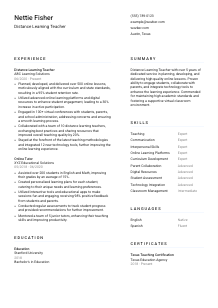
Guiding from afar, but your CV feels misplaced? Check out this Distance Learning Teacher CV example, created with Wozber free CV builder. Learn how to weave your virtual instructional expertise to match job requirements, charting a career that's always in range, even if you're teaching from strange new places!
Distance learning puts your teaching practice in plain view. Schools can see how well you plan instruction, keep students engaged through a screen, give feedback without delay, and maintain steady communication with families. A CV for this field needs to make those online classroom habits visible, not just confirm that you have taught before.
When the wording on your CV reflects virtual instruction, learning platforms, parent conferences, and standards-based lesson delivery, reviewers can quickly separate online teaching experience from general classroom experience. Wozber's free CV builder helps you shape that into an ATS-compliant CV, so the first read makes it clear you can run a structured, responsive digital classroom.
For a distance learning teacher, the header does more than identify you. It tells the school whether you are easy to contact, professionally presented online, and already aligned with practical requirements such as location and role focus.
Use your full name in a clean, readable format at the top of the page. Keep it slightly more prominent than the rest of the header so school administrators can identify your application quickly during a high-volume review.
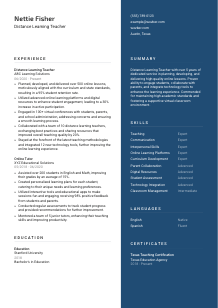
Place "Distance Learning Teacher" directly under your name when that is the role you are pursuing. Matching the posted title helps both ATS screening and human reviewers see that your experience is framed for virtual instruction rather than a general teaching role.
Add a reliable phone number and a professional email address, ideally in a straightforward format such as firstname.lastname@email.com. In online teaching, prompt communication matters, so your contact information should look current and dependable.
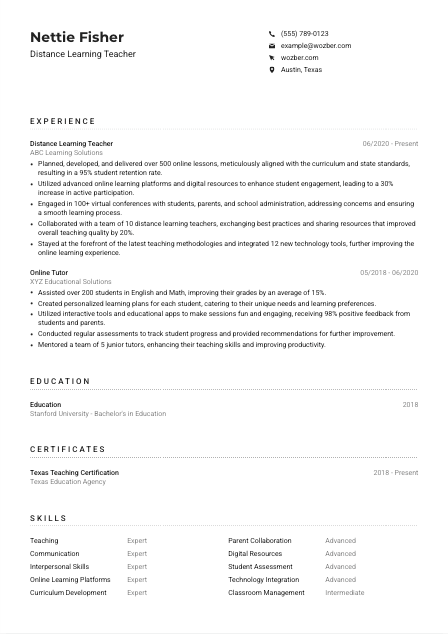
If the school requires candidates to be based in a specific area, list that clearly in your header. Here, "Austin, Texas" matters because it answers a stated requirement upfront and avoids uncertainty about time zone, state presence, or relocation.
A LinkedIn profile, teaching portfolio, or professional website can strengthen your application when it shows virtual lesson samples, digital classroom projects, or instructional materials. Only include it if the content supports the same professional standard as the CV itself.
Your header should confirm basic eligibility fast: who you are, what role you teach in, how to reach you, and whether you meet practical requirements such as location. Wozber's free CV builder helps keep this information clean, complete, and easy to scan.




Distance learning experience is judged by execution. Schools want to see how you handled lesson delivery, student participation, parent communication, assessment, and technology use in an online setting, with enough detail to understand your day-to-day impact.
Start by identifying the work the school needs done now. For a distance learning teacher, that usually means planning online lessons, aligning instruction to curriculum or state standards, assessing student work, communicating with families, and using digital platforms with confidence. Those priorities should shape which bullets you keep and which you rewrite.
List each position in reverse chronological order with your job title, school or employer name, and dates of employment. This format gives hiring teams a quick view of your teaching path and makes it easier to spot whether your recent work includes virtual instruction rather than only traditional classroom teaching.
Generic lines like "taught students online" do not show much. Focus on what you delivered and what changed because of your work. The example CV does this well with points such as delivering more than 500 online lessons and holding 100+ virtual conferences, which shows both instructional volume and family engagement.
Quantify results with measures that make sense for teaching, such as retention, participation, grade improvement, conference volume, feedback rates, or number of students served. A 95% student retention rate or a 30% increase in participation tells a school far more than broad claims about being effective online.
Prioritise experience that reflects virtual classroom management, online assessment, digital resource use, and collaboration with students, parents, and other educators. Even a related role like online tutoring can help if you frame it around individualized learning plans, digital tools, progress tracking, and measurable student improvement.
Your experience section should show that you can run online instruction with structure, consistency, and measurable student results. In Wozber's ATS-friendly CV template, those details stay readable while still carrying the terminology schools use in distance learning postings.
For teaching roles, education is usually a screening checkpoint before anyone gets to your methods or results. Make your degree easy to confirm and clearly connected to the academic background the posting asks for.
If the job asks for a bachelor's degree in Education or a related field, present that information in the same clear language. A degree listed as "Bachelor's in Education" immediately answers the requirement without forcing the reviewer to interpret your background.
List your degree, field of study, school, and graduation year in a clean order. Schools reviewing dozens of teaching applications do not need extra decoration here. They need to confirm the credential quickly and move on to the parts of the CV that show your instructional practice.
When your degree directly matches the posting, say so plainly. In the example, "Bachelor's in Education" from Stanford University lines up neatly with the stated requirement and supports the applicant's teaching foundation without overexplaining it.
Recent graduates or career changers can benefit from listing coursework tied to online pedagogy, instructional design, educational technology, literacy instruction, or assessment. If you already have several years of teaching experience, coursework usually matters less than classroom results and licensure.
Honors, scholarships, or major education projects can help when they support your teaching profile, especially early in your career. Keep them if they reinforce subject knowledge, instructional leadership, or digital learning work. Leave them out if they distract from stronger professional experience.
This section should answer one question quickly: do you meet the academic requirement for the role. Wozber's free CV builder helps present that information in an ATS-friendly CV format that schools can review without hunting for the essentials.
In education, certification is often a gate, not a bonus. Your CV should make your active teaching credential easy to find, then use any additional certificates to show continued growth in online instruction or educational technology.
If the posting asks for valid state certification or licensure, list that credential clearly and early in the section. For this example, a "Texas Teaching Certification" directly answers a non-negotiable requirement and supports eligibility for the role.
You do not need to include every workshop or short course you have completed. Focus on certifications tied to teaching practice, digital learning tools, curriculum delivery, assessment, special populations, or virtual classroom methods.
Include dates when they help confirm that your license or certificate is active. Schools need to know they can move forward with you without licensing uncertainty, especially when state compliance matters for instruction.
Distance learning changes quickly as platforms, engagement tools, and digital assessment methods evolve. Ongoing training in learning management systems, accessibility, online differentiation, or remote student engagement can strengthen your profile and show that your methods stay current.
Your certificates section should first remove doubt about licensure, then show that you continue to sharpen your online teaching practice. Wozber's free CV builder can help keep those credentials visible and well aligned for ATS optimisation.
For a distance learning teacher, the skills section should read like the operating toolkit of an online educator. It needs to cover instructional ability, digital fluency, communication, and the day-to-day skills that keep students progressing in a remote setting.
Read the job description closely and note the skills named directly, such as online learning platforms, communication, and interpersonal ability. Then add the related teaching skills the work requires, including lesson planning, assessment, parent collaboration, curriculum alignment, and technology integration.
Use the same terminology the school uses when it accurately reflects your experience. Phrases like "online learning platforms," "digital resources," "curriculum development," and "parent collaboration" help both ATS matching and human review, especially when they already appear in your work history.
Choose skills that support actual online teaching performance rather than filling space with broad traits. The example list works because it combines instruction, communication, assessment, and technology. That gives a fuller picture of how the candidate manages a virtual classroom.
A focused skills list should reinforce the teaching methods, platform fluency, and communication strengths already shown elsewhere on the CV. With Wozber, you can align that language closely to the posting and improve ATS optimisation without making the section read like a keyword dump.
Language ability can be especially useful in distance learning, where clear written instruction, parent communication, and student support often happen across different channels and settings. Even when only English is required, the way you present languages should stay precise and relevant.
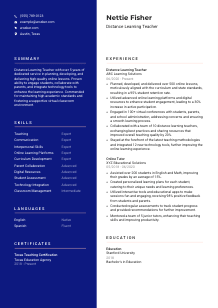
If proficiency in English is listed as a requirement, place English first and mark your level clearly. That immediately confirms you meet a basic communication standard for lesson delivery, feedback, family outreach, and collaboration with school staff.
List required or most useful languages first, then add others that could support your teaching practice. In school environments with diverse families or multilingual learners, additional language ability can strengthen communication and trust.
Another language is worth listing when it can help you connect with students, explain concepts to families, or support a broader school community. For example, Spanish can be especially useful in many districts, but it should be included as added value rather than treated as a universal requirement.
Terms like "Native," "Fluent," "Advanced," or "Intermediate" are easier to interpret than vague descriptions. Be accurate. Schools may rely on these labels when deciding who can handle bilingual communication or multilingual family engagement.
Do not let languages overshadow your teaching record unless multilingual instruction is central to the job. For most distance learning teacher CVs, this section is supporting information that complements your instructional and communication strengths.
This section should support your credibility as a clear communicator in a remote learning environment. Presented well, language skills can also show added reach with students and families across different backgrounds.
The summary is where you frame your teaching background before the reader reaches the details. For a distance learning teacher, it should establish your years of experience, your virtual instruction strengths, and the kind of student outcomes or teaching environment you handle well.
Review the posting and identify the few themes that matter most for the opening paragraph of your CV. Here, those include online lesson delivery, standards alignment, digital platform use, feedback, and communication with students and parents. Build your summary around the themes you can prove elsewhere on the page.
Start with a concise line that tells the reader who you are professionally. A phrase such as "Distance Learning Teacher with 5+ years of experience" works because it quickly establishes role alignment and teaching depth without unnecessary filler.
Mention the capabilities that define your value in online teaching, such as creating high-quality virtual lessons, increasing participation, or supporting student progress through regular feedback and family communication. The example summary works because it connects years of service with technology integration, engagement, and academic standards.
Aim for three to five lines that read cleanly and match the rest of your CV. Avoid generic claims about passion or dedication unless they are tied to concrete teaching work. The summary should sound like the top line of your professional record, not a personal statement.
By the end of this section, a school should already understand your online teaching scope, your core instructional strengths, and the kind of virtual classroom results you tend to deliver. Wozber helps you shape that opening with job-aligned language and solid ATS optimisation.
A strong distance learning teacher CV makes your virtual classroom practice easy to recognize. It shows how you plan instruction, manage engagement, communicate with families, assess student work, and use technology to keep learning on track.
Use the job description to guide your wording, then make every section prove those points with clear facts, role-relevant skills, and measurable teaching outcomes. With Wozber, you can turn that experience into an ATS-compliant CV that gives schools a clear read on your readiness to teach online.