



Use Wozber and land your dream job
Create CV
No registration required
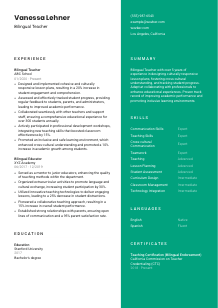
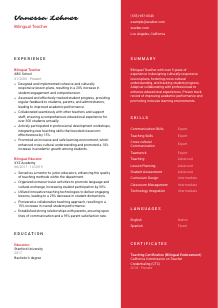
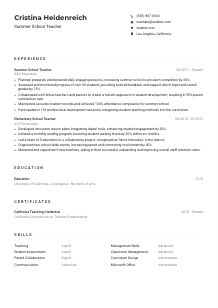
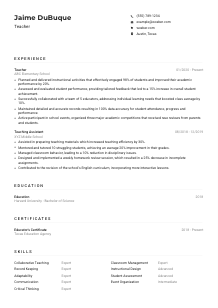
Bridge cultures, but feeling lost in translation when it comes to writing your Bilingual Teacher CV? Check out this example, created with Wozber free CV builder. It shows how to blend your linguistic expertise with the job's educational requirements, paving the way for your career to come across as multilingual and meaningful as your classroom conversations!
Bilingual teaching is judged in the classroom long before it is judged on paper. Schools need teachers who can move students across two languages without losing rigor, maintain a safe and inclusive learning environment, and build trust with families from different cultural backgrounds. Your CV should make that classroom range visible through lesson planning, student progress tracking, language proficiency, and collaboration with support staff.
When that experience is tailored to the posting, reviewers can quickly tell whether you teach in bilingual settings or simply happen to speak two languages. Wozber's free CV builder helps you shape that distinction into an ATS-compliant CV by aligning your language, certifications, and classroom results with the job description, so hiring teams can immediately see your readiness to lead bilingual instruction.
School hiring teams move fast through contact details, title alignment, and basic eligibility checks. In bilingual education, this section should confirm that you are reachable, professionally presented, and, when relevant to the posting, already based where the school needs to hire.
Place your full name at the top in a clean, readable format. Keep it slightly larger than the rest of the text so it anchors the page right away. For teaching roles, presentation matters, and a clear heading helps the CV feel organised from the first line.
Add the role title directly under your name. If you are applying for a Bilingual Teacher opening, say "Bilingual Teacher" rather than a broader label like "Educator" or "Language Professional." That direct match helps both ATS screening and human reviewers connect your CV to the opening without guesswork.
List a phone number and a professional email address that you actively monitor. A missed digit or outdated inbox can cost you an interview, especially when schools are trying to fill teaching assignments before term deadlines. Keep the format simple and current.
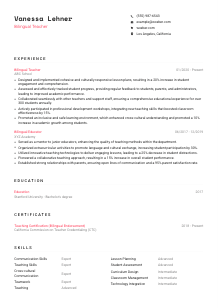
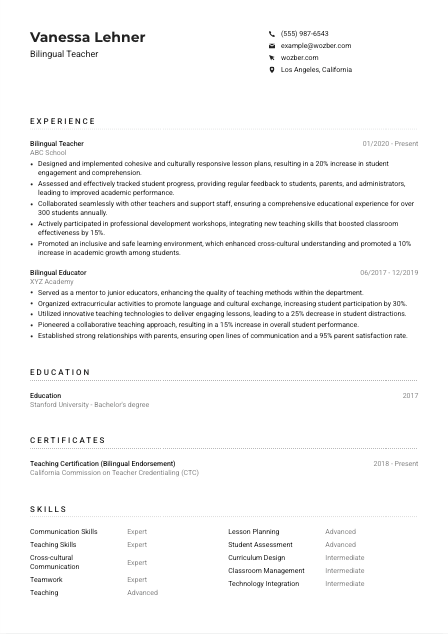
If the job asks for candidates to be located in a specific area, show that clearly in your city and state. In the example, "Los Angeles, California" directly answers a stated requirement and removes doubt about local availability. Use this only when location is relevant to the posting, not as a default selling point for every application.
Include a LinkedIn profile or professional site if it supports your candidacy with teaching experience, certifications, classroom philosophy, or portfolio materials. Make sure it matches your CV dates, titles, and credentials. Any mismatch can create unnecessary questions during review.
This section should confirm the basics quickly: who you are, what role you are targeting, how to reach you, and whether you meet any location requirement. That leaves more room for the rest of the CV to show how you teach.




For bilingual teaching roles, experience is where schools look for proof that you can plan instruction, manage a multilingual classroom, measure growth, and work across families, teachers, and administrators. The strongest bullets describe what you taught, how you supported students, and what changed because of your work.
Read the posting closely and mark the responsibilities that define the role. Here, the priorities include culturally responsive lesson planning, student assessment, regular feedback, staff collaboration, professional development, and an inclusive classroom environment. Those themes should appear in your own experience if they reflect work you have actually done.
List positions in reverse chronological order and prioritise jobs tied to bilingual instruction, dual-language classrooms, ESL support, or multilingual student populations. Include your title, school or organisation, and dates so reviewers can quickly understand your teaching timeline and level of responsibility.
Each bullet should pair a teaching action with an outcome. Instead of writing only that you "planned lessons," show the result, such as stronger engagement, better comprehension, improved family communication, or measurable academic growth. The example does this well with a bullet about culturally responsive lesson plans leading to a 20% increase in student engagement and comprehension.
Numbers help schools understand scope. Use student counts, grade levels, growth percentages, parent satisfaction data, attendance improvements, or reductions in classroom disruption when those measures are available. Metrics like serving more than 300 students annually or raising participation in language exchange activities by 30% give your teaching impact real shape.
If you have broader teaching or education experience, select accomplishments that still connect to bilingual instruction, cross-cultural communication, differentiated learning, or collaboration around multilingual student success. The CV should consistently answer one question: how do you perform in a bilingual classroom setting.
A hiring team should be able to scan this section and understand your classroom range, the students you served, and the outcomes you influenced. Focus on instruction, assessment, collaboration, and student growth, because those are the day-to-day measures of bilingual teaching.
Education matters in teacher hiring because it establishes the academic base behind your classroom practice. For bilingual teaching roles, this section should confirm that you meet the degree requirement first, then add any study that strengthens your work with multilingual learners.
Start with the credential the job asks for. In this case, a bachelor's degree in Education or a related field is a core qualification, so it should be easy to spot. If your degree is directly in Education, that alignment deserves clear placement.
List your degree, field of study, school name, and graduation year or date. Keep the format clean so the reader can verify the credential in seconds. Teacher hiring often involves fast checks for degree completion before the CV moves deeper into review.
If your degree title lines up closely with the posting, reflect that language naturally. For example, "Bachelor's degree, Education" makes the match immediate. Avoid overcomplicating the section with extra wording that hides the credential instead of clarifying it.
Most experienced teachers do not need a long course list, but it can help early-career candidates or those shifting into bilingual education. Courses in language acquisition, literacy development, multicultural education, curriculum design, or assessment can strengthen the connection to the role when your practical experience is lighter.
Honors, teaching practicums, research projects, or student organizations are useful when they reinforce your preparation for classroom work. Keep them brief and relevant. Once you have several years of teaching experience, these details should support your profile rather than take over the section.
Your education section should answer the school's degree requirement without effort. If you also studied areas tied to multilingual learning or culturally responsive instruction, include them where they strengthen your teaching profile.
Teaching certificates often determine whether an application can move forward at all. In bilingual education, your credentialing section should clearly show that you meet state teaching requirements and hold any endorsement needed to teach bilingual learners.
Place your valid state teaching certification first, especially when the posting explicitly requires a bilingual endorsement. That is a baseline qualification, not an extra detail. In the example, the California credential with bilingual endorsement directly addresses the job requirement.
List certificates that matter for hiring decisions before optional professional development badges. State licensure, bilingual authorization, ESL-related endorsements, and district-recognized teaching credentials belong at the top because they determine whether you can legally and practically step into the classroom.
Include the issue date, expiration date, or active range when relevant. A line such as "2018 - Present" works well for an active credential and reassures reviewers that your certification is current. This is especially important in regulated school hiring processes.
Ongoing training matters in bilingual education because instructional strategies, language development frameworks, and family engagement practices continue to evolve. Add newer certifications when they deepen your teaching in literacy, culturally responsive practice, special education support, or multilingual instruction.
This section should make it easy for a principal, district recruiter, or HR reviewer to confirm that you are licensed and authorized for bilingual teaching. Start with the credential they need to see, then add the training that supports your classroom practice.
The skills section works best when it reads like a snapshot of how you teach, communicate, and manage learning across languages. Schools are looking for classroom-relevant strengths here, not a long generic list.
Use the job description to identify the skills that matter most. For this role, that includes interpersonal communication, bilingual proficiency, lesson planning, student assessment, collaboration, and inclusive classroom practice. Those are the skills worth prioritising because they reflect the actual work.
Choose skills you can support elsewhere in the CV. If you list communication skills, your experience section should show parent feedback, staff coordination, or student support. If you list cross-cultural communication or classroom management, your bullets should show how those skills helped multilingual learners succeed.
A shorter, better targeted list is more useful than a long inventory of every tool or trait. Mix hard and soft skills that belong in bilingual teaching, such as lesson planning, curriculum adaptation, student assessment, family communication, classroom management, and technology integration. The example keeps that balance by pairing teaching skills with cross-cultural communication and assessment-related strengths.
This section should reinforce the strengths already visible in your experience and credentials. When the skills match the language of the posting and the substance of your work, the CV reads as consistent and well prepared.
For a bilingual teacher, language ability is a core qualification. Schools need to see not only which languages you speak, but whether your proficiency is strong enough for instruction, student support, and family communication.
Check the posting for the exact language expectation and list those languages first. If the school requires English plus a specific second language, those should appear at the top of the section with clear proficiency levels. This is one of the fastest screening points in bilingual teacher hiring.
Lead with the languages you can use in teaching, assessment, and parent communication. In the example, "English - Native" and "Spanish - Fluent" immediately establish bilingual classroom capability. Use your own accurate pairing based on the role you are targeting.
Extra language ability can strengthen your profile, especially in diverse school communities, but keep the section centered on the languages the role requires. Additional languages are a plus when they support community engagement or multicultural school environments, not a substitute for the core teaching pair.
Use plain labels such as Native, Fluent, Advanced, Intermediate, or Basic. Avoid vague wording that makes your ability hard to interpret. In school settings, overstating proficiency can create real classroom problems, so clarity matters.
Your language section should reinforce that you can deliver instruction, explain concepts, assess understanding, and communicate with families across languages. That practical teaching use is what separates bilingual educators from candidates who only list conversational language skills.
List languages in a way that makes instructional readiness obvious. Schools should be able to see at a glance whether you can teach, support students, and communicate with families in the languages the role requires.
Your summary should quickly establish the kind of bilingual teacher you are, how much experience you bring, and what classroom strengths define your work. Keep it concise, but make sure it speaks to instruction, student growth, and multilingual learning rather than broad enthusiasm alone.
Before writing, identify the few themes the school emphasizes most. In this case, those include culturally responsive lesson planning, student progress monitoring, collaboration, and inclusive classroom practice. Use that focus to decide what belongs in the opening lines.
Start with a direct description such as "Bilingual Teacher with 5+ years of experience" or a version that accurately reflects your background. That gives the reader immediate context and helps position you at the right level for the role.
Mention the teaching areas where you consistently deliver value, such as designing culturally responsive lessons, improving academic performance, supporting cross-cultural understanding, or building strong collaboration with families and staff. The example summary works because it connects these strengths to actual classroom outcomes rather than listing traits in isolation.
Aim for 3 to 5 lines that can be read in one quick pass. Focus on the qualifications most relevant to bilingual instruction and avoid repeating details that already appear elsewhere. A concise summary sets the tone and prepares the reader for the experience section that follows.
A well-written summary should tell a school what kind of bilingual educator you are before they reach your first job entry. Keep it centered on instruction, language capability, collaboration, and the student results your work supports.
Once each section is tailored to the role, your CV should show a clear through line: you meet the teaching requirements, you can work across languages, and you have a record of helping students grow in inclusive classroom settings. That is what school leaders are trying to confirm when they review applications for bilingual teaching roles.
Wozber's free CV builder can help you organise that experience into an ATS-friendly CV format, align your wording with the posting, and strengthen ATS optimisation without losing the human side of your teaching story. The final result should make it easy to see your certification status, language proficiency, classroom results, and readiness to step into a bilingual learning environment.