



Use Wozber and land your dream job
Create CV
No registration required
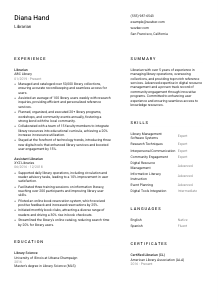
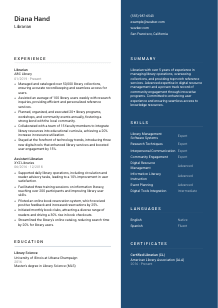
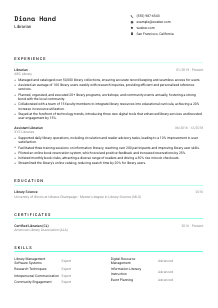
Delivering Dewey decimally, but your CV feels overdue? Shush it up and explore this Librarian CV example, created with Wozber free CV builder. Learn how to catalogue your literary expertise to match the job's plot, and rewrite a career chapter that's always on the bestseller list!
Library work sits at the intersection of access, accuracy, and service. A librarian CV needs to show more than a general love of books or public service. It should make clear that you can manage collections, guide research, support learning, and keep records reliable across both physical and digital resources.
In librarian hiring, vague experience often gets mistaken for basic circulation support when the role actually calls for cataloging depth, reference skill, and instructional ability. Using Wozber's free CV builder to tailor your wording and build an ATS-compliant CV helps bring those distinctions forward, so hiring teams can quickly see where your collection work, user support, and program delivery line up with the position.
This section should be clean, professional, and easy to scan. For librarian roles, it mainly needs to confirm identity, contact access, and any location detail that removes friction for the employer.
Place your full name at the top in the largest text on the page. Keep it simple and professional so the focus stays on your qualifications, not formatting choices.
If you are applying for a Librarian position, use "Librarian" near your name. This immediately connects your profile to the role being filled and helps distinguish you from adjacent titles such as Library Assistant, Archivist, or Information Specialist when your background supports the move.
Hiring teams should be able to reach you without hunting through the page. Use one reliable phone number and a professional email address that matches the rest of your application.
Some librarian roles have clear on-site expectations tied to campus support, public programming, or local community service. Here, the employer specifies San Francisco, CA, so listing "San Francisco, California" helps remove an immediate question about availability or relocation.
A LinkedIn profile, portfolio, or professional webpage can help if it extends your CV with publications, presentations, committee work, or library projects. Include it only when it is updated and consistent with the experience on the page.
Your personal details should answer basic logistical questions without taking attention away from your library experience. If this section is clear, the reader can move straight to your collections work, research support, and instructional strengths.




For librarian roles, the experience section carries most of the hiring weight. This is where you show the scale of your collection work, the quality of your reference support, the programs you delivered, and how your work improved access, learning, or engagement.
Read the posting closely and identify the work patterns behind it. In this case, the employer is looking for collection management, catalogue accuracy, research assistance, information literacy support, community programming, and collaboration with faculty or staff. Those themes should shape which bullets you keep, expand, or cut.
Start with your most recent position and work backward. For each job, include your title, employer, and dates so the reader can track your progression from support responsibilities into broader ownership of services, collections, or instruction.
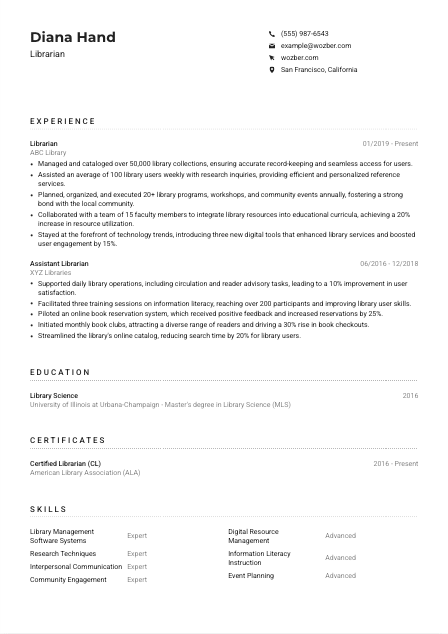
Focus each bullet on work that matters in libraries: cataloging accuracy, user support volume, program attendance, database or digital tool adoption, resource usage, or curriculum integration. The example CV does this well by pairing duties with real outcomes, such as managing more than 50,000 items, assisting about 100 users weekly, and increasing resource utilization through faculty collaboration.
Metrics make library work easier to understand. Collection size, weekly patron inquiries, annual program count, training attendance, search-time reduction, checkout growth, and digital engagement all help the employer picture your scope. Choose measures that reflect how your library tracked success rather than forcing numbers into every line.
Do not crowd the section with generic administrative tasks if your stronger value comes from reference work, instruction, collection maintenance, metadata quality, or community programming. Keep bullets that reinforce the kind of librarian work the employer needs, and trim details that belong to unrelated service roles or entry-level duties you have already outgrown.
A hiring team should be able to see how you handle collections, patron questions, educational support, and service improvement from this section alone. Use the employer's language naturally, and your experience will read clearly to both people and ATS screening.
For many librarian positions, education is a core qualification rather than a supporting detail. When a role calls for an MLS or equivalent, this section needs to confirm that requirement quickly and without ambiguity.
If you hold a Master of Library Science, Master of Library and Information Science, or equivalent credential, list it prominently. The posting here specifically asks for an MLS from an ALA-accredited institution, so that degree should be easy to find.
Include the degree, school, field of study, and graduation year or date. A clean format works best because the value is in the credential itself, not in decorative presentation.
Coursework, concentrations, or academic projects can help if they relate directly to the position, such as digital librarianship, metadata, archives, research instruction, youth services, or academic library support. For experienced candidates, keep these additions selective.
Scholarships, honors, or major academic projects can add context early in your career. If you already have several years of library experience, they should stay secondary to your professional record unless they connect strongly to the role.
Libraries change with new discovery tools, digital access models, and information literacy demands. If you have completed later coursework or formal training in areas like digital resource management or instructional design, include it when it adds relevance.
For librarian hiring, the education section often answers a yes-or-no requirement in seconds. State the degree clearly, keep the format straightforward, and let it support the more detailed story told in your experience section.
Certificates are not required for every librarian opening, but they can strengthen your profile when they show current practice, specialization, or continued engagement with the field. The key is relevance, not quantity.
Choose credentials tied to library services, cataloging, archives, information literacy, digital collections, or public programming. If a posting does not require certification, treat this section as an enhancement rather than a substitute for experience or education.
A certification such as Certified Librarian from the American Library Association can reinforce your standing, especially when paired with direct experience in collection management, reference services, or instructional support. Use the strongest credential first.
Include the year earned and, if relevant, the active period. Dates help the employer see whether the credential is current and how it fits alongside your broader development in the profession.
Short courses and certificates can be especially useful when they reflect current needs such as digital resource platforms, accessibility, metadata standards, online programming, or teaching research skills. Add them as they become genuinely relevant to the roles you pursue.
A concise certificates section can show that you keep pace with changing library services and tools. Lead with recognized, relevant credentials and leave out anything that does not add to your work as a librarian.
The skills section should reflect how librarian work is actually done. That usually means a mix of technical library systems knowledge, research and instruction ability, and the communication skills needed to support patrons, students, faculty, or community members.
Pull out the capabilities the employer has already emphasized and mirror them with accurate wording. For this role, that includes library management software systems, digital resource management, research techniques, reference tools, information literacy instruction, and communication.
A librarian CV should not read like either a pure software profile or a generic customer service summary. Show both sides of the work: catalogue and resource systems on one hand, and research support, teaching, outreach, or collaboration on the other.
Put the most important skills first so the reader sees your strongest match immediately. In the example CV, library management software, research techniques, digital resource management, and information literacy instruction all connect directly to the posting, while community engagement and event planning support the programming side of the role.
Every skill listed should connect to something you have done in practice, whether that is managing records, guiding research, teaching users, or improving access to resources. Wozber's ATS optimisation can help you align those terms with the posting while keeping the section natural and readable.
Language ability can matter in librarian roles because the work depends on clear communication, instruction, and service for diverse users. The right language entry can reinforce both professionalism and community reach.
Some roles specify a language because of the user population, instructional setting, or communication demands. Here, strong English communication is explicitly required, so English should appear clearly in this section.
Place English at the top and describe your proficiency accurately using terms such as Native, Fluent, or Professional. For a librarian role, written and verbal clarity matters in reference interviews, workshops, and day-to-day patron support.
Extra languages can be valuable in public libraries, schools, universities, and community-facing environments where multilingual support improves access. Spanish, for example, can strengthen service reach in many settings, even when it is not formally required.
Avoid overstating your ability. If you can greet patrons but not handle research guidance or workshop delivery in that language, choose a lower level. Accuracy matters because language skill is often tested in real interactions.
If you serve multilingual communities, support international students, or work in outreach-heavy environments, language ability becomes more than a nice extra. It can directly improve reference service, program participation, and user trust.
For librarian applications, language skills work best when they support a real service context. Keep the section honest, place required languages first, and use additional languages to show broader user support where relevant.
The summary should quickly tell the employer what kind of librarian you are and where your strongest value sits. In a few lines, connect your experience level with the parts of library work you handle best, such as collections, reference, digital resources, instruction, or community programming.
Start with a direct statement that identifies you as a Librarian and gives a credible sense of tenure. "Librarian with over 5 years of experience" works because it immediately frames the candidate's level before moving into specialization.
Choose two or three areas that align with the posting. For this role, digital resource management, reference services, research support, and community programming all fit well. The example summary works because it ties operational strengths to user outcomes rather than repeating generic traits.
Aim for 3 to 5 lines with concrete language. Skip broad claims about passion or dedication unless they are backed by actual library work, such as improving access, increasing engagement, or supporting instruction across a campus or community.
A well-written summary helps the reader understand your direction before they reach the detail below. When it reflects the librarian role accurately and uses the right terminology, it strengthens both ATS alignment and the hiring team's first read of your experience.
A librarian CV works when it makes your professional scope easy to understand. The reader should be able to see your record in collections, research support, programming, digital resources, and collaboration without having to infer it from generic service language.
Use Wozber's free CV builder to structure that experience clearly, tailor your wording with an ATS CV scanner, and present it in an ATS-friendly CV format that supports accurate screening. The result should make one thing clear right away: you are ready to contribute as a librarian in the setting you are targeting.