



Use Wozber and land your dream job
Create CV
No registration required
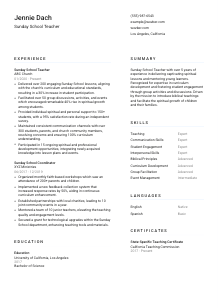
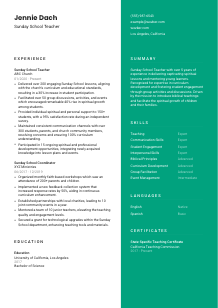
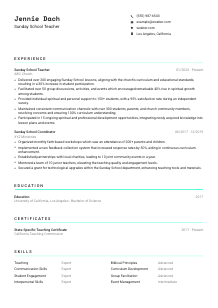
Shaping young minds, but your CV feels unattended? Check out this Sunday School Teacher CV example, created with Wozber free CV builder. It shows how to blend your spiritual dedication and educational chops to meet job expectations, ensuring your career journey is as enlightening as the lessons you teach!
Sunday School teaching asks for more than classroom comfort. Churches look for someone who can turn biblical lessons into age-appropriate teaching, hold a room of children with warmth and structure, and stay attentive to the pastoral side of the work when a student needs individual guidance. Your CV should make that blend of spiritual grounding, lesson delivery, and child engagement easy to see from the first few lines.
A tailored CV changes how quickly a church can recognize whether your background matches its ministry needs, especially when screening for curriculum experience, communication with families, and work with young learners. Wozber's free CV builder helps you shape that experience into an ATS-compliant CV with language that reflects the posting, so your application shows both ministry alignment and practical teaching ability.
For a Sunday School Teacher, the top of the CV should feel clear, grounded, and immediately relevant. This is where you confirm the basics a church may screen for first, including your role, your location when required, and the contact details they will use to move the conversation forward.
Use your full name in a clean, readable format that stands out from the rest of the page. Keep it simple and professional. In church hiring, the goal here is clarity, not decoration, especially when the reader may be reviewing several ministry and education CVs in one sitting.
Place "Sunday School Teacher" under your name when that is the role you are pursuing. Matching the title helps frame your experience around children's ministry, lesson delivery, and spiritual instruction right away. It also keeps your CV aligned with the wording used in the posting and improves ATS matching.
Include a phone number you answer, a professional email address, and only links that support your candidacy. If you add a website or profile, make sure it reflects your teaching background, ministry involvement, or educational philosophy. Broken links or casual email handles can undercut an otherwise thoughtful application.
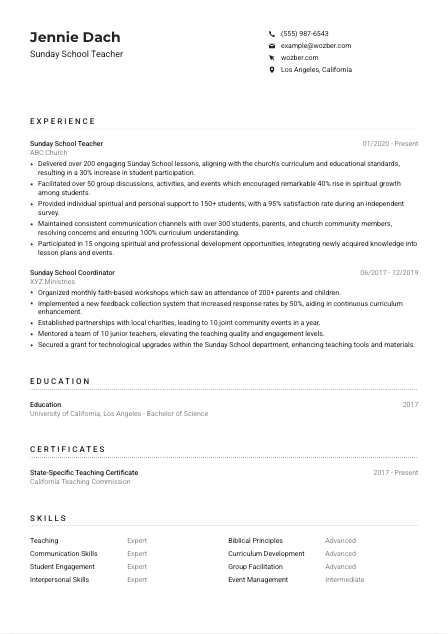
Some Sunday School roles are tied closely to the local church community. In the provided example, residency in Los Angeles, California is a stated requirement, so listing Los Angeles, California in the personal section removes that question immediately. Treat location this way when a posting makes geography part of eligibility.
A LinkedIn page, ministry bio, or teaching portfolio can help if it shows lesson planning, child education experience, volunteer leadership, or faith-based programming. Leave it out if it is sparse or outdated. Every item in this section should support your credibility as someone who can teach children and communicate well with families.
This section should confirm that you are reachable, professionally presented, and positioned for the specific church community you are applying to serve. Keep it clean and relevant so the reader can move straight to your teaching and ministry experience.




Experience carries a lot of weight in Sunday School hiring because churches want to see how you have actually taught, guided, and supported children. This section should show what age groups you served, how you delivered lessons, how you encouraged participation, and how you communicated with parents or the wider church community.
Review the posting for the responsibilities that matter most, then shape your bullet points around those themes. For a Sunday School Teacher, that usually means lesson preparation, biblical instruction, group facilitation, student support, and parent communication. In the example, the strongest bullets mirror those needs by focusing on lessons taught, discussions led, and support provided to students.
List your most recent role first, then work backward. Include the organisation name, your title, and dates of employment so the reader can follow your progression in teaching, ministry, or child-focused work. Titles such as Sunday School Teacher, Children's Ministry Coordinator, or Faith Formation Instructor all help when the duties clearly connect to the target role.
Avoid vague lines such as "responsible for teaching children." Instead, show what you delivered and what changed because of your work. Good bullets might reference weekly lesson planning, age-appropriate Bible teaching, small-group activities, seasonal events, or parent outreach. The example does this well by pairing actions like delivering lessons and facilitating discussions with visible results in participation and spiritual growth.
Metrics make impact easier to picture when they are native to the role. Useful examples include number of lessons taught, student participation growth, attendance at events, families reached, volunteer teams supported, or survey feedback from parents. A bullet such as "Delivered over 200 Sunday School lessons, contributing to a 30% increase in student participation" gives a much sharper picture than a generic claim about being engaging.
If an accomplishment does not help explain your work with children, curriculum, family communication, volunteer coordination, or spiritual development, cut it or rewrite it. Breadth matters less than relevance here. Even when you include adjacent ministry work, frame it through outcomes that matter to a Sunday School program, such as stronger participation, smoother event delivery, or better communication with parents.
The best experience sections for this role read like a record of real ministry work. When your bullets show lesson delivery, student engagement, family communication, and measurable participation, a church can picture you in the classroom instead of guessing from generic teaching language.
Education matters here because it shows formal preparation for teaching, child development, theology, or related work. A church may not need a long academic history, but it does need to see that your training supports the way you teach, explain biblical material, and work with young learners.
If the posting asks for a bachelor's degree in Education, Theology, or a related field, make sure that degree is easy to find. In the example, a Bachelor of Science in Education aligns directly with the requirement and should stay prominent. Lead with your strongest relevant qualification rather than burying it under less important credentials.
List the degree, field of study, school, and graduation year in a consistent order. Hiring teams and ATS systems both benefit from straightforward formatting. This section does not need extra wording if the degree already speaks clearly to your preparation for teaching or faith-based instruction.
Use the official wording of your degree, but pay attention to how the posting describes educational expectations. If your background is in education, theology, religious studies, child development, or a closely related field, make that connection easy to understand. That helps the reader place your academic preparation alongside the job's teaching and ministry demands.
If you are earlier in your career, relevant coursework can add useful detail, especially classes in curriculum design, child psychology, classroom management, theology, or religious education. Honors, ministry leadership programs, or student teaching placements can also strengthen this section when your full-time experience is still developing.
Additional training in teaching methods, child safeguarding, biblical studies, or church education can reinforce your commitment to growth. This is especially useful when it connects to the practical work of preparing lessons, caring for students well, or serving in a faith-based learning environment.
Your education section should quickly show that your training supports the mix of teaching skill and biblical understanding the role calls for. Keep it concise, accurate, and centered on preparation that matters in a Sunday School classroom.
Certificates matter most when they answer a requirement directly or strengthen trust in your teaching background. For Sunday School roles, that often means state teaching credentials when requested, along with any training that supports work with children, curriculum delivery, or safe ministry practice.
Start with the job description. In this case, the church asks for any necessary state-specific teaching certifications or licenses, or willingness to obtain them. If that kind of language appears, your CV should answer it clearly instead of assuming the reader will infer it from your experience.
Prioritise credentials tied to teaching, child instruction, or ministry compliance. The example's "State-Specific Teaching Certificate" is effective because it speaks directly to the stated requirement. You can also include relevant safeguarding or church education certificates if they are current and recognized in your context.
Add the issue date and, if relevant, the renewal period or current status. This matters when a credential must be active. A clear date range such as "2017 - Present" helps the church see that the certification is not outdated and that you have maintained it over time.
If you do not yet hold a required license but are eligible or in the process of getting it, say so honestly. That is better than leaving the issue unclear. Churches often appreciate candidates who are transparent and already taking steps to meet local teaching or ministry requirements.
This section should answer practical questions about licensing and professional preparation. When the right credentials are visible and current, the hiring team can focus on your teaching approach and ministry experience rather than chasing missing compliance details.
For Sunday School teaching, the skills section should do more than list personality traits. It should point to the abilities you use in the classroom and church setting, including biblical instruction, child engagement, communication with families, and the practical side of lesson and activity planning.
Read the job description closely and note the capabilities it emphasizes. Here, the important themes include biblical principles, communication, interpersonal ability, teaching children, and facilitating activities. Those are the skills to prioritise over broad terms that could belong on any CV.
Every skill listed should connect to your experience, education, or certificates. If you claim curriculum development, your experience section should show lesson planning or program improvement. If you list student engagement, back it up with outcomes such as increased participation, stronger attendance, or successful group discussions, as the example CV does.
Put the most important capabilities first. For this kind of role, teaching, biblical knowledge, communication with children and parents, group facilitation, and curriculum-related skills usually belong near the top. Keep niche or secondary abilities, such as event management, lower unless the posting puts strong emphasis on large church programs or family events.
A well-ordered skills section gives a quick snapshot of how you work in a Sunday School setting. Keep the list focused on classroom ministry, child engagement, and communication so it reinforces the rest of your CV instead of repeating generic strengths.
Language ability can matter in Sunday School work because teaching children often involves communicating clearly with both students and parents. English proficiency may be non-negotiable, and additional languages can be useful when they help you serve a multilingual congregation or community.
If the posting requires you to operate effectively in English, list English prominently with an accurate proficiency level such as Native or Fluent. Do not make the reader search for it. This is a basic eligibility point, and it should be obvious at a glance.
Order your languages by practical value for the role. English should appear first when it is required for teaching, parent communication, and church meetings. That ordering also helps ATS systems and human reviewers catch the requirement quickly.
Additional languages can strengthen your CV if they help you communicate with children, parents, or volunteers in the church community. In the example, basic Spanish is worth listing because it can be useful in a diverse congregation, even though English remains the essential language for the role.
Choose levels that reflect how well you can actually teach, converse, or handle parent communication. If you can greet families but not explain curriculum details, "Basic" is the right label. Accuracy matters, especially in a role built on trust and communication.
Some churches serve multilingual families, and language ability can be a real asset in building relationships. Still, only highlight extra languages when they are genuine strengths or useful support skills. They should complement your teaching qualifications, not distract from them.
This section works best when it quickly confirms that you can teach and communicate in the required language, then adds any extra language ability that could help you serve the church community more effectively.
The summary is your opening snapshot. For a Sunday School Teacher, it should quickly combine teaching experience, biblical grounding, and the way you engage children and families, so the reader understands both your classroom value and your ministry approach before reaching the detailed sections.
Start with the job description and pull out the themes that define the work. In this case, that includes teaching children, communicating biblical principles clearly, leading discussions and activities, and supporting spiritual growth. Those ideas should shape your wording more than generic statements about being passionate or hardworking.
Begin with a direct line that states who you are and how much relevant experience you bring. A phrase like "Sunday School Teacher with 5+ years of experience" immediately anchors the summary in ministry and education work, which is stronger than an abstract introduction.
Choose abilities that matter most for the role and that you can prove in the experience section. Good examples include lesson planning, student engagement, biblical instruction, parent communication, or curriculum development. The sample summary works because it pairs experience with clear strengths such as curriculum development and fostering engagement through group activities and discussions.
Aim for 3 to 5 lines that read cleanly and avoid repetition. This is enough space to mention your teaching background, ministry focus, and one or two strengths without turning the summary into a paragraph of broad claims. Tight writing here helps the rest of the CV land faster.
A focused summary gives the hiring team an immediate sense of your classroom presence, ministry experience, and ability to guide children in faith formation. When it is tailored well, the rest of the CV feels like proof rather than explanation.
A Sunday School Teacher CV should now show the full picture: relevant teaching experience, biblical understanding, communication with children and families, and the practical details that meet the posting's requirements. When each section reflects the language and priorities of the role, your application reads as someone prepared to teach, guide, and contribute to the life of the church.
Wozber's free CV builder can help you shape that content into an ATS-friendly CV template, refine wording with role-specific language, and check alignment with an ATS CV scanner before you apply. The result should make it easy for a church to see your readiness to lead lessons, support spiritual growth, and work well within its community.